Portronics Nova
Tronsmart Halo 300

Portronics Nova Tronsmart Halo 300

Overview

Welcome to our in-depth specification comparison between the Portronics Nova and the Tronsmart Halo 300. These two Bluetooth 5.3 speakers share a surprising number of features, yet differ dramatically in scale, power, and intended use. In this comparison, we examine key battlegrounds including audio output power, battery life, physical dimensions, and connectivity options to help you decide which speaker truly fits your lifestyle and listening needs.

Common Features

  • Both products feature 2 drivers.
  • Neither product includes a neodymium magnet.
  • Both products have a control panel placed on the device.
  • Neither product includes a travel bag.
  • Neither product has a touch screen.
  • Both products have a detachable cable.
  • Neither product is a neckband speaker.
  • Neither product includes a remote control.
  • Neither product has a subwoofer.
  • Neither product has a noise-canceling microphone.
  • Neither product has magnetic shielding.
  • Both products have a battery level indicator.
  • Both products feature a rechargeable battery.
  • Neither product has a removable battery.
  • Neither product supports wireless charging.
  • Both products use Bluetooth version 5.3.
  • Neither product supports Bluetooth pairing using NFC.
  • Neither product has a 3.5 mm audio jack socket.
  • Neither product supports aptX Lossless, LDAC, aptX Adaptive, aptX HD, or aptX.
  • Both products can be used wirelessly.
  • Both products support remote smartphone control.
  • Neither product has fast pairing.
  • Neither product supports voice commands.
  • Neither product has a built-in radio.
  • Both products have voice prompts.
  • Neither product works as a power bank.
  • Both products have a sleep timer.
  • Both products support pairing for stereo sound.

Main Differences

  • Volume is 2.975625 cm³ on Portronics Nova and 111281.352 cm³ on Tronsmart Halo 300.
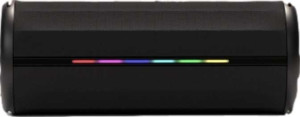
  • RGB lighting is present on Portronics Nova but not available on Tronsmart Halo 300.
  • Weight is 930 g on Portronics Nova and 14000 g on Tronsmart Halo 300.
  • Height is 11.5 mm on Portronics Nova and 753 mm on Tronsmart Halo 300.
  • Width is 22.5 mm on Portronics Nova and 364 mm on Tronsmart Halo 300.
  • Thickness is 11.5 mm on Portronics Nova and 406 mm on Tronsmart Halo 300.
  • Audio output power is 2 x 20W on Portronics Nova and 2 x 120W on Tronsmart Halo 300.
  • Battery life is 5 hours on Portronics Nova and 20 hours on Tronsmart Halo 300.
  • AUX input is available on Tronsmart Halo 300 but not on Portronics Nova.
  • Maximum Bluetooth range is 10 m on Portronics Nova and 15 m on Tronsmart Halo 300.
  • A microphone input is available on Tronsmart Halo 300 but not on Portronics Nova.
Specs Comparison
Portronics Nova

Portronics Nova

Tronsmart Halo 300

Tronsmart Halo 300

Design:
volume 2.975625 cm³ 111281.352 cm³
drivers count 2 2
has a neodymium magnet
control panel placed on a device
travel bag is included
has a touch screen
has RGB lighting
has a detachable cable
is a neckband speaker
has a remote control
weight 930 g 14000 g
height 11.5 mm 753 mm
width 22.5 mm 364 mm
thickness 11.5 mm 406 mm

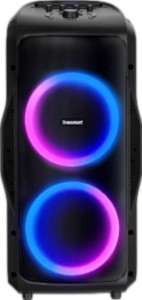
The most defining design difference between these two speakers is their physical scale — and it is dramatic. The Portronics Nova is an ultra-compact unit measuring just 22.5 × 11.5 × 11.5 mm with a volume of roughly 2.98 cm³ and a weight of 930 g, while the Tronsmart Halo 300 is a large-format speaker at 753 × 364 × 406 mm, a volume of over 111,000 cm³, and a substantial 14,000 g. These are not competitors in the same portability class — the Nova is designed for minimal footprint use cases, whereas the Halo 300 is clearly a stationary or semi-permanent home/party speaker built for physical presence.

Both share a handful of structural similarities: each has a control panel placed directly on the device, supports a detachable cable, and neither includes a travel bag or a remote control. With only 2 drivers each and no neodymium magnets in either unit, the driver configuration is identical on paper. Where they part ways aesthetically is RGB lighting — the Nova features RGB lighting, which adds visual flair suited to desktop or ambient setups, while the Halo 300 offers none.

For design, the edge depends entirely on the use case. If compactness and portability matter, the Nova wins decisively — its footprint is negligible. If a bold, room-filling physical presence is the goal, the Halo 300's large enclosure signals it is built for that role. The Nova's RGB lighting is a minor but notable aesthetic advantage for users who value it, though it does not shift the overall design conclusion: these two products are designed for fundamentally different environments.

Sound quality:
has a subwoofer
audio output power 2 x 20W 2 x 120W
has a noise-canceling microphone
has a magnetic shielding

Output power is the single defining differentiator here. The Tronsmart Halo 300 delivers 2 × 120W — a total of 240W — compared to the Portronics Nova's 2 × 20W (40W total). That is a sixfold difference in rated power, which translates directly to the ability to fill much larger spaces with sound and sustain higher volume levels without distortion. For context, 240W is firmly in party-speaker territory, capable of energizing outdoor gatherings or large rooms, while 40W is better suited for personal listening or small indoor spaces.

Where both products are identical is in what they lack: neither includes a subwoofer, a noise-canceling microphone, or magnetic shielding. The absence of a dedicated subwoofer on the Halo 300 is worth noting — despite its substantial power output, bass reproduction will depend entirely on its two main drivers rather than a dedicated low-frequency unit. The Nova is in the same position, though at its power level the expectation for deep bass is lower to begin with.

On sound quality specs, the Halo 300 holds a clear and significant edge purely by virtue of its power output. More wattage does not automatically guarantee better audio quality, but it does guarantee greater headroom, loudness potential, and dynamic range — all of which matter in real-world listening. The Nova's 40W is respectable for its size class, but it cannot compete with the Halo 300 when raw output capability is the measure.

Power:
Battery life 5 hours 20 hours
has a battery level indicator
has a rechargeable battery
has a removable battery
has wireless charging

Battery life is where the gap between these two speakers becomes especially pronounced. The Tronsmart Halo 300 is rated for 20 hours of continuous playback, compared to just 5 hours on the Portronics Nova. That four-to-one difference has real consequences: the Halo 300 can comfortably power through an all-day outdoor event or a full weekend of casual listening without needing a recharge, while the Nova would require multiple recharges across the same period.

It is worth keeping in mind that the Halo 300 achieves this runtime while pushing significantly more power output — making its 20-hour figure even more notable in context. The Nova's 5-hour rating, while modest, is not unusual for a compact speaker in its size class, where battery capacity is inherently constrained by physical volume. Both speakers share a battery level indicator, which is a practical feature that helps users avoid unexpected shutdowns, and neither offers wireless charging or a removable battery.

On power endurance, the Halo 300 wins decisively. For users who need a speaker that can run through extended sessions — parties, outdoor use, or simply long listening days — its 20-hour runtime is a meaningful practical advantage. The Nova's 5-hour ceiling makes it more dependent on access to a charging source, which limits its usability in untethered scenarios.

Connectivity:
Bluetooth version 5.3 5.3
supports Bluetooth pairing using NFC
has a socket for a 3.5 mm audio jack
has an AUX input
has aptX Lossless
has LDAC
has aptX Adaptive
has aptX HD
has aptX
has aptX Low Latency
has AAC
has AirPlay
has Chromecast built-in
has Auracast
has Bluetooth LE Audio
maximum Bluetooth range 10 m 15 m
supports Wi-Fi
has a 3.5mm male connector
has an external memory slot
is DLNA-certified
supports Ethernet
has a microphone input

Both speakers share Bluetooth 5.3 as their primary wireless protocol, which is a current-generation standard offering solid stability and energy efficiency. Neither supports advanced audio codecs like aptX, LDAC, or AAC, meaning audio is transmitted over standard SBC — functional for most listeners, but not optimized for audiophile-grade wireless fidelity. Wi-Fi, Chromecast, AirPlay, and Auracast are absent on both, keeping the connectivity profile relatively simple on either side.

The meaningful differences emerge in two areas. First, the Tronsmart Halo 300 extends to a 15 m Bluetooth range versus 10 m on the Portronics Nova — a 50% increase that matters in larger rooms or outdoor setups where the source device may not be close to the speaker. Second, the Halo 300 adds both an AUX input and a microphone input, neither of which the Nova offers. The AUX input allows wired playback from devices without Bluetooth, and the microphone input opens up PA or karaoke-style use cases — a notable functional expansion consistent with the Halo 300's party-speaker positioning.

On connectivity, the Halo 300 holds a clear edge. Its longer Bluetooth range, wired audio fallback via AUX, and microphone input collectively offer more versatility. The Nova's connectivity is lean and sufficient for straightforward personal listening, but it provides no wired alternatives and no input expansion — a limitation that will matter to users who need more than a single Bluetooth source.
Features:
release date June 2025 May 2025
Can be used wirelessly
supports a remote smartphone
has fast pairing
has voice commands
Has a radio
Has voice prompts
works as a power bank
has a sleep timer

Across every feature data point in this group, the Portronics Nova and Tronsmart Halo 300 are in complete lockstep. Both can be used wirelessly, support smartphone remote control, include voice prompts, and offer a sleep timer — a convenience feature that automatically powers down the speaker after a set period, useful for nighttime listening without manual intervention.

Neither speaker offers fast pairing, voice command integration, built-in radio, or power bank functionality. The absence of fast pairing is a minor friction point for users who frequently switch between devices, as it means standard Bluetooth pairing flows apply. The lack of a power bank feature is more notable on the Halo 300, given its large physical size, where battery capacity is presumably substantial — but per the provided specs, it does not share that capacity with connected devices.

With no differentiating data points in this group, the feature set comparison is a dead tie. Both speakers offer the same functional capabilities and the same omissions. Users choosing between them on the basis of features alone will find no advantage on either side.

Miscellaneous:
supports pairing for stereo sound

This group contains a single shared specification: both the Portronics Nova and the Tronsmart Halo 300 support pairing for stereo sound. This means each speaker can be wirelessly linked with a second unit of the same model to create a dedicated left/right stereo channel split — a notable step up from mono playback that produces a wider, more immersive soundstage when two speakers are placed apart in a room.

Given that this is the only data point in the group, and it is identical for both products, there is nothing further to differentiate them here. The result is a complete tie — both offer the same stereo pairing capability, and neither holds any advantage over the other on this specification.

Comparison Summary & Verdict

After reviewing all available specifications, it is clear that the Portronics Nova and the Tronsmart Halo 300 are built for very different audiences. The Nova is a compact, lightweight speaker weighing just 930 g, making it well suited for users who value portability. However, its 2 x 20W output and 5-hour battery life reflect its modest, on-the-go positioning. The Tronsmart Halo 300, on the other hand, is a powerhouse: its 2 x 120W audio output, impressive 20-hour battery life, AUX input, and microphone input make it the obvious choice for those seeking a high-output speaker for extended sessions, parties, or professional use. Both share stereo pairing, sleep timer, and voice prompts, ensuring a solid feature baseline across the board.

Portronics Nova
Buy Portronics Nova if...

Buy the Portronics Nova if you need a compact, lightweight speaker for everyday portable use and do not require high output power or long battery sessions.

Tronsmart Halo 300
Buy Tronsmart Halo 300 if...

Buy the Tronsmart Halo 300 if you want significantly more audio power, a much longer battery life, and added connectivity options like AUX and microphone inputs for larger gatherings or extended use.