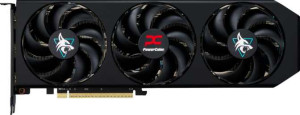
PowerColor Hellhound Radeon RX 9060 XT 16GB
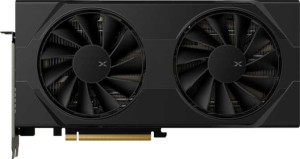
XFX Swift Radeon RX 9060 XT OC Gaming Edition 16GB

PowerColor Hellhound Radeon RX 9060 XT 16GB XFX Swift Radeon RX 9060 XT OC Gaming Edition 16GB

Overview

Welcome to our head-to-head specification breakdown of the PowerColor Hellhound Radeon RX 9060 XT 16GB and the XFX Swift Radeon RX 9060 XT OC Gaming Edition 16GB. Both cards share the same RDNA 4.0 DNA, 16GB of GDDR6 memory, and a broad feature set that includes ray tracing and FSR4, yet they differ meaningfully in clock speeds, memory bandwidth, physical dimensions, and visual aesthetics. Read on to discover which card best suits your build and priorities.

Common Features

  • Both cards share a GPU memory speed of 2518 MHz.
  • Both cards feature 2048 shading units.
  • Both cards have 128 texture mapping units (TMUs).
  • Both cards have 64 render output units (ROPs).
  • Double Precision Floating Point (DPFP) is supported on both cards.
  • Both cards have an effective memory speed of 20000 MHz.
  • Both cards come equipped with 16GB of VRAM.
  • Both cards use GDDR6 memory.
  • Both cards feature a 128-bit memory bus width.
  • ECC memory is supported on both cards.
  • Both cards support DirectX 12 Ultimate.
  • Both cards support OpenGL version 4.6.
  • Both cards support OpenCL version 2.2.
  • Multi-display technology is supported on both cards.
  • Ray tracing is supported on both cards.
  • 3D support is available on both cards.
  • DLSS is not supported on either card.
  • FSR4 is available on both cards.
  • Both cards include one HDMI 2.1b port and two DisplayPort outputs, with no USB-C or DVI outputs.
  • Both cards are built on the RDNA 4.0 architecture with a 4 nm semiconductor size, 29700 million transistors, a 160W TDP, and PCIe 5 interface.
  • Air-water cooling is not available on either card.

Main Differences

  • GPU base clock speed is 1700 MHz on PowerColor Hellhound Radeon RX 9060 XT 16GB and 1900 MHz on XFX Swift Radeon RX 9060 XT OC Gaming Edition 16GB.
  • GPU turbo clock is 3311 MHz on PowerColor Hellhound Radeon RX 9060 XT 16GB and 3320 MHz on XFX Swift Radeon RX 9060 XT OC Gaming Edition 16GB.
  • Pixel rate is 211.9 GPixel/s on PowerColor Hellhound Radeon RX 9060 XT 16GB and 212.5 GPixel/s on XFX Swift Radeon RX 9060 XT OC Gaming Edition 16GB.
  • Floating-point performance is 27.12 TFLOPS on PowerColor Hellhound Radeon RX 9060 XT 16GB and 27.2 TFLOPS on XFX Swift Radeon RX 9060 XT OC Gaming Edition 16GB.
  • Texture rate is 423.8 GTexels/s on PowerColor Hellhound Radeon RX 9060 XT 16GB and 425 GTexels/s on XFX Swift Radeon RX 9060 XT OC Gaming Edition 16GB.
  • Maximum memory bandwidth is 322.3 GB/s on PowerColor Hellhound Radeon RX 9060 XT 16GB and 340 GB/s on XFX Swift Radeon RX 9060 XT OC Gaming Edition 16GB.
  • RGB lighting is not present on PowerColor Hellhound Radeon RX 9060 XT 16GB but is available on XFX Swift Radeon RX 9060 XT OC Gaming Edition 16GB.
  • Card width is 330 mm on PowerColor Hellhound Radeon RX 9060 XT 16GB and 270 mm on XFX Swift Radeon RX 9060 XT OC Gaming Edition 16GB.
  • Card height is 120 mm on PowerColor Hellhound Radeon RX 9060 XT 16GB and 124 mm on XFX Swift Radeon RX 9060 XT OC Gaming Edition 16GB.
Specs Comparison
PowerColor Hellhound Radeon RX 9060 XT 16GB

PowerColor Hellhound Radeon RX 9060 XT 16GB

XFX Swift Radeon RX 9060 XT OC Gaming Edition 16GB

XFX Swift Radeon RX 9060 XT OC Gaming Edition 16GB

Performance:
GPU clock speed 1700 MHz 1900 MHz
GPU turbo 3311 MHz 3320 MHz
pixel rate 211.9 GPixel/s 212.5 GPixel/s
floating-point performance 27.12 TFLOPS 27.2 TFLOPS
texture rate 423.8 GTexels/s 425 GTexels/s
GPU memory speed 2518 MHz 2518 MHz
shading units 2048 2048
texture mapping units (TMUs) 128 128
render output units (ROPs) 64 64
Has Double Precision Floating Point (DPFP)

At the architectural level, these two cards are virtually identical: both share the same 2048 shading units, 128 TMUs, 64 ROPs, and 2518 MHz memory speed. This means their theoretical throughput ceiling — pixel fill rate, texture rate, and floating-point compute — differs by less than 0.3% across every metric. In practical terms, that gap is indistinguishable in any real workload.

The one meaningful difference on paper is the base GPU clock: the XFX Swift ships at 1900 MHz versus the PowerColor Hellhound's 1700 MHz, a 12% higher starting point. However, the turbo clocks nearly converge — 3320 MHz versus 3311 MHz — a 9 MHz spread that is statistically irrelevant. Since modern GPUs spend virtually all of their time under load boosting toward their turbo ceiling rather than sitting at base, the higher base clock on the XFX is largely a spec-sheet distinction with no material gaming impact.

For this performance group, these cards are effectively tied. The XFX Swift holds a nominal edge in base clock frequency, but with turbo clocks and all fixed hardware units being equal, neither card can claim a real-world performance advantage over the other. The decision between them should rest on factors outside this group — pricing, cooling solution, or power delivery design — rather than raw GPU performance.

Memory:
effective memory speed 20000 MHz 20000 MHz
maximum memory bandwidth 322.3 GB/s 340 GB/s
VRAM 16GB 16GB
GDDR version GDDR6 GDDR6
memory bus width 128-bit 128-bit
Supports ECC memory

The memory configurations of these two cards share the same foundation: 16GB of GDDR6 across a 128-bit bus at an effective speed of 20000 MHz, with ECC support on both. For a card in this segment, 16GB is a genuinely future-proof allocation — enough headroom for high-resolution texture packs, VRAM-hungry workloads, and upcoming titles that are beginning to push past the 12GB threshold.

The only divergence surfaces in reported maximum memory bandwidth: the XFX Swift lists 340 GB/s versus the PowerColor Hellhound's 322.3 GB/s, a gap of roughly 5.5%. Given that both cards run identical bus widths and memory speeds, this difference likely reflects variance in how each manufacturer rates or measures peak throughput. In practice, memory bandwidth at this level is rarely the primary bottleneck in gaming — it becomes more relevant in compute-heavy or high-resolution scenarios where the GPU is continuously streaming large texture datasets.

Overall, this group is essentially a tie for typical gaming use. The XFX Swift's bandwidth figure is nominally higher, which could offer a marginal advantage in bandwidth-sensitive workloads, but the shared VRAM capacity, bus width, and memory speed mean both cards will behave nearly identically in the vast majority of real-world scenarios. Neither card holds a meaningful structural memory advantage over the other.

Features:
DirectX version DirectX 12 Ultimate DirectX 12 Ultimate
OpenGL version 4.6 4.6
OpenCL version 2.2 2.2
Supports multi-display technology
supports ray tracing
Supports 3D
supports DLSS
has FSR4
has XeSS (XMX)
AMD SAM / Intel Resizable BAR AMD SAM AMD SAM
has LHR
has RGB lighting
supported displays 3 3

From a software and API standpoint, these two cards are completely interchangeable. Both support DirectX 12 Ultimate, ray tracing, and FSR4 — AMD's latest upscaling generation — while neither supports DLSS or XeSS, which is expected given their AMD heritage. FSR4 is a meaningful inclusion: it delivers AI-driven upscaling that can substantially boost frame rates in supported titles with minimal visual quality loss, partially closing the gap with NVIDIA's DLSS ecosystem. AMD SAM support on both cards also ensures CPU-to-GPU memory access is fully optimized on compatible platforms.

The only functional difference in this group is RGB lighting: the XFX Swift includes it, while the PowerColor Hellhound does not. This is purely an aesthetic consideration with no impact on gaming performance or compatibility. For builders assembling a synchronized RGB rig, the XFX Swift integrates more naturally; for those who prefer a cleaner, no-frills look — or simply don't want to manage lighting software — the Hellhound's absence of RGB is a non-issue or even a preference.

On features, these cards are a functional tie. Every performance-relevant capability — ray tracing, FSR4, multi-display support up to 3 screens, DirectX 12 Ultimate — is identical. The XFX Swift's edge is limited strictly to aesthetics, making the choice here a matter of personal taste rather than capability.

Ports:
has an HDMI output
HDMI ports 1 1
HDMI version HDMI 2.1b HDMI 2.1b
DisplayPort outputs 2 2
USB-C ports 0 0
DVI outputs 0 0
mini DisplayPort outputs 0 0

Port selection is identical across both cards: one HDMI 2.1b output and two DisplayPort outputs, totaling three display connections — which aligns with the three-display limit noted in their features specs. The absence of USB-C, DVI, or mini DisplayPort on either card is entirely expected for modern mid-range GPUs, where those legacy or alternative connectors have largely been phased out.

The inclusion of HDMI 2.1b is worth noting for its practical implications. It supports up to 4K at high refresh rates and 8K output, making these cards display-future-proof well beyond typical gaming monitor resolutions. For users running a mixed setup — say, a DisplayPort gaming monitor alongside an HDMI-connected TV — the port layout on both cards accommodates that without adapters.

This group is a complete tie. Every port type, count, and version is identical between the PowerColor Hellhound and the XFX Swift. Connectivity should play no role whatsoever in choosing between these two cards.

General info:
GPU architecture RDNA 4.0 RDNA 4.0
release date June 2025 June 2025
Thermal Design Power (TDP) 160W 160W
PCI Express (PCIe) version 5 5
semiconductor size 4 nm 4 nm
number of transistors 29700 million 29700 million
Has air-water cooling
width 330 mm 270 mm
height 120 mm 124 mm

Under the hood, these cards are built from the same silicon: identical RDNA 4.0 architecture, 4nm process node, and 29,700 million transistors, all operating at the same 160W TDP. That shared power envelope is significant — it means both cards draw the same amount of power under load, place equal demands on your PSU, and should produce broadly similar thermal output. PCIe 5.0 support on both is forward-compatible with current and upcoming platforms without any practical bandwidth difference at this GPU tier.

Where these cards genuinely diverge is physical footprint. The PowerColor Hellhound measures 330mm in length, while the XFX Swift comes in notably shorter at 270mm — a 60mm difference that is far from trivial. In compact mid-tower or mini-ITX builds where GPU clearance is tight, that gap can be the deciding factor between a card fitting or not. Heights are nearly identical at 120mm versus 124mm, so the length dimension is the one to check against your case specifications.

For most standard ATX builds, both cards will fit without issue, making this a tie for typical use cases. However, for small form factor builders, the XFX Swift holds a clear practical advantage purely by virtue of its more compact length — and that distinction has nothing to do with performance, only physical compatibility.

Comparison Summary & Verdict

At their core, both cards are remarkably close siblings: identical RDNA 4.0 architecture, the same 16GB GDDR6 memory pool, a shared 160W TDP, and the same port configuration. Where they diverge is in execution. The XFX Swift Radeon RX 9060 XT OC Gaming Edition 16GB steps ahead with a higher base clock of 1900 MHz, a slightly elevated turbo of 3320 MHz, and a more substantial memory bandwidth of 340 GB/s compared to 322.3 GB/s on the Hellhound, which may translate to smoother performance in memory-intensive scenarios. It also brings RGB lighting and a more compact 270 mm card length. The PowerColor Hellhound Radeon RX 9060 XT 16GB counters with a slimmer 120 mm height and a no-frills aesthetic suited to clean or space-constrained builds, while remaining competitive across all core specifications. Neither card is a clear loser; the right choice comes down to whether you value higher factory clocks and RGB flair, or a quieter, slightly more compact-height design.

PowerColor Hellhound Radeon RX 9060 XT 16GB
Buy PowerColor Hellhound Radeon RX 9060 XT 16GB if...

Buy the PowerColor Hellhound Radeon RX 9060 XT 16GB if you prefer a no-RGB, lower 120 mm height card that fits snugly into tighter cases without sacrificing any core features.

XFX Swift Radeon RX 9060 XT OC Gaming Edition 16GB
Buy XFX Swift Radeon RX 9060 XT OC Gaming Edition 16GB if...

Buy the XFX Swift Radeon RX 9060 XT OC Gaming Edition 16GB if you want a higher base clock of 1900 MHz, greater memory bandwidth of 340 GB/s, and RGB lighting in a more compact 270 mm length.