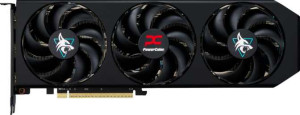
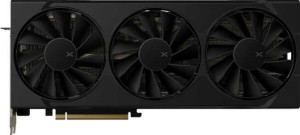
Sharing the same RDNA 4.0 architecture and PCIe 5.0 interface, these two cards are built from the same generational blueprint — but the silicon underneath tells two distinct stories. The RX 9070 OC is built on a 5 nm process and packs 53,900 million transistors, compared to the Hellhound RX 9060 XT's 4 nm node and 29,700 million transistors. The 9060 XT's finer node is noteworthy: smaller process nodes generally allow for better power efficiency per transistor, which helps explain how it achieves competitive clock speeds on a much smaller die. The 9070 OC's larger transistor count, meanwhile, is the physical foundation for its wider shader and memory bus configuration seen in other spec groups.
Power consumption reflects this die size gap directly. The Hellhound draws a 160W TDP versus the 9070 OC's 220W — a 37.5% increase. In practice, that delta means the 9070 OC demands a more capable PSU and will generate more heat under sustained load, which has implications for system airflow and long-term noise levels. For small form factor or thermally constrained builds, the 9060 XT's lower power envelope is a genuine advantage beyond just electricity costs.
Physically, both cards are similarly sized — the 9060 XT at 330 × 120 mm and the 9070 OC at 325 × 150 mm — so case compatibility is comparable in length, though the 9070 OC is notably taller. Neither offers liquid cooling. In this group, there is no single winner: the Hellhound RX 9060 XT holds an edge in power efficiency and thermal footprint, while the RX 9070 OC's larger die underpins its broader compute capability. Which trade-off matters more depends entirely on the user's system constraints.