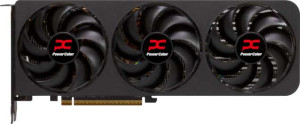
At their core, both the Hellhound and the Reaper share the same fundamental GPU architecture: identical base clocks of 1330 MHz, the same 3584 shading units, 224 TMUs, 128 ROPs, and matched memory speeds of 2518 MHz. This means the two cards start from the same silicon foundation, and any performance gap between them comes down entirely to how far each card is willing to push the GPU under boost conditions.
That gap is defined by the turbo clock: the Hellhound boosts to 2590 MHz versus the Reaper's 2520 MHz — a difference of 70 MHz, or roughly 2.8%. This modest but consistent advantage flows directly into every compute-derived metric. The Hellhound delivers 37.13 TFLOPS of floating-point throughput against the Reaper's 36.13 TFLOPS, a pixel rate of 331.5 GPixel/s versus 322.6 GPixel/s, and a texture rate of 580.2 GTexels/s versus 564.5 GTexels/s. In real-world terms, a ~1 TFLOP difference at this performance tier is unlikely to be felt as a dramatic framerate swing, but it does represent a consistently higher performance ceiling — particularly relevant in sustained GPU-bound workloads like ray tracing, compute tasks, or heavily tessellated scenes.
The Hellhound holds a clear but incremental edge in this group. Both cards are equally capable at the hardware level — same ROPs, same shading units, same memory bandwidth potential — but the Hellhound's higher factory boost clock means it consistently extracts more from the shared silicon. Buyers who prioritize peak performance out of the box, without manual overclocking, will find the Hellhound the stronger choice in this category.