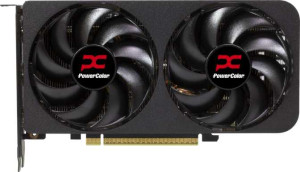
PowerColor Reaper Radeon RX 9060 XT 16GB
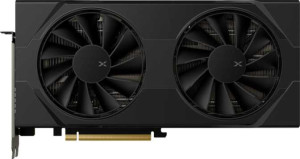
XFX Swift Radeon RX 9060 XT OC Gaming Edition 8GB

PowerColor Reaper Radeon RX 9060 XT 16GB XFX Swift Radeon RX 9060 XT OC Gaming Edition 8GB

Overview

Welcome to our detailed spec comparison between the PowerColor Reaper Radeon RX 9060 XT 16GB and the XFX Swift Radeon RX 9060 XT OC Gaming Edition 8GB. Both cards share the same RDNA 4.0 architecture and a 160W TDP, yet they diverge in meaningful ways across VRAM capacity, clock speeds, physical dimensions, and aesthetic features, making the choice between them far from straightforward.

Common Features

  • Both cards share the same GPU memory speed of 2518 MHz.
  • Both cards feature 2048 shading units.
  • Both cards have 128 texture mapping units (TMUs).
  • Both cards have 64 render output units (ROPs).
  • Double Precision Floating Point (DPFP) is supported on both cards.
  • Both cards have an effective memory speed of 20000 MHz.
  • Both cards use GDDR6 memory.
  • Both cards use a 128-bit memory bus width.
  • ECC memory is supported on both cards.
  • Both cards support DirectX 12 Ultimate.
  • Both cards support OpenGL version 4.6.
  • Both cards support OpenCL version 2.2.
  • Multi-display technology is supported on both cards.
  • Ray tracing is supported on both cards.
  • 3D support is available on both cards.
  • DLSS is not supported on either card.
  • FSR4 is available on both cards.
  • Both cards include one HDMI 2.1b output.
  • Both cards have two DisplayPort outputs.
  • Neither card has USB-C or DVI outputs.
  • Both cards are built on the RDNA 4.0 architecture.
  • Both cards have a Thermal Design Power (TDP) of 160W.
  • Both cards use PCIe version 5.
  • Both cards are manufactured on a 4 nm semiconductor process.
  • Both cards feature 29,700 million transistors.
  • Neither card uses air-water cooling.

Main Differences

  • GPU base clock speed is 1700 MHz on PowerColor Reaper Radeon RX 9060 XT 16GB and 1900 MHz on XFX Swift Radeon RX 9060 XT OC Gaming Edition 8GB.
  • GPU turbo clock speed is 3230 MHz on PowerColor Reaper Radeon RX 9060 XT 16GB and 3320 MHz on XFX Swift Radeon RX 9060 XT OC Gaming Edition 8GB.
  • Pixel rate is 206.7 GPixel/s on PowerColor Reaper Radeon RX 9060 XT 16GB and 212.5 GPixel/s on XFX Swift Radeon RX 9060 XT OC Gaming Edition 8GB.
  • Floating-point performance is 26.46 TFLOPS on PowerColor Reaper Radeon RX 9060 XT 16GB and 27.2 TFLOPS on XFX Swift Radeon RX 9060 XT OC Gaming Edition 8GB.
  • Texture rate is 413.4 GTexels/s on PowerColor Reaper Radeon RX 9060 XT 16GB and 425 GTexels/s on XFX Swift Radeon RX 9060 XT OC Gaming Edition 8GB.
  • Maximum memory bandwidth is 322.3 GB/s on PowerColor Reaper Radeon RX 9060 XT 16GB and 340 GB/s on XFX Swift Radeon RX 9060 XT OC Gaming Edition 8GB.
  • VRAM is 16GB on PowerColor Reaper Radeon RX 9060 XT 16GB and 8GB on XFX Swift Radeon RX 9060 XT OC Gaming Edition 8GB.
  • RGB lighting is present on XFX Swift Radeon RX 9060 XT OC Gaming Edition 8GB but not available on PowerColor Reaper Radeon RX 9060 XT 16GB.
  • Card width is 220 mm on PowerColor Reaper Radeon RX 9060 XT 16GB and 270 mm on XFX Swift Radeon RX 9060 XT OC Gaming Edition 8GB.
  • Card height is 120 mm on PowerColor Reaper Radeon RX 9060 XT 16GB and 124 mm on XFX Swift Radeon RX 9060 XT OC Gaming Edition 8GB.
Specs Comparison
PowerColor Reaper Radeon RX 9060 XT 16GB

PowerColor Reaper Radeon RX 9060 XT 16GB

XFX Swift Radeon RX 9060 XT OC Gaming Edition 8GB

XFX Swift Radeon RX 9060 XT OC Gaming Edition 8GB

Performance:
GPU clock speed 1700 MHz 1900 MHz
GPU turbo 3230 MHz 3320 MHz
pixel rate 206.7 GPixel/s 212.5 GPixel/s
floating-point performance 26.46 TFLOPS 27.2 TFLOPS
texture rate 413.4 GTexels/s 425 GTexels/s
GPU memory speed 2518 MHz 2518 MHz
shading units 2048 2048
texture mapping units (TMUs) 128 128
render output units (ROPs) 64 64
Has Double Precision Floating Point (DPFP)

At their core, both cards share identical shader hardware: 2048 shading units, 128 TMUs, and 64 ROPs. This means the fundamental compute and rasterization pipeline is the same silicon — any performance difference between them comes entirely from how fast that silicon is clocked, not from architectural differences.

And that is exactly where the XFX Swift pulls ahead. Its base clock of 1900 MHz versus the PowerColor Reaper's 1700 MHz is a meaningful 11.8% gap at the floor, and the turbo advantage (3320 MHz vs 3230 MHz) carries through to the derived throughput figures: the Swift delivers 27.2 TFLOPS of floating-point performance and a 425 GTexels/s texture rate, compared to 26.46 TFLOPS and 413.4 GTexels/s for the Reaper. In practice this translates to a modest but consistent frame-rate advantage in GPU-bound scenarios — expect roughly 2–3% higher average performance in favor of the Swift under sustained load.

Memory subsystem specs are a dead tie — both run at 2518 MHz and both support Double Precision Floating Point, so neither card has an edge in memory bandwidth or compute versatility. Overall, the XFX Swift holds a clear, if narrow, performance advantage in this group purely by virtue of its higher factory overclock; the PowerColor Reaper trades that small clock deficit for whatever thermal or acoustic tuning its cooler prioritizes.

Memory:
effective memory speed 20000 MHz 20000 MHz
maximum memory bandwidth 322.3 GB/s 340 GB/s
VRAM 16GB 8GB
GDDR version GDDR6 GDDR6
memory bus width 128-bit 128-bit
Supports ECC memory

The memory story here is defined by one stark trade-off: capacity versus bandwidth. The PowerColor Reaper ships with 16GB of VRAM — double the 8GB found on the XFX Swift — and that difference is far from cosmetic. At higher resolutions and with modern titles increasingly pushing VRAM usage past 8GB (particularly with high-resolution texture packs and demanding RT workloads), the Reaper has meaningful headroom that the Swift simply lacks. Running out of VRAM forces the GPU to spill data into system memory, causing severe frame-time spikes that no amount of clock speed can compensate for.

Somewhat counterintuitively, the XFX Swift edges ahead on maximum memory bandwidth at 340 GB/s versus the Reaper's 322.3 GB/s — a roughly 5.5% gap — despite sharing the same 128-bit bus width and identical 20000 MHz effective memory speed. This discrepancy likely reflects differences in how each card's memory subsystem is tuned or validated by the board partner. In practice, higher bandwidth benefits texture streaming and compute throughput, but the advantage is modest and will rarely be the deciding factor in gaming scenarios.

Both cards use GDDR6 on a 128-bit bus and both support ECC memory, so error-correction capability is not a differentiator. The decisive edge in this group belongs to the PowerColor Reaper: double the VRAM is a future-proofing and workload-headroom advantage that outweighs the Swift's marginal bandwidth lead for the overwhelming majority of users.

Features:
DirectX version DirectX 12 Ultimate DirectX 12 Ultimate
OpenGL version 4.6 4.6
OpenCL version 2.2 2.2
Supports multi-display technology
supports ray tracing
Supports 3D
supports DLSS
has FSR4
has XeSS (XMX)
AMD SAM / Intel Resizable BAR AMD SAM AMD SAM
has LHR
has RGB lighting
supported displays 3 3

From a software and API feature standpoint, these two cards are functionally identical. Both support DirectX 12 Ultimate, ray tracing, FSR4, and AMD SAM, and neither supports DLSS or XeSS — exactly what you'd expect from two cards built on the same AMD architecture. FSR4 is worth calling out as a genuine asset: AMD's latest upscaling generation delivers a meaningful image quality step up, making it relevant for users pushing higher resolutions or frame rates. Neither card is disadvantaged here.

The only differentiator this group surfaces is aesthetic: the XFX Swift includes RGB lighting, while the PowerColor Reaper does not. For builders who care about case aesthetics or themed setups, this is a tangible perk on the Swift's side. For those who are indifferent to lighting, it is a non-factor.

Functionally, this group is essentially a tie. Both cards offer the same API support, the same upscaling ecosystem, the same multi-display capability across 3 displays, and identical compute feature sets. The XFX Swift's RGB lighting gives it a marginal lifestyle edge, but it carries no bearing on gaming or compute performance.

Ports:
has an HDMI output
HDMI ports 1 1
HDMI version HDMI 2.1b HDMI 2.1b
DisplayPort outputs 2 2
USB-C ports 0 0
DVI outputs 0 0
mini DisplayPort outputs 0 0

Port configurations are a complete mirror image between these two cards. Both offer 1 HDMI 2.1b output and 2 DisplayPort outputs, with no USB-C, DVI, or mini-DisplayPort connections on either. That three-output total aligns with the three-display multi-monitor capability noted in their feature specs, so there is no hidden limitation hiding here.

The presence of HDMI 2.1b on both is worth noting positively: it supports up to 10K resolution, high frame rates at 4K, and VRR passthrough for compatible TVs — making either card a solid choice for users who connect to a modern television alongside a monitor. DisplayPort outputs remain the go-to for high-refresh-rate PC monitors, and having two of them covers the vast majority of dual-monitor desktop setups.

This group is an unambiguous tie. There is no connectivity advantage to be found on either side — buyers can make their decision entirely on other criteria without worrying about port selection.

General info:
GPU architecture RDNA 4.0 RDNA 4.0
release date June 2025 June 2025
Thermal Design Power (TDP) 160W 160W
PCI Express (PCIe) version 5 5
semiconductor size 4 nm 4 nm
number of transistors 29700 million 29700 million
Has air-water cooling
width 220 mm 270 mm
height 120 mm 124 mm

Underneath their respective coolers, these two cards are built on identical silicon: the same RDNA 4.0 architecture, the same 4nm process node, and the same 29,700 million transistors. Their 160W TDP is also a perfect match, meaning power supply requirements and expected thermal output are equivalent — neither card demands more from your system than the other.

Where they diverge is physical footprint. The PowerColor Reaper measures 220mm in length, while the XFX Swift stretches to 270mm — a 50mm difference that is significant in practice. Compact and mini-ITX cases that cap GPU length in the 220–240mm range may accommodate the Reaper but reject the Swift outright. For small form factor builders, this is not a minor consideration; it can be the deciding factor before any other spec is even weighed.

On shared fundamentals this group is a tie, but the PowerColor Reaper earns a clear physical advantage for space-constrained builds. Users with full-size mid-tower or larger cases will find both cards equally viable, but anyone building in a compact chassis should treat the Reaper's shorter length as a meaningful practical benefit.

Comparison Summary & Verdict

After examining every specification, the two cards reveal distinct identities despite their shared foundation. The PowerColor Reaper Radeon RX 9060 XT 16GB stands out with its generous 16GB of GDDR6 VRAM and a more compact 220 mm width, making it the stronger pick for users who work with memory-intensive workloads or need a card that fits smaller chassis. The XFX Swift Radeon RX 9060 XT OC Gaming Edition 8GB, on the other hand, edges ahead in raw throughput, delivering a higher 3320 MHz turbo clock, 27.2 TFLOPS of floating-point performance, and 340 GB/s of memory bandwidth, alongside RGB lighting for those who value aesthetics. If future-proofing VRAM headroom is your priority, the PowerColor wins; if you want the last drop of factory-overclocked performance with visual flair, the XFX is the better match.

PowerColor Reaper Radeon RX 9060 XT 16GB
Buy PowerColor Reaper Radeon RX 9060 XT 16GB if...

Buy the PowerColor Reaper Radeon RX 9060 XT 16GB if you need the extra headroom of 16GB VRAM for memory-intensive tasks or prefer a more compact card at 220 mm wide.

XFX Swift Radeon RX 9060 XT OC Gaming Edition 8GB
Buy XFX Swift Radeon RX 9060 XT OC Gaming Edition 8GB if...

Buy the XFX Swift Radeon RX 9060 XT OC Gaming Edition 8GB if you want higher factory clock speeds, greater memory bandwidth, and RGB lighting in your build.