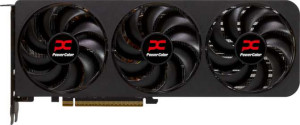
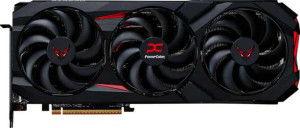
The PowerColor Reaper RX 9070 XT holds a clear and consistent performance advantage over the PowerColor Red Devil RX 9070 across every major compute metric. Its 4096 shading units versus 3584 on the RX 9070 represent a roughly 14% wider shader array, which directly translates to more parallel work being done per clock cycle — the foundation of GPU throughput. That wider execution width is compounded by a significantly higher boost clock of 2970 MHz versus 2700 MHz, meaning the RX 9070 XT runs faster and has more execution resources doing so simultaneously.
The downstream effect of those two advantages is visible in the derived metrics: the RX 9070 XT delivers 48.66 TFLOPS of floating-point throughput against 38.71 TFLOPS for the RX 9070 — a gap of roughly 26% that is directly relevant to compute-heavy workloads like ray tracing, AI-accelerated features, and high-resolution rendering. Its texture rate of 760.3 GTexels/s versus 604.8 GTexels/s also means noticeably faster texture throughput in complex, detail-rich scenes. The two cards do share identical memory clock speeds of 2518 MHz and the same 128 ROPs, so their pixel fill-rate gap is narrower and both will handle framebuffer writes and blending at similar efficiency — the RX 9070 XT′s pixel rate lead (380.2 vs 345.6 GPixel/s) comes purely from its higher boost clock rather than a raster pipeline width advantage.
Both cards support Double Precision Floating Point, which matters for GPU-accelerated scientific or professional compute tasks, so neither has an edge there. Overall, the RX 9070 XT has a clear and meaningful performance advantage in this group: more shaders, higher clocks, and substantially greater compute and texture throughput. The RX 9070 is not weak by any measure, but if raw GPU horsepower is the deciding factor, the RX 9070 XT is unambiguously the stronger card based on these specifications.