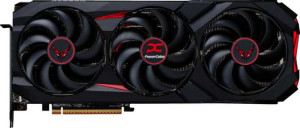
PowerColor Red Devil Radeon RX 9070 XT
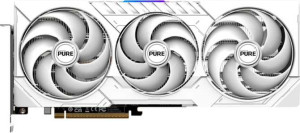
Sapphire Pure Radeon RX 9070 XT

PowerColor Red Devil Radeon RX 9070 XT Sapphire Pure Radeon RX 9070 XT

Overview

When choosing between the PowerColor Red Devil Radeon RX 9070 XT and the Sapphire Pure Radeon RX 9070 XT, buyers face a nuanced decision within the same GPU family. Both cards share the same RDNA 4.0 architecture and 16GB of GDDR6 memory, yet they diverge in meaningful ways across raw performance headroom, display connectivity, feature set, and physical footprint. This comparison breaks down exactly where each card pulls ahead.

Common Features

  • Both cards share a base GPU clock speed of 1660 MHz.
  • Both cards have a GPU memory speed of 2518 MHz.
  • Both cards feature 4096 shading units.
  • Both cards have 256 texture mapping units (TMUs).
  • Both cards have 128 render output units (ROPs).
  • Double Precision Floating Point (DPFP) is supported on both cards.
  • Both cards have an effective memory speed of 20000 MHz.
  • Both cards offer a maximum memory bandwidth of 644.6 GB/s.
  • Both cards come with 16GB of VRAM.
  • Both cards use GDDR6 memory.
  • Both cards feature a 256-bit memory bus width.
  • ECC memory is supported on both cards.
  • Both cards support OpenGL version 4.6.
  • Both cards support OpenCL version 2.2.
  • Multi-display technology is supported on both cards.
  • Ray tracing is supported on both cards.
  • 3D support is available on both cards.
  • DLSS is not supported on either card.
  • FSR4 is available on both cards.
  • XeSS (XMX) is not available on either card.
  • Both cards include an HDMI 2.1b output.
  • Neither card has USB-C ports, DVI outputs, or mini DisplayPort outputs.
  • Both cards are built on the RDNA 4.0 GPU architecture.
  • Both cards use PCIe version 5.
  • Both cards are manufactured on a 4 nm semiconductor process.
  • Both cards feature 53900 million transistors.
  • Neither card supports air-water cooling.

Main Differences

  • GPU turbo clock is 3060 MHz on PowerColor Red Devil Radeon RX 9070 XT and 3010 MHz on Sapphire Pure Radeon RX 9070 XT.
  • Pixel rate is 391.7 GPixel/s on PowerColor Red Devil Radeon RX 9070 XT and 385.3 GPixel/s on Sapphire Pure Radeon RX 9070 XT.
  • Floating-point performance is 50.14 TFLOPS on PowerColor Red Devil Radeon RX 9070 XT and 49.32 TFLOPS on Sapphire Pure Radeon RX 9070 XT.
  • Texture rate is 783.4 GTexels/s on PowerColor Red Devil Radeon RX 9070 XT and 770.6 GTexels/s on Sapphire Pure Radeon RX 9070 XT.
  • The DirectX version is DirectX 12 on PowerColor Red Devil Radeon RX 9070 XT and DirectX 12 Ultimate on Sapphire Pure Radeon RX 9070 XT.
  • RGB lighting is present on Sapphire Pure Radeon RX 9070 XT but not available on PowerColor Red Devil Radeon RX 9070 XT.
  • The number of HDMI ports is 1 on PowerColor Red Devil Radeon RX 9070 XT and 2 on Sapphire Pure Radeon RX 9070 XT.
  • DisplayPort outputs number 3 on PowerColor Red Devil Radeon RX 9070 XT and 2 on Sapphire Pure Radeon RX 9070 XT.
  • Thermal Design Power (TDP) is 304W on PowerColor Red Devil Radeon RX 9070 XT and 317W on Sapphire Pure Radeon RX 9070 XT.
  • Card width is 352 mm on PowerColor Red Devil Radeon RX 9070 XT and 320 mm on Sapphire Pure Radeon RX 9070 XT.
  • Card height is 149 mm on PowerColor Red Devil Radeon RX 9070 XT and 120.3 mm on Sapphire Pure Radeon RX 9070 XT.
Specs Comparison
PowerColor Red Devil Radeon RX 9070 XT

PowerColor Red Devil Radeon RX 9070 XT

Sapphire Pure Radeon RX 9070 XT

Sapphire Pure Radeon RX 9070 XT

Performance:
GPU clock speed 1660 MHz 1660 MHz
GPU turbo 3060 MHz 3010 MHz
pixel rate 391.7 GPixel/s 385.3 GPixel/s
floating-point performance 50.14 TFLOPS 49.32 TFLOPS
texture rate 783.4 GTexels/s 770.6 GTexels/s
GPU memory speed 2518 MHz 2518 MHz
shading units 4096 4096
texture mapping units (TMUs) 256 256
render output units (ROPs) 128 128
Has Double Precision Floating Point (DPFP)

At their core, both cards share identical GPU architectures in terms of raw silicon: the same 4096 shading units, 256 TMUs, 128 ROPs, and a base clock of 1660 MHz. This means the theoretical ceiling of what each card can do is determined entirely by how aggressively the manufacturer has set the boost clock — and this is exactly where they diverge.

The PowerColor Red Devil carries a GPU turbo of 3060 MHz, compared to 3010 MHz on the Sapphire Pure — a 50 MHz advantage that flows directly into every throughput metric. The Red Devil's floating-point performance lands at 50.14 TFLOPS versus 49.32 TFLOPS, its texture rate at 783.4 GTexels/s versus 770.6 GTexels/s, and its pixel rate at 391.7 GPixel/s versus 385.3 GPixel/s. In practice, this ~1.6% performance delta is unlikely to manifest as a noticeable frame-rate difference in most games, but it does indicate the Red Devil benefits from a more permissive power and cooling budget that allows it to sustain higher clocks.

In this group, the Red Devil holds a narrow but consistent edge across every computed throughput metric, all traceable to its higher boost clock. If raw peak GPU performance is the deciding factor, the Red Devil is the stronger card on paper. That said, the gap is slim enough that real-world rendering performance will depend heavily on sustained-clock behavior under thermal load — a factor these specs alone do not capture.

Memory:
effective memory speed 20000 MHz 20000 MHz
maximum memory bandwidth 644.6 GB/s 644.6 GB/s
VRAM 16GB 16GB
GDDR version GDDR6 GDDR6
memory bus width 256-bit 256-bit
Supports ECC memory

Memory is one area where choosing between these two cards requires no deliberation whatsoever. Every single specification — 16GB of GDDR6, a 256-bit bus, 20000 MHz effective speed, and 644.6 GB/s of bandwidth — is identical across both the Red Devil and the Sapphire Pure.

These are strong numbers in context: 644.6 GB/s of bandwidth is ample for driving high-resolution textures and large frame buffers at 1440p and 4K, while 16GB of VRAM ensures neither card will be constrained by memory capacity in current-generation titles or when running memory-intensive workloads like AI inferencing. The shared support for ECC memory is a notable inclusion, adding error-correction capability that is typically associated with professional and compute workloads rather than consumer graphics cards.

This group is a complete tie. There is no memory-side differentiator to weigh here — both cards will deliver identical bandwidth, capacity, and data integrity characteristics in every scenario.

Features:
DirectX version DirectX 12 DirectX 12 Ultimate
OpenGL version 4.6 4.6
OpenCL version 2.2 2.2
Supports multi-display technology
supports ray tracing
Supports 3D
supports DLSS
has FSR4
has XeSS (XMX)
AMD SAM / Intel Resizable BAR AMD SAM AMD SAM
has LHR
has RGB lighting
supported displays 4 4

Most of the feature set here is shared ground: both cards support ray tracing, FSR4, AMD SAM, up to four simultaneous displays, and the same OpenGL and OpenCL versions. Neither supports DLSS or XeSS, which is expected for AMD hardware. The more meaningful divergence comes down to two points — one functional, one aesthetic.

On the functional side, the Sapphire Pure lists DirectX 12 Ultimate while the Red Devil is listed simply as DirectX 12. DirectX 12 Ultimate is a certification that encompasses a specific set of advanced API features including hardware-accelerated ray tracing tiers, mesh shaders, variable rate shading, and sampler feedback — capabilities increasingly leveraged by modern game engines. If this spec difference reflects the card's actual certified feature tier rather than a data entry inconsistency, it gives the Sapphire Pure a meaningful forward-compatibility advantage for titles that explicitly target DX12 Ultimate features. The aesthetic differentiator is RGB lighting, present on the Pure but absent on the Red Devil — relevant purely to those building a visually coordinated system.

Based strictly on the provided data, the Sapphire Pure holds the edge in this group. The DirectX 12 Ultimate listing is the weightier distinction, signaling broader API feature compliance for current and future titles. RGB lighting is a secondary differentiator whose value is entirely subjective.

Ports:
has an HDMI output
HDMI ports 1 2
HDMI version HDMI 2.1b HDMI 2.1b
DisplayPort outputs 3 2
USB-C ports 0 0
DVI outputs 0 0
mini DisplayPort outputs 0 0

Both cards top out at four total display outputs and share the same HDMI 2.1b standard, which supports 4K at high refresh rates and 8K output. The difference lies entirely in how those four ports are allocated between connection types.

The Red Devil opts for 1 HDMI + 3 DisplayPort, while the Sapphire Pure flips the ratio to 2 HDMI + 2 DisplayPort. This is a meaningful distinction depending on your display setup. Users connecting multiple monitors that rely on HDMI — such as TVs used as secondary screens, or older monitors lacking DisplayPort — will find the Pure's dual-HDMI layout more accommodating without the need for adapters. Conversely, the Red Devil's three DisplayPort outputs suit users with a DisplayPort-native multi-monitor desk setup, where daisy-chaining or connecting several high-refresh-rate gaming monitors is the priority.

Neither layout is objectively superior — the right choice depends entirely on the displays being connected. However, since HDMI is the more universally present connector across consumer devices, the Sapphire Pure holds a practical edge for users with mixed or TV-inclusive setups, while the Red Devil is better suited to dedicated DisplayPort multi-monitor configurations.

General info:
GPU architecture RDNA 4.0 RDNA 4.0
release date March 2025 March 2025
Thermal Design Power (TDP) 304W 317W
PCI Express (PCIe) version 5 5
semiconductor size 4 nm 4 nm
number of transistors 53900 million 53900 million
Has air-water cooling
width 352 mm 320 mm
height 149 mm 120.3 mm

Sharing the same RDNA 4.0 architecture, 4nm process node, and identical transistor count, these two cards are built from the same silicon foundation — differences here come down to how each manufacturer has packaged and tuned that hardware. Two figures stand out: TDP and physical size.

The Sapphire Pure carries a higher TDP of 317W versus the Red Devil's 304W, a 13W gap that is somewhat counterintuitive given the Pure's lower boost clock noted in the Performance group. A higher TDP on a slower-clocked card suggests the Pure's power delivery and thermal solution are tuned with less aggressive efficiency optimization, which may affect long-term electricity costs marginally but is unlikely to be felt in practice. More striking is the size difference: the Red Devil measures 352 × 149 mm while the Pure is notably more compact at 320 × 120.3 mm. That 32mm reduction in length and nearly 29mm reduction in height is significant — the Pure will fit comfortably in mid-tower and even some smaller form-factor cases where the Red Devil may not clear the clearance requirements.

For this group, the Sapphire Pure holds a practical advantage for builders working with space-constrained cases, and the Red Devil claims the win on power efficiency with its lower TDP. Overall, if case compatibility is a concern, the Pure's smaller footprint makes it the more versatile option.

Comparison Summary & Verdict

Both cards are strong performers built on identical foundations, but their differences cater to distinct buyer profiles. The PowerColor Red Devil Radeon RX 9070 XT edges ahead with a higher GPU turbo clock of 3060 MHz, delivering slightly better pixel rate, texture rate, and floating-point throughput, all while drawing less power at 304W TDP. It also offers three DisplayPort outputs for multi-monitor setups. The Sapphire Pure Radeon RX 9070 XT, on the other hand, counters with DirectX 12 Ultimate support, dual HDMI 2.1b ports ideal for living-room or multi-TV configurations, RGB lighting, and a noticeably more compact form factor at 320mm in length. Neither card is the outright winner for everyone; the choice comes down to whether you prioritize peak performance and port flexibility or feature richness and a smaller build.

PowerColor Red Devil Radeon RX 9070 XT
Buy PowerColor Red Devil Radeon RX 9070 XT if...

Buy the PowerColor Red Devil Radeon RX 9070 XT if you want the highest possible GPU turbo clock and better raw performance figures, a lower TDP, and three DisplayPort outputs for a multi-monitor desktop setup.

Sapphire Pure Radeon RX 9070 XT
Buy Sapphire Pure Radeon RX 9070 XT if...

Buy the Sapphire Pure Radeon RX 9070 XT if you need DirectX 12 Ultimate support, dual HDMI ports for connecting multiple displays or TVs, RGB lighting, or a more compact card that fits smaller chassis.