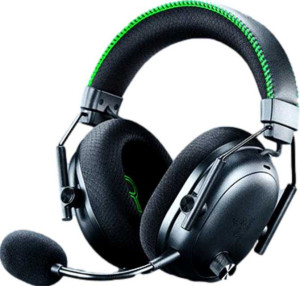
Razer BlackShark V3 Pro
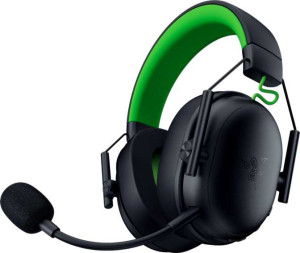
Razer BlackShark V3 X HyperSpeed

Razer BlackShark V3 Pro Razer BlackShark V3 X HyperSpeed

Overview

When choosing between the Razer BlackShark V3 Pro and the Razer BlackShark V3 X HyperSpeed, the decision goes beyond brand recognition. Both headsets share a remarkably similar foundation, yet they diverge on several key fronts, including active noise cancellation, overall weight, microphone frequency range, and wired connectivity options. This detailed spec comparison will help you identify which model truly fits your needs.

Common Features

  • Both headsets have an over-ear fit.
  • Both headsets come with a detachable cable.
  • Neither headset features RGB lighting.
  • Neither headset can be folded.
  • Neither headset has an open-back design.
  • Both headsets include a tangle-free cable.
  • Both headsets have stereo speakers.
  • Both headsets share a lowest frequency of 12 Hz and a highest frequency of 28000 Hz.
  • Both headsets offer virtual surround sound with spatial audio support.
  • Both headsets use a 50 mm driver unit with a neodymium magnet.
  • Both headsets provide passive noise reduction.
  • Both headsets have a driver count of 2.
  • Both headsets feature a noise-canceling microphone that is removable.
  • Both headsets have a single microphone.
  • Both headsets offer a battery life of 70 hours and a charge time of 4 hours.
  • Both headsets have a rechargeable battery with a battery level indicator.
  • Both headsets can be used wirelessly and include USB Type-C connectivity.
  • Neither headset supports aptX, aptX HD, aptX Adaptive, aptX Low Latency, LDAC, or LDHC.
  • Both headsets are compatible with PC, PlayStation, Xbox, and Nintendo Switch.
  • Both headsets have a control panel placed on the device but no in-line control panel.
  • Neither headset has a vibration function.
  • Both headsets come with a 2-year warranty and include a travel bag.

Main Differences

  • Weight is 367 g on Razer BlackShark V3 Pro and 270 g on Razer BlackShark V3 X HyperSpeed.
  • Active noise cancellation (ANC) is present on Razer BlackShark V3 Pro but not available on Razer BlackShark V3 X HyperSpeed.
  • The lowest microphone frequency is 12 Hz on Razer BlackShark V3 Pro and 60 Hz on Razer BlackShark V3 X HyperSpeed.
  • The highest microphone frequency is 10000 Hz on Razer BlackShark V3 Pro and 16000 Hz on Razer BlackShark V3 X HyperSpeed.
  • A removable battery is present on Razer BlackShark V3 Pro but not available on Razer BlackShark V3 X HyperSpeed.
  • Connectivity options include 3.5mm, USB, 2.4GHz wireless, and Bluetooth on Razer BlackShark V3 Pro, while Razer BlackShark V3 X HyperSpeed offers 2.4GHz wireless, Bluetooth, and USB only.
  • Headset usage mode (microphone-enabled call use) is supported on Razer BlackShark V3 X HyperSpeed but not available on Razer BlackShark V3 Pro.
Specs Comparison
Razer BlackShark V3 Pro

Razer BlackShark V3 Pro

Razer BlackShark V3 X HyperSpeed

Razer BlackShark V3 X HyperSpeed

Design:
Fit Over-ear Over-ear
has a detachable cable
weight 367 g 270 g
has RGB lighting
can be folded
has an open-back design
has a tangle free cable
has stereo speakers

Both the Razer BlackShark V3 Pro and the BlackShark V3 X HyperSpeed share the same fundamental design DNA: over-ear, closed-back builds with detachable, tangle-free cables and stereo speakers. Neither offers RGB lighting or a foldable form factor, so for users prioritizing those features, neither headset delivers. In terms of structural flexibility and cable management, they are effectively tied.

The single most meaningful differentiator in this group is weight. The V3 Pro comes in at 367 g, while the V3 X HyperSpeed is notably lighter at 270 g — a difference of 97 g, which is roughly the weight of a large egg. In practice, this gap matters significantly during extended sessions: a heavier headset accelerates listener fatigue, causes more pressure on the headband, and can become uncomfortable after several hours of continuous wear. The V3 X HyperSpeed's lighter frame gives it a real ergonomic advantage for marathon gaming or work-from-home use cases.

On design, the V3 X HyperSpeed holds a clear edge purely due to its substantially lower weight. All other design attributes are identical between the two, so the comfort advantage of saving nearly 100 g tips the balance decisively in its favor for users who prioritize wearability over long periods.

Sound quality:
lowest frequency 12 Hz 12 Hz
highest frequency 28000 Hz 28000 Hz
has active noise cancellation (ANC)
Surround sound Virtual Virtual
supports spatial audio
driver unit size 50 mm 50 mm
has a neodymium magnet
has passive noise reduction
drivers count 2 2

At the driver level, these two headsets are essentially identical: both use 50 mm neodymium drivers, cover the same frequency range of 12 Hz to 28,000 Hz, and deliver virtual surround sound with spatial audio support. That shared foundation means the raw audio reproduction capability — tonal range, driver size, and positional audio features — is on equal footing out of the box.

Where the comparison diverges meaningfully is noise isolation. Both headsets offer passive noise reduction through their closed-back, over-ear design, which physically blocks ambient sound. However, the V3 Pro goes a step further with active noise cancellation (ANC) — a feature the V3 X HyperSpeed entirely lacks. ANC uses microphones to electronically cancel incoming ambient noise, which is particularly effective against low-frequency, constant sounds like fans, HVAC systems, or office chatter. For users in noisy environments who want to stay immersed in audio without raising the volume, this is a tangible, real-world advantage.

On sound quality specs, the V3 Pro has a clear edge, and it comes down entirely to ANC. Since audio reproduction hardware is matched across both products, the addition of active noise cancellation on the V3 Pro meaningfully elevates its ability to deliver a clean, isolated listening experience — something the V3 X HyperSpeed simply cannot replicate through passive isolation alone.

Microphone:
has a noise-canceling microphone
lowest mic frequency 12 Hz 60 Hz
highest mic frequency 10000 Hz 16000 Hz
has a removable microphone
number of microphones 1 1

Both headsets field a single, removable noise-canceling microphone — a setup that covers the essentials for gaming and calls without adding complexity. The structural parity ends there, however, because the frequency response ranges tell meaningfully different stories about capture quality.

The V3 Pro mic spans 12 Hz to 10,000 Hz, while the V3 X HyperSpeed mic reaches from 60 Hz to 16,000 Hz. For voice communication, the upper ceiling is the more consequential figure. Human speech intelligibility and the subtle tonal qualities that make a voice sound natural and clear extend well past 10,000 Hz — into the 12,000–16,000 Hz range where consonants, sibilance, and vocal presence live. The V3 X HyperSpeed's higher upper limit means it captures more of that detail, which translates to a crisper, more lifelike voice reproduction for teammates or call participants on the other end. The V3 Pro's lower floor of 12 Hz vs 60 Hz, by contrast, captures sub-bass frequencies that carry virtually no practical value in voice pickup.

On microphone performance, the V3 X HyperSpeed holds the edge, driven by its wider high-frequency ceiling of 16,000 Hz. For users who prioritize voice clarity in squad communication or streaming, that extended range is a genuine, audible advantage over the V3 Pro's more limited mic response.

Power:
Battery life 70 hours 70 hours
charge time 4 hours 4 hours
has a rechargeable battery
has a battery level indicator
has a removable battery

From a raw endurance standpoint, these two headsets are perfectly matched: both deliver 70 hours of battery life on a single charge and refill completely in 4 hours. At 70 hours, neither headset is likely to leave a user stranded mid-session — that figure comfortably covers multiple days of heavy use before a charge is needed, making the recharge cadence a non-issue for virtually all use cases.

The one structural difference is the V3 Pro's removable battery, a feature the V3 X HyperSpeed lacks. In practice, a swappable battery means a user can carry a spare and achieve effectively unlimited runtime without ever waiting on a charge cycle — a meaningful advantage in professional or travel scenarios where downtime is costly. For the average home user who can simply plug in overnight, it matters less, but the option itself adds long-term serviceability: as battery capacity degrades over years of use, the V3 Pro's battery can be replaced without retiring the headset entirely.

On power specs, the V3 Pro holds a modest but real advantage thanks to its removable battery. Runtime and charging speed are identical, so for most users the difference is negligible day-to-day — but for power users or those thinking about long-term ownership, the ability to swap or replace the battery tips the scale in the V3 Pro's favor.

Connectivity:
connectivity 3.5mm, USB, 2.4GHz wireless, Bluetooth 2.4GHz wireless, Bluetooth, USB
compatibility PC, PlayStation, Xbox, Nintendo Switch PlayStation, PC, Xbox, Nintendo Switch
Can be used wirelessly
Has USB Type-C
has aptX Adaptive
has aptX Low Latency
has LDAC
has LDHC
has aptX HD
has aptX
has AAC
maximum Bluetooth range 10 m 10 m
supports Bluetooth pairing using NFC
has fast pairing

Across platform compatibility and wireless options, these two headsets are nearly indistinguishable — both support 2.4GHz wireless, Bluetooth, and USB Type-C, and both work across PC, PlayStation, Xbox, and Nintendo Switch. Neither headset supports advanced Bluetooth codecs or NFC pairing, so Bluetooth on both is best understood as a convenience connection for low-demand use rather than an audiophile-grade wireless path.

The sole differentiator in this group is the V3 Pro's inclusion of a 3.5mm analog connection, which the V3 X HyperSpeed omits. While this may seem minor in an increasingly wireless world, the 3.5mm jack is the universal fallback — it works with any device that has a headphone port, requires no pairing, adds zero latency, and functions even when the battery is dead. For users who travel, use legacy devices, or want a guaranteed no-fuss backup connection, its presence is a quiet but practical advantage.

Connectivity is broadly a tie, but the V3 Pro earns a narrow edge by adding 3.5mm support to an otherwise identical feature set. It simply offers one more way to connect, which expands compatibility and provides a reliable wired fallback that the V3 X HyperSpeed cannot match.

Features:
release date July 2025 July 2025
control panel placed on a device
can be used as a headset
has a vibration function
Has an in-line control panel
warranty period 2 years 2 years
travel bag is included

Most of the features in this group are shared equally: both headsets place controls directly on the earcup, include a travel bag in the box, and carry a 2-year warranty. These are welcome quality-of-life touches, but they don't separate the two products in any meaningful way.

The one functional divergence is that the V3 X HyperSpeed is rated for headset use — meaning it is certified or designed to function as a communications device beyond gaming — while the V3 Pro is not. In practical terms, this distinction matters most for users who intend to use the headset across professional calls, remote work platforms, or softphone systems where headset certification or compatibility may be expected. For a pure gaming context the difference is largely academic, but it does give the V3 X HyperSpeed a broader utility footprint.

On features, the V3 X HyperSpeed holds a narrow edge by virtue of its headset-capable designation. Everything else is matched, so this advantage is most relevant to users who need a single headset to serve double duty across gaming and professional or productivity environments — a scenario where the V3 Pro simply doesn't qualify on paper.

Comparison Summary & Verdict

Both the Razer BlackShark V3 Pro and the Razer BlackShark V3 X HyperSpeed are well-matched on core features: identical 70-hour battery life, 50 mm neodymium drivers, virtual surround sound, passive noise reduction, and multi-platform compatibility. That said, the V3 Pro distinguishes itself with active noise cancellation, a removable battery, a lower microphone frequency floor of 12 Hz, and an additional 3.5mm wired connection option, making it ideal for users who demand premium audio isolation and connection versatility. The V3 X HyperSpeed, meanwhile, is notably lighter at 270 g versus 367 g, reaches a higher microphone frequency ceiling of 16000 Hz, and supports headset usage mode, making it the stronger pick for comfort-focused users and those who rely on clear voice communication during long sessions.

Razer BlackShark V3 Pro
Buy Razer BlackShark V3 Pro if...

Buy the Razer BlackShark V3 Pro if you need active noise cancellation, a removable battery, and wired 3.5mm connectivity for maximum platform flexibility.

Razer BlackShark V3 X HyperSpeed
Buy Razer BlackShark V3 X HyperSpeed if...

Buy the Razer BlackShark V3 X HyperSpeed if you prefer a lighter headset for extended comfort, headset usage mode support, and a wider microphone frequency ceiling.