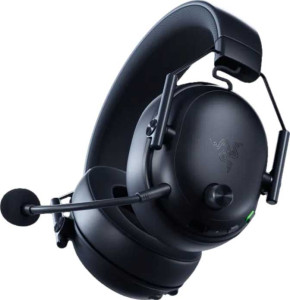
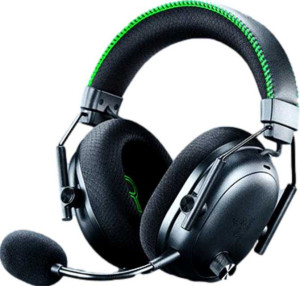
Razer BlackShark V3
Razer BlackShark V3 Pro

Razer BlackShark V3 Razer BlackShark V3 Pro

Overview

Welcome to our in-depth specification comparison between the Razer BlackShark V3 and the Razer BlackShark V3 Pro. While both headsets share the same audio foundation, key battlegrounds emerge around active noise cancellation, build weight, microphone performance, and connectivity options. Whether you prioritize portability or a richer feature set, this comparison will help you find the right fit for your setup.

Common Features

  • Both headsets use an over-ear fit.
  • Both headsets have a detachable cable.
  • Neither headset features RGB lighting.
  • Neither headset can be folded.
  • Neither headset uses an open-back design.
  • Both headsets have a tangle-free cable.
  • Both headsets have stereo speakers.
  • Both headsets share a lowest frequency of 12 Hz and a highest frequency of 28000 Hz.
  • Both headsets offer virtual surround sound.
  • Spatial audio is supported on both headsets.
  • Both headsets use a 50 mm driver unit size.
  • Both headsets feature a neodymium magnet.
  • Passive noise reduction is present on both headsets.
  • Both headsets have 2 drivers.
  • Both headsets include a noise-canceling microphone.
  • The microphone is removable on both headsets.
  • Both headsets have 1 microphone.
  • Both headsets offer 70 hours of battery life.
  • Both headsets have a charge time of 4 hours.
  • The battery is rechargeable on both headsets.
  • A battery level indicator is present on both headsets.
  • Both headsets can be used wirelessly.
  • Both headsets have a USB Type-C connector.
  • Neither headset supports aptX Adaptive, aptX Low Latency, LDAC, LDHC, aptX HD, or aptX.
  • Both headsets have a control panel placed on the device.
  • Neither headset has a vibration function.
  • Neither headset has an in-line control panel.
  • Both headsets come with a 2-year warranty.
  • A travel bag is included with both headsets.

Main Differences

  • The Razer BlackShark V3 weighs 270 g while the Razer BlackShark V3 Pro weighs 367 g.
  • Active noise cancellation (ANC) is present on the Razer BlackShark V3 Pro but not available on the Razer BlackShark V3.
  • The lowest microphone frequency is 60 Hz on the Razer BlackShark V3 and 12 Hz on the Razer BlackShark V3 Pro.
  • The highest microphone frequency is 16000 Hz on the Razer BlackShark V3 and 10000 Hz on the Razer BlackShark V3 Pro.
  • The battery is removable on the Razer BlackShark V3 Pro but not removable on the Razer BlackShark V3.
  • The Razer BlackShark V3 connects via 2.4GHz wireless, Bluetooth, and USB, while the Razer BlackShark V3 Pro connects via 3.5mm, USB, 2.4GHz wireless, and Bluetooth.
  • The Razer BlackShark V3 is compatible with PlayStation, PC, Xbox, and Nintendo Switch, while the Razer BlackShark V3 Pro is compatible with PC, PlayStation, Xbox, and Nintendo Switch.
  • The Razer BlackShark V3 can be used as a headset, while this functionality is not available on the Razer BlackShark V3 Pro.
Specs Comparison
Razer BlackShark V3

Razer BlackShark V3

Razer BlackShark V3 Pro

Razer BlackShark V3 Pro

Design:
Fit Over-ear Over-ear
has a detachable cable
weight 270 g 367 g
has RGB lighting
can be folded
has an open-back design
has a tangle free cable
has stereo speakers

In terms of design, the Razer BlackShark V3 and the BlackShark V3 Pro share the same fundamental blueprint: both are over-ear, closed-back headsets with no folding mechanism, no RGB lighting, and a tangle-free detachable cable. For users, this means a consistent physical experience — the closed-back design offers passive noise isolation, while the detachable cable adds convenience and repairability.

The one meaningful differentiator in this category is weight. The V3 comes in at 270 g, while the V3 Pro is noticeably heavier at 367 g — a difference of 97 g, or roughly 36% more mass. In practice, this gap becomes significant during extended sessions: a lighter headset reduces fatigue on the neck and head over hours of use, making the V3 the more comfortable option for marathon gaming or work-from-home scenarios.

On design alone, the Razer BlackShark V3 holds a clear edge due to its substantially lower weight. Unless the extra mass of the Pro is justified by features in other categories (such as wireless capability or audio upgrades), users who prioritize long-term wearing comfort should favor the standard V3.

Sound quality:
lowest frequency 12 Hz 12 Hz
highest frequency 28000 Hz 28000 Hz
has active noise cancellation (ANC)
Surround sound Virtual Virtual
supports spatial audio
driver unit size 50 mm 50 mm
has a neodymium magnet
has passive noise reduction
drivers count 2 2

At the hardware level, both headsets are built on an identical acoustic foundation: 50 mm neodymium drivers, a shared frequency range of 12 Hz to 28,000 Hz, virtual surround sound, spatial audio support, and passive noise reduction. This means the raw transducer performance and tonal range on offer are the same — users can expect equivalent bass extension and high-frequency detail from either model out of the box.

The single but significant divergence is Active Noise Cancellation (ANC), which is present on the V3 Pro and absent on the standard V3. While passive noise reduction (shared by both) relies on physical ear cup isolation to muffle ambient sound, ANC uses microphones and signal processing to actively counteract environmental noise. For users in loud environments — open offices, busy households, or travel — this is a meaningful real-world upgrade that goes beyond what closed-back padding alone can achieve.

Given that every other sound quality specification is identical, the Razer BlackShark V3 Pro holds a clear edge in this category solely on the strength of its ANC capability. For users where ambient noise is not a concern, the two headsets are effectively tied in pure audio hardware terms — but anyone who values focused listening in noisy environments will find the Pro's active noise cancellation a genuinely useful differentiator.

Microphone:
has a noise-canceling microphone
lowest mic frequency 60 Hz 12 Hz
highest mic frequency 16000 Hz 10000 Hz
has a removable microphone
number of microphones 1 1

Both headsets arrive with a removable, noise-canceling microphone and a single capsule — so the structural setup is identical. The real story here lies in the frequency response numbers, which tell two different tuning philosophies. The V3 captures from 60 Hz to 16,000 Hz, while the V3 Pro spans 12 Hz to 10,000 Hz.

For voice communication, the upper frequency ceiling matters more than the low-end floor. Human speech intelligibility — the crispness of consonants, the clarity of sibilants — lives in the upper midrange and lower treble, roughly between 4 kHz and 16 kHz. The V3's microphone reaches 16,000 Hz, meaning it captures more of that presence and airiness that makes voices sound natural and distinct. The V3 Pro, cutting off at 10,000 Hz, rolls off that top-end detail earlier. Its deeper low-frequency extension down to 12 Hz is largely irrelevant for voice, as those sub-bass frequencies are well below the range of any human speech.

On microphone specifications alone, the Razer BlackShark V3 holds the edge. Its significantly higher frequency ceiling translates directly to more detailed, intelligible voice capture — a meaningful advantage for competitive gaming communication or streaming where mic clarity is a priority.

Power:
Battery life 70 hours 70 hours
charge time 4 hours 4 hours
has a rechargeable battery
has a battery level indicator
has a removable battery

From a power standpoint, the two headsets are nearly mirror images of each other. Both deliver 70 hours of battery life and require 4 hours to fully recharge — figures that place them firmly in the long-endurance tier, where most users will only need to charge every few days even with heavy daily use.

The one point of divergence is the removable battery, a feature the V3 Pro carries and the standard V3 does not. This distinction matters most for power users who need truly uninterrupted operation: with a spare charged battery on hand, the V3 Pro can be back at full capacity instantly without waiting through a charge cycle. For the V3, once the battery is depleted, the 4-hour charge time is unavoidable. It also has longer-term implications — as rechargeable batteries degrade over years of use, a removable battery means the V3 Pro can be restored to like-new endurance simply by swapping the cell, while the V3's lifespan is tied directly to its built-in battery.

Given identical runtime and charge times, the Razer BlackShark V3 Pro edges ahead in this category on the strength of its removable battery alone. It's a meaningful advantage for professional or heavy users, though for casual users who are comfortable with the shared 70-hour runtime, the practical difference will rarely surface.

Connectivity:
connectivity 2.4GHz wireless, Bluetooth, USB 3.5mm, USB, 2.4GHz wireless, Bluetooth
compatibility PlayStation, PC, Xbox, Nintendo Switch PC, PlayStation, Xbox, Nintendo Switch
Can be used wirelessly
Has USB Type-C
has aptX Adaptive
has aptX Low Latency
has LDAC
has LDHC
has aptX HD
has aptX
has AAC
maximum Bluetooth range 10 m 10 m
supports Bluetooth pairing using NFC
has fast pairing

Connectivity is largely a draw between these two headsets. Both support 2.4GHz wireless, Bluetooth, and USB, cover the same platform range (PC, PlayStation, Xbox, and Nintendo Switch), share a 10 m Bluetooth range, and lack advanced Bluetooth codecs such as aptX, LDAC, or AAC. For most users, this shared feature set is more than sufficient — 2.4GHz wireless delivers low-latency audio well-suited to gaming, while Bluetooth provides flexibility for casual listening across devices.

The sole differentiator is the V3 Pro's addition of a 3.5mm analog connection, which the standard V3 does not offer. While this may seem minor in an increasingly wireless world, a 3.5mm jack provides a universally compatible, zero-latency, no-battery-required fallback — useful when connecting to devices that lack USB or Bluetooth, such as certain older consoles, audio interfaces, or in-flight entertainment systems.

The Razer BlackShark V3 Pro holds a narrow edge here purely due to its additional 3.5mm input, which extends compatibility to scenarios the V3 simply cannot accommodate. For users who operate exclusively within the wireless and USB ecosystem, however, this distinction will rarely matter, and the two headsets are effectively equivalent in day-to-day connectivity.

Features:
release date July 2025 July 2025
control panel placed on a device
can be used as a headset
has a vibration function
Has an in-line control panel
warranty period 2 years 2 years
travel bag is included

Across most feature-level specs, these two headsets are identical: both place controls directly on the ear cup, neither includes an in-line control panel or vibration function, both come with a travel bag, and both carry a 2-year warranty. For most users, this shared baseline is perfectly adequate — on-device controls keep adjustments accessible without the clutter of a cable-mounted remote.

The one functional divergence is noteworthy: the V3 is listed as usable as a headset (meaning it supports two-way voice communication in telephony contexts), while the V3 Pro is not. This means the standard V3 has broader everyday utility beyond gaming — it can serve double duty for phone calls or conferencing applications where headset mode is required, without any workarounds.

Based strictly on these specs, the Razer BlackShark V3 holds the edge in this category. For users who want a single device that covers both gaming and general voice communication needs, its headset compatibility is a practical advantage the V3 Pro does not offer.

Comparison Summary & Verdict

Both the Razer BlackShark V3 and the Razer BlackShark V3 Pro deliver a strong shared foundation: identical 50 mm drivers, the same 12 Hz–28000 Hz frequency range, virtual surround sound, 70 hours of battery life, and a removable noise-canceling microphone. Where they diverge is meaningful. The Razer BlackShark V3 is the lighter option at 270 g, supports headset use, and offers a broader microphone frequency range topping out at 16000 Hz, making it a compelling pick for users who want a capable, no-frills wireless headset. The Razer BlackShark V3 Pro, on the other hand, adds active noise cancellation, a removable battery, and a 3.5mm wired connection option, at the cost of extra weight and a slightly narrower mic range. Choose the Pro if you need ANC and long-term battery flexibility; stick with the standard V3 if weight and headset functionality matter most.

Razer BlackShark V3
Buy Razer BlackShark V3 if...

Buy the Razer BlackShark V3 if you want a lighter headset at 270 g with headset functionality and a wider microphone frequency range, without paying a premium for active noise cancellation.

Razer BlackShark V3 Pro
Buy Razer BlackShark V3 Pro if...

Buy the Razer BlackShark V3 Pro if active noise cancellation, a removable battery for long-term convenience, and a wired 3.5mm connection option are priorities for your setup.