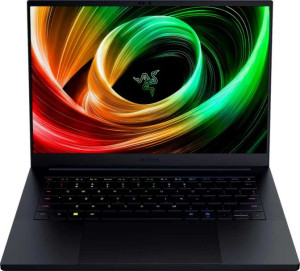
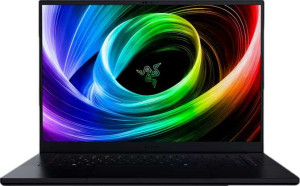
The Razer Blade 14 (2025) and Razer Blade 16 (2025) share several core features, but with some differences in GPU and power characteristics. Both laptops feature a clock multiplier of 20 and support Intel Resizable BAR. They also use Blackwell GPU architecture, with integrated graphics. The Blade 14 has a Thermal Design Power (TDP) of 50W, while the Blade 16 has a significantly higher TDP of 95W, indicating a higher power requirement for the Blade 16.
In terms of GPU performance, the Blade 14 is equipped with the Radeon 780M, which has 4608 shading units, 144 texture mapping units (TMUs), and 48 render output units (ROPs). The Blade 16, on the other hand, features the Radeon 890M with 10496 shading units, 328 TMUs, and 128 ROPs, suggesting a higher graphics processing capability. Additionally, the Blade 14 has a 128-bit memory bus width, while the Blade 16 benefits from a wider 256-bit memory bus, offering greater memory bandwidth of 811.5 GB/s, compared to the Blade 14's 405.8 GB/s.
Both models support 3D and multi-display technology, with the same effective memory speed of 25400 MHz, and the same GPU memory speed of 2000 MHz. They also both support ECC memory and have the same RAM speed maximum of 7500 MHz. The Blade 16, however, features more GPU execution units (16 vs 12 in the Blade 14) and slightly more L2 cache (12 MB vs 10 MB in the Blade 14). Both laptops have a maximum CPU temperature of 100 °C and include NX bit security support. The Blade 14 has an unlocked multiplier, whereas the Blade 16 does not.