Realme 14 Pro
Realme 14T 5G

Realme 14 Pro Realme 14T 5G

Overview

When choosing between the Realme 14 Pro and the Realme 14T 5G, buyers face a genuinely interesting decision across several key areas. Both phones share a 6000 mAh battery, 12GB of RAM, a 120Hz OLED display, and Android 15, yet they diverge meaningfully in processing power, camera capabilities, and connectivity features. This detailed spec comparison will help you weigh exactly where each device pulls ahead before you make your choice.

Common Features

  • Both phones have an IP68 ingress protection rating.
  • Neither phone has a rugged build.
  • Neither phone can be folded.
  • Both phones feature an OLED/AMOLED display.
  • Both phones have a 120Hz refresh rate.
  • Neither phone has branded damage-resistant glass.
  • HDR10 support is not available on either phone.
  • HDR10+ support is not available on either phone.
  • Dolby Vision support is not available on either phone.
  • Neither phone has a secondary screen.
  • Both phones have a touch screen.
  • Both phones come with 12GB of RAM.
  • Both phones support LTE connectivity.
  • Both phones support 64-bit processing.
  • Both phones use DirectX 12.
  • Both phones feature integrated graphics.
  • Both phones use big.LITTLE technology.
  • Both phones have 8 CPU threads.
  • Both phones use HMP technology.
  • Both phones have a main camera with 50 & 2 MP resolution.
  • Both phones share the same wide aperture values of 2.4 & 1.8f on the main camera.
  • Both phones have a dual-lens main camera.
  • Both phones have a 16MP front camera.
  • Neither phone has a dual-tone LED flash.
  • Neither phone has a BSI sensor.
  • Both phones have a CMOS sensor.
  • Both phones support continuous autofocus when recording video.
  • Both phones run Android 15.
  • Both phones show clipboard warnings.
  • Both phones offer location privacy options.
  • Both phones provide camera and microphone privacy options.
  • Mail Privacy Protection is not available on either phone.
  • Both phones support theme customization.
  • Both phones can block app tracking.
  • Cross-site tracking blocking is not available on either phone.
  • Both phones have a 6000 mAh battery.
  • Neither phone supports wireless charging.
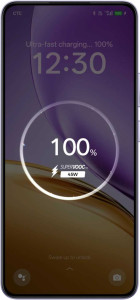
  • Both phones support fast charging at 45W.
  • Both phones come with a charger included.
  • Neither phone has a removable battery.
  • Both phones have a battery level indicator.
  • Both phones have a rechargeable battery.
  • Neither phone has a 3.5mm audio jack.
  • Both phones have stereo speakers.
  • aptX support is not available on either phone.
  • aptX HD support is not available on either phone.
  • aptX Adaptive support is not available on either phone.
  • aptX Lossless support is not available on either phone.
  • Neither phone has a radio.
  • Both phones support 5G.
  • Both phones support dual SIM cards.
  • Neither phone has an external memory slot.
  • Both phones have a USB Type-C port.
  • Both phones have a fingerprint scanner.
  • Emergency SOS via satellite is not available on either phone.
  • Crash detection is not available on either phone.
  • Neither phone is DLNA-certified.
  • Both phones have a video light.
  • Neither phone has a sapphire glass display.
  • Neither phone has an e-paper display.

Main Differences

  • Water resistance is present on the Realme 14 Pro but not available on the Realme 14T 5G.
  • Weight is 182g on the Realme 14 Pro and 196g on the Realme 14T 5G.
  • Thickness is 7.6mm on the Realme 14 Pro and 8mm on the Realme 14T 5G.
  • Width is 74.9mm on the Realme 14 Pro and 75.7mm on the Realme 14T 5G.
  • Height is 162.8mm on the Realme 14 Pro and 163.2mm on the Realme 14T 5G.
  • Volume is 92.67 cm³ on the Realme 14 Pro and 98.83 cm³ on the Realme 14T 5G.
  • Screen size is 6.77″ on the Realme 14 Pro and 6.67″ on the Realme 14T 5G.
  • Pixel density is 388 ppi on the Realme 14 Pro and 386 ppi on the Realme 14T 5G.
  • Resolution is 1080 x 2392 px on the Realme 14 Pro and 1080 x 2400 px on the Realme 14T 5G.
  • Touch sampling rate is 240Hz on the Realme 14 Pro and 180Hz on the Realme 14T 5G.
  • Always-On Display is available on the Realme 14 Pro but not on the Realme 14T 5G.
  • Internal storage is 512GB on the Realme 14 Pro and 256GB on the Realme 14T 5G.
  • The chipset is MediaTek Dimensity 7300 on the Realme 14 Pro and MediaTek Dimensity 6300 on the Realme 14T 5G.
  • The GPU is Mali G615 MC2 on the Realme 14 Pro and Arm Mali-G57 MC2 on the Realme 14T 5G.
  • CPU speed is 4 x 2.5 & 4 x 2 GHz on the Realme 14 Pro and 2 x 2.4 & 6 x 2 GHz on the Realme 14T 5G.
  • Geekbench 6 multi-core score is 2932 on the Realme 14 Pro and 2012 on the Realme 14T 5G.
  • Geekbench 6 single-core score is 1026 on the Realme 14 Pro and 782 on the Realme 14T 5G.
  • GPU clock speed is 1047 MHz on the Realme 14 Pro and 950 MHz on the Realme 14T 5G.
  • RAM speed is 6400 MHz on the Realme 14 Pro and 2133 MHz on the Realme 14T 5G.
  • Semiconductor size is 4nm on the Realme 14 Pro and 6nm on the Realme 14T 5G.
  • Maximum memory amount is 16GB on the Realme 14 Pro and 12GB on the Realme 14T 5G.
  • DDR memory version is DDR5 on the Realme 14 Pro and DDR4 on the Realme 14T 5G.
  • Optical image stabilization is present on the Realme 14 Pro but not available on the Realme 14T 5G.
  • Main camera video recording goes up to 2160p at 30fps on the Realme 14 Pro and 1080p at 60fps on the Realme 14T 5G.
  • The number of flash LEDs is 3 on the Realme 14 Pro and 1 on the Realme 14T 5G.
  • LDAC support is available on the Realme 14 Pro but not on the Realme 14T 5G.
  • Wi-Fi 6 (802.11ax) support is present on the Realme 14 Pro but not available on the Realme 14T 5G.
  • Bluetooth version is 5.4 on the Realme 14 Pro and 5.3 on the Realme 14T 5G.
  • NFC is available on the Realme 14 Pro but not on the Realme 14T 5G.
  • Download speed is 3270 Mbits/s on the Realme 14 Pro and 3300 Mbits/s on the Realme 14T 5G.
  • A curved display is featured on the Realme 14 Pro but not on the Realme 14T 5G.
Specs Comparison
Realme 14 Pro

Realme 14 Pro

Realme 14T 5G

Realme 14T 5G

Design:
water resistance Waterproof None
weight 182 g 196 g
thickness 7.6 mm 8 mm
width 74.9 mm 75.7 mm
height 162.8 mm 163.2 mm
volume 92.672272 cm³ 98.83392 cm³
Ingress Protection (IP) rating IP68 IP68
has a rugged build
can be folded

In terms of physical form, the Realme 14 Pro holds a meaningful advantage in compactness. At 7.6 mm thick and 182 g, it is noticeably slimmer and lighter than the Realme 14T 5G, which measures 8 mm and weighs 196 g. That 14-gram difference is genuinely perceptible during extended one-handed use or when the phone sits in a pocket all day. The smaller overall volume — 92.7 cm³ versus 98.8 cm³ — confirms the 14 Pro is the more pocketable of the two, despite their similar footprint dimensions.

The most significant differentiator in this group is water protection. The Realme 14 Pro is explicitly listed as Waterproof, while the Realme 14T 5G has no water resistance designation, even though both share an IP68 rating entry in the data. This inconsistency in the source data makes it difficult to draw a firm conclusion on the 14T 5G's real-world submersion tolerance, and buyers who prioritize liquid protection should verify this independently before purchasing.

Neither device offers a rugged build or a foldable form factor, so both target the same conventional smartphone use case. Overall, the Realme 14 Pro has a clear edge in design refinement — it is lighter, thinner, and carries an unambiguous waterproof claim — making it the stronger choice for users who value a premium, slim feel and reliable water protection.

Display:
Display type OLED/AMOLED OLED/AMOLED
screen size 6.77" 6.67"
pixel density 388 ppi 386 ppi
resolution 1080 x 2392 px 1080 x 2400 px
refresh rate 120Hz 120Hz
touch sampling rate 240Hz 180Hz
has branded damage-resistant glass
supports HDR10
supports HDR10+
Always-On Display
supports Dolby Vision
Has a secondary screen
has a touch screen

Both phones share the same panel technology — OLED/AMOLED — and an identical 120Hz refresh rate, so everyday scrolling and animation smoothness will feel essentially the same. Pixel density is also virtually indistinguishable at 388 ppi on the Realme 14 Pro versus 386 ppi on the 14T 5G; no human eye will register that two-pixel gap. The 14 Pro does carry a marginally larger 6.77″ screen compared to the 14T 5G's 6.67″, which translates to a bit more comfortable reading or media-viewing real estate, though neither display supports HDR10, HDR10+, or Dolby Vision.

Where a real difference emerges is in touch responsiveness and software display features. The 14 Pro's 240Hz touch sampling rate versus the 14T 5G's 180Hz means the 14 Pro registers finger input more frequently per second — a tangible advantage for fast-paced gaming where precision timing matters. Casual users may not notice the gap, but mobile gamers will. Additionally, the 14 Pro supports Always-On Display while the 14T 5G does not, allowing glanceable clock and notification info without fully waking the screen — a quality-of-life feature that adds subtle convenience.

The Realme 14 Pro takes a clear edge in this category. It offers a slightly larger screen, a faster touch sampling rate, and Always-On Display support — three advantages that stack up meaningfully for users who spend a lot of time on their phone, particularly those who game or multitask frequently.

Performance:
internal storage 512GB 256GB
RAM 12GB 12GB
Chipset (SoC) name MediaTek Dimensity 7300 MediaTek Dimensity 6300
GPU name Mali G615 MC2 Arm Mali-G57 MC2
CPU speed 4 x 2.5 & 4 x 2 GHz 2 x 2.4 & 6 x 2 GHz
Geekbench 6 result (multi) 2932 2012
Geekbench 6 result (single) 1026 782
GPU clock speed 1047 MHz 950 MHz
Has integrated LTE
RAM speed 6400 MHz 2133 MHz
semiconductor size 4 nm 6 nm
Supports 64-bit
DirectX version DirectX 12 DirectX 12
Has integrated graphics
Uses big.LITTLE technology
CPU threads 8 threads 8 threads
Uses HMP
maximum memory amount 16GB 12GB
DDR memory version 5 4

The chipset gap here is substantial. The Realme 14 Pro runs on the MediaTek Dimensity 7300, built on a 4 nm process, while the 14T 5G uses the MediaTek Dimensity 6300 on a 6 nm node. A smaller manufacturing process generally means greater power efficiency and thermal headroom — the 14 Pro's chip can sustain higher performance while generating less heat. This architectural advantage shows clearly in the Geekbench 6 scores: the 14 Pro posts 1026 single-core and 2932 multi-core results versus the 14T 5G's 782 and 2012 respectively. That is roughly a 31% single-core and 46% multi-core lead — differences that translate to snappier app launches, smoother multitasking, and more headroom for demanding tasks.

Memory tells a similarly one-sided story. Both devices ship with 12 GB of RAM, but the 14 Pro's RAM runs at 6400 MHz on DDR5, compared to the 14T 5G's 2133 MHz DDR4. Faster memory bandwidth means data moves between the processor and RAM significantly quicker, which benefits everything from loading large apps to sustaining frame rates in games. The 14 Pro also supports a maximum of 16 GB of memory expansion versus the 14T 5G's ceiling of 12 GB, giving it more headroom for future-proofing via virtual RAM features. On storage, the 14 Pro doubles the 14T 5G with 512 GB versus 256 GB — a meaningful real-world difference for users who store large media libraries or avoid cloud storage.

The Realme 14 Pro dominates this category across every measurable dimension — faster chip, newer process node, faster and more expandable RAM, and double the base storage. For any user who cares about sustained performance, gaming, or longevity, the 14 Pro is unambiguously the stronger performer.

Cameras:
megapixels (main camera) 50 & 2 MP 50 & 2 MP
wide aperture (main camera) 2.4 & 1.8f 2.4 & 1.8f
Has a dual-lens (or multi-lens) main camera
megapixels (front camera) 16MP 16MP
has built-in optical image stabilization
video recording (main camera) 2160 x 30 fps 1080 x 60 fps
Has a dual-tone LED flash
number of flash LEDs 3 1
has a BSI sensor
has a CMOS sensor
has continuous autofocus when recording movies
Has phase-detection autofocus for photos
supports slow-motion video recording
has a built-in HDR mode
has manual exposure
has a flash
optical zoom 0x 0x
has manual ISO
has a serial shot mode
has manual focus
has a front camera
Has laser autofocus
Shoots 360° panorama
has manual white balance
shoots raw
has touch autofocus
has manual shutter speed
can create panoramas in-camera
wide aperture (front camera) 2.4f 2.4f
Has timelapse function
Has a front-facing LED flash
has a dual-lens (or multi-lens) front camera
supports HDR10 recording
supports Dolby Vision recording
has a front-facing camera under the display
Has a RGB LED flash
has 3D photo/video recording capabilities

On paper, the two phones look nearly identical in camera hardware — both carry a 50 MP + 2 MP dual rear system with matching apertures, a 16 MP front camera, and the same suite of manual controls and autofocus technologies. For still photography, this parity is largely genuine: users of either device can expect similar flexibility in shooting modes and comparable sensor configurations. Where the comparison diverges is in two specific areas that have an outsized impact on real-world output quality.

The first is optical image stabilization (OIS), present on the Realme 14 Pro but absent on the 14T 5G. OIS physically compensates for hand movement during capture, making a meaningful difference in low-light stills and handheld video — situations where even small tremors cause blur. The second differentiator is video resolution: the 14 Pro records at 4K (2160p) at 30 fps, while the 14T 5G tops out at 1080p at 60 fps. Neither is outright wrong as a trade-off — 1080p/60fps yields smoother motion — but 4K offers far greater detail and future-proofing for anyone who wants to crop, reframe, or display footage on larger screens. The 14 Pro also packs 3 flash LEDs compared to just 1 on the 14T 5G, which can produce more even flash illumination in dark environments.

The Realme 14 Pro takes a clear win in this group. OIS and 4K video recording are both meaningful, practical upgrades over what the 14T 5G offers — especially for users who shoot video regularly or in challenging lighting conditions.

Operating system:
Android version Android 15 Android 15
has clipboard warnings
has location privacy options
has camera/microphone privacy options
has Mail Privacy Protection
has theme customization
can block app tracking
blocks cross-site tracking
has on-device machine learning
has notification permissions
has media picker
Can play games while they download
has dark mode
has Wi-Fi password sharing
has battery health check
has an extra dim mode
has focus modes
has dynamic theming
can offload apps
Has customizable notifications
has Live Text
has full-page screenshots
supports split screen
gets direct OS updates
has PiP
Can be used as a PC
Has sharing intents
has a child lock
Supports widgets
Is free and open source
Has offline voice recognition
has voice commands
Tracks the current position of a mobile device
is a multi-user system
has Quick Start

This is a rare case of a complete dead heat. Both the Realme 14 Pro and the Realme 14T 5G run Android 15 and share an identical feature set across every single data point in this category — from privacy controls like location and camera/microphone permissions, to usability features like split-screen, Picture-in-Picture, dynamic theming, and offline voice recognition. There is no meaningful distinction to draw between them on software.

It is worth noting what both phones share as a baseline, since some of these features carry real user value. On-device machine learning, Live Text, customizable notifications, and app tracking controls are all present — a solid privacy and productivity foundation. Neither device gets direct OS updates, meaning both rely on Realme's own update pipeline rather than receiving patches straight from Google, which can introduce delays in security and feature rollouts for both equally.

This group is a complete tie. Every spec is identical, and no advantage can be declared for either device based solely on the provided data. Software experience will come down entirely to factors outside this dataset, such as Realme's update cadence or any UI-level differences in their Realme UI skin.

Battery:
battery power 6000 mAh 6000 mAh
has wireless charging
Supports fast charging
charging speed 45W 45W
comes with a charger
has a removable battery
has a battery level indicator
has a rechargeable battery

Battery is another category where the two phones are mirror images of each other. Both pack a 6000 mAh cell — a generous capacity that comfortably places them in the all-day and potentially two-day battery life bracket for moderate users. Both also support 45W fast charging and ship with a charger included, so refill times from low battery should be comparable on either device.

Neither phone offers wireless charging, and neither has a removable battery — both standard trade-offs at this segment. The absence of wireless charging is worth flagging for users who have invested in wireless charging pads, but it is a shared limitation rather than a differentiator between the two.

This group is a complete tie. Every battery specification is identical across both devices. Real-world battery life may still differ in practice — the 14 Pro's more efficient 4 nm chipset (noted in the Performance group) could translate to better endurance — but based strictly on the data provided here, neither phone holds any advantage over the other in this category.

Audio:
has a socket for a 3.5 mm audio jack
has stereo speakers
has aptX
has LDAC
has aptX HD
has aptX Adaptive
has aptX Lossless
Has a radio

Shared ground first: both phones ditch the 3.5 mm headphone jack and offer stereo speakers — a trade-off that has become standard at this tier. Stereo output makes a genuine difference for media consumption, giving music and video a wider, more immersive soundstage compared to a single mono driver.

The one meaningful split is wireless audio codec support. The Realme 14 Pro supports LDAC, Sony's high-resolution Bluetooth codec capable of transmitting audio at up to three times the data rate of standard Bluetooth audio. For users with LDAC-compatible headphones or earbuds, this unlocks noticeably higher audio fidelity over a wireless connection — closer to wired quality. The 14T 5G supports none of the advanced codecs listed, meaning it is limited to standard Bluetooth audio quality for wireless listening.

The Realme 14 Pro takes the edge here, solely on the strength of LDAC support. For casual listeners streaming at standard quality, the difference may go unnoticed. But for audiophiles or anyone who owns hi-res wireless audio gear, the 14 Pro is the clear choice in this category.

Connectivity & Features:
release date January 2025 April 2025
has 5G support
Wi-Fi version Wi-Fi 4 (802.11n), Wi-Fi 5 (802.11ac), Wi-Fi 6 (802.11ax) Wi-Fi 4 (802.11n), Wi-Fi 5 (802.11ac)
SIM cards 2 SIM 2 SIM
Bluetooth version 5.4 5.3
has an external memory slot
Has USB Type-C
has NFC
download speed 3270 MBits/s 3300 MBits/s
Has a fingerprint scanner
has emergency SOS via satellite
has crash detection
is DLNA-certified
has a gyroscope
supports ANT+
Has a heart rate monitor
has GPS
has a compass
supports Wi-Fi
Has an infrared sensor
has an accelerometer
has a cellular module
Has a barometer
has an HDMI output
Uses 3D facial recognition
Has an iris scanner
Stylus included
supports Galileo
Has motion tracking
Has optical tracking
Has a built-in projector

At a high level, both phones share a solid connectivity foundation — 5G, dual SIM, USB Type-C, fingerprint scanner, GPS with Galileo support, and a full motion sensor suite. However, two differences stand out as genuinely impactful for daily use. The Realme 14 Pro includes NFC, while the 14T 5G does not. NFC enables contactless payments, quick device pairing, and transit card functionality — features that have become a practical expectation for many users, and their absence on the 14T 5G is a tangible omission rather than a minor footnote.

The 14 Pro also steps ahead on wireless standards, supporting Wi-Fi 6 (802.11ax) in addition to Wi-Fi 4 and 5, whereas the 14T 5G tops out at Wi-Fi 5 (802.11ac). Wi-Fi 6 delivers better performance in congested environments — think offices, apartments, or public spaces with many connected devices — along with improved efficiency that can reduce battery drain during wireless activity. The 14 Pro's Bluetooth 5.4 is also a step ahead of the 14T 5G's 5.3, though this difference is marginal in practice. Download speeds, notably, are nearly identical at 3270 vs 3300 Mbits/s — effectively a wash.

The Realme 14 Pro holds a clear advantage in this group. NFC alone is a meaningful real-world differentiator for a large segment of users, and the addition of Wi-Fi 6 support further cements it as the more future-ready device from a connectivity standpoint.

Miscellaneous:
has a video light
Has sapphire glass display
Has a curved display
Has an e-paper display

This is a compact category with only one real differentiator. Both phones share a video light and neither features sapphire glass or an e-paper display — leaving the curved display on the Realme 14 Pro as the sole distinguishing factor. The 14T 5G has a flat panel.

A curved screen is primarily an aesthetic and ergonomic choice. The gentle edge curvature on the 14 Pro gives it a more premium, sculpted feel in the hand and can make swiping in from the edges feel more natural. The trade-off is that curved displays are slightly more prone to accidental edge touches and can be more difficult to protect with standard flat-glass screen protectors. Users who prioritize a sleek, flagship-like look will appreciate the curve; those who prefer practicality and easier screen protection may actually prefer the 14T 5G's flat panel.

Based strictly on the provided data, the Realme 14 Pro has a marginal edge for users who value premium aesthetics, courtesy of its curved display. However, this is a matter of personal preference more than a clear functional advantage — making it one of the few categories in this comparison where the ″winner″ depends entirely on what the individual user prioritizes.

Comparison Summary & Verdict

After examining every spec, a clear picture emerges for each device. The Realme 14 Pro is the stronger all-round performer: its MediaTek Dimensity 7300 chipset on a 4nm process, DDR5 RAM at 6400 MHz, and significantly higher Geekbench scores give it a decisive performance edge. Add in optical image stabilization, 4K video recording, a curved Always-On Display, NFC, Wi-Fi 6, LDAC audio, and a lighter 182g build, and it is clearly aimed at users who want a feature-rich, capable daily driver. The Realme 14T 5G, on the other hand, keeps things practical: it shares the same large battery, stereo speakers, dual-SIM 5G support, and 45W fast charging at what is typically a lower price point. If your priorities are straightforward connectivity and solid battery endurance without needing the premium extras, it remains a sensible pick.

Realme 14 Pro
Buy Realme 14 Pro if...

Buy the Realme 14 Pro if you want stronger performance, 4K video recording with optical image stabilization, NFC, Wi-Fi 6, and a lighter, more feature-packed design.

Realme 14T 5G
Buy Realme 14T 5G if...

Buy the Realme 14T 5G if you need a reliable 5G phone with a large battery and fast charging, and do not require premium extras like NFC, OIS, or Wi-Fi 6.