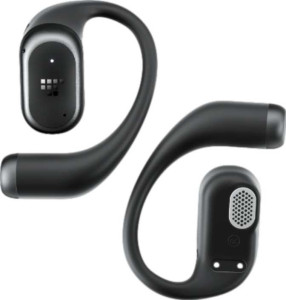
The most fundamental design difference between these two earbuds lies in their fit style. The Realme Buds T200 uses a traditional in-ear design, meaning the eartips create a seal inside the ear canal. This typically delivers better passive noise isolation and stronger bass response. The Tronsmart OpenFly 2 Pro, by contrast, adopts an open-ear form factor, which rests outside the ear canal entirely. Open-ear designs prioritize situational awareness — letting ambient sound in naturally — making them more comfortable for extended wear and safer for outdoor use, but at the cost of audio isolation and low-end punch. These are fundamentally different philosophies, and the right choice depends entirely on the user's use case.
On water resistance, both carry an IPX5-class protection against water jets, making both suitable for workouts and light rain. However, the Realme Buds T200 holds a notable edge here: its rating is IP55, which adds a dust resistance component (the first ″5″) that the Tronsmart's IPX5 rating lacks entirely. For users in dusty or sandy environments, this extra layer of protection is a real-world advantage. To compensate for the open-ear fit's inherent tendency to shift during activity, the Tronsmart includes wingtips in the box — a practical inclusion that the Realme omits, relying instead on the natural grip of in-ear insertion.
Both earbuds are fully wireless, free of neckbands, and share no RGB lighting or display gimmicks, keeping their designs clean and focused. Overall, the Realme Buds T200 holds a clear design edge in environmental durability thanks to its superior IP55 dual-axis protection, while the Tronsmart OpenFly 2 Pro wins for users who specifically want the comfort and awareness of an open-ear form — a choice that is a matter of preference rather than a universal advantage.