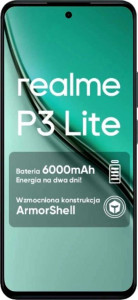
The chipset divide is where these two phones genuinely separate. The Realme P3x 5G runs on the MediaTek Dimensity 6400, built on a modern 6 nm process node, while the Realme P3 Lite 4G relies on the Unisoc T7250 at 12 nm. That process node difference matters: a smaller nm figure means more transistors packed into the same space, translating to better power efficiency and less heat generation under sustained workloads. In everyday terms, the P3x is likely to stay cooler during extended gaming or multitasking sessions and will place less strain on the battery in the process.
Raw CPU clock speeds reinforce this gap. The P3x's performance cores reach 2.5 GHz with efficiency cores at 2.0 GHz, compared to the P3 Lite's 1.8 GHz and 1.6 GHz respectively. That headroom makes a tangible difference when launching heavy apps, handling demanding games, or running multiple tasks simultaneously. The GPU tells a similar story — the P3x's Mali-G57 MC2 clocks at 950 MHz versus 850 MHz on the P3 Lite, a modest but real advantage for graphically intensive applications. Memory bandwidth also favors the P3x, with 2133 MHz RAM versus 1866 MHz, meaning data is fed to the processor faster under load.
Storage and RAM capacity are identical at 128GB and 6GB respectively, so neither device has an edge there. The overall performance verdict, however, is unambiguous: the P3x 5G holds a clear advantage across CPU speed, GPU throughput, memory bandwidth, and manufacturing efficiency. For users who prioritize smooth, sustained performance, the Dimensity 6400 platform is meaningfully ahead of the Unisoc T7250.