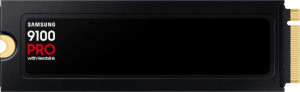
Samsung 9100 Pro 1TB
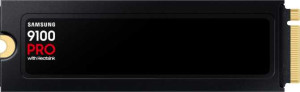
Samsung 9100 Pro 2TB

Samsung 9100 Pro 1TB Samsung 9100 Pro 2TB

Overview

Welcome to this in-depth specification comparison between the Samsung 9100 Pro 1TB and the Samsung 9100 Pro 2TB. Both drives share the same powerful foundation — including PCIe 5.0, NVMe 2, and the Samsung Presto controller — yet they diverge in ways that matter depending on your workload. In this comparison, we break down the key battlegrounds of storage capacity, write performance, and long-term endurance to help you choose the right drive for your needs.

Common Features

  • Both products have a sequential read speed of 14700 MB/s.
  • Both products have a random read speed of 1850000 IOPS.
  • Both products have a random write speed of 2600000 IOPS.
  • Both products use the M2 form factor.
  • Both products feature a DRAM cache.
  • Both products are NVMe SSDs.
  • Both products use NVMe version 2.
  • Both products are powered by the Samsung Presto (S4LY027) controller.
  • Both products use TLC SSD storage type.
  • Both products support PCIe version 5.
  • Both products have 8 controller channels.

Main Differences

  • Sequential write speed is 13300 MB/s on Samsung 9100 Pro 1TB and 13400 MB/s on Samsung 9100 Pro 2TB.
  • Internal storage capacity is 1000GB on Samsung 9100 Pro 1TB and 2000GB on Samsung 9100 Pro 2TB.
  • Terabytes Written (TBW) endurance rating is 600 TBW on Samsung 9100 Pro 1TB and 1200 TBW on Samsung 9100 Pro 2TB.
Specs Comparison
Samsung 9100 Pro 1TB

Samsung 9100 Pro 1TB

Samsung 9100 Pro 2TB

Samsung 9100 Pro 2TB

Read speed:
sequential read speed 14700 MB/s 14700 MB/s
random read speed 1850000 IOPS 1850000 IOPS

In terms of read performance, the Samsung 9100 Pro 1TB and Samsung 9100 Pro 2TB are completely identical across both sequential and random metrics. Both drives achieve a sequential read speed of 14700 MB/s and a random read speed of 1850000 IOPS, placing them at the very top of consumer NVMe performance.

Those sequential figures translate to extremely fast large-file transfers — think 4K video projects, large game installations, or system image restores completing in seconds rather than minutes. The random read IOPS figure is equally impressive: at nearly 2 million IOPS, both drives handle the kind of intense, scattered small-file workloads typical of OS boot sequences, application launches, and database reads with no perceivable bottleneck.

This group is a clear tie. Capacity choice between the 1TB and 2TB variants has zero impact on read performance — users can select based on storage needs and budget without making any trade-off in read speed.

Write speed:
sequential write speed 13300 MB/s 13400 MB/s
random write speed 2600000 IOPS 2600000 IOPS

Write performance tells a more nuanced story than read performance for these two drives. Sequential write speed is where a small but real gap emerges: the 9100 Pro 2TB edges ahead at 13400 MB/s versus 13300 MB/s for the 1TB model — a 100 MB/s difference that reflects a common pattern in NVMe storage, where higher-capacity drives can leverage more NAND parallelism to sustain slightly faster sustained writes.

Random write performance, however, is identical at 2600000 IOPS on both variants. At 2.6 million IOPS, this figure is exceptional for any workload that involves frequent, scattered writes — think virtual machines, compile operations, or heavy multitasking with many small files being written simultaneously. Neither drive creates a bottleneck here.

The 2TB variant holds a marginal edge in this group, strictly due to its higher sequential write ceiling. In practice, the 100 MB/s gap will only surface during sustained large-file write operations — such as copying multi-gigabyte files or writing large media assets. For typical everyday workloads, both drives are effectively equivalent in write performance.

General info:
type M2 M2
SSD cache DRAM cache DRAM cache
Is an NVMe SSD
NVMe version 2 2
internal storage 1000GB 2000GB
release date February 2025 February 2025
controller Samsung Presto (S4LY027) Samsung Presto (S4LY027)
SSD storage type TLC TLC
PCI Express (PCIe) version 5 5
Controller channels 8 8
Terabytes Written (TBW) 600 1200
MTBF 1.5million hours 1.5million hours
warranty period 5 years 5 years
Has an integrated heatsink
bits of encryption supported 256 256
has RGB lighting

At their core, these two drives share an identical architectural foundation: both are M.2 NVMe SSDs running on PCIe 5.0 with NVMe 2.0, powered by the same Samsung Presto controller with 8 channels, backed by DRAM cache, and using TLC NAND. This means the silicon-level design decisions — controller efficiency, cache behavior, and storage cell type — are exactly the same regardless of which capacity you choose.

The one specification that meaningfully diverges beyond raw storage capacity is endurance. The 2TB model is rated for 1200 TBW (Terabytes Written), exactly double the 600 TBW of the 1TB variant. This scales proportionally with capacity, which is expected — but it matters in practice for write-intensive workloads like video editing, frequent large backups, or use as a scratch disk. Both drives share the same 1.5 million hour MTBF and 5-year warranty, so long-term reliability confidence is equal across the board.

For this group, the 2TB model has a clear advantage in absolute endurance headroom, though its TBW-per-GB ratio is identical to the 1TB. Users with high write workloads will simply have more total write budget before the drive approaches its rated limit. For lighter everyday use, the endurance difference is unlikely to matter within the warranty period — making the choice here primarily one of storage capacity rather than durability.

Comparison Summary & Verdict

After examining all available specifications, both the Samsung 9100 Pro 1TB and Samsung 9100 Pro 2TB prove to be exceptional NVMe SSDs built on the same core architecture, sharing identical sequential read speeds of 14700 MB/s and random write speeds of 2600000 IOPS. The differences, while few, are meaningful. The 2TB variant edges ahead with a marginally higher sequential write speed of 13400 MB/s versus 13300 MB/s, doubles the storage capacity, and offers a significantly higher TBW endurance rating of 1200 compared to 600 on the 1TB model. If you are a mainstream user or enthusiast seeking blazing-fast performance without needing massive storage, the Samsung 9100 Pro 1TB is a cost-effective choice. However, power users, content creators, and professionals who demand higher capacity and greater long-term endurance will find the Samsung 9100 Pro 2TB to be the more future-proof investment.

Samsung 9100 Pro 1TB
Buy Samsung 9100 Pro 1TB if...

Buy the Samsung 9100 Pro 1TB if you need a high-performance PCIe 5.0 NVMe SSD and 1000GB of storage is sufficient for your use case.

Samsung 9100 Pro 2TB
Buy Samsung 9100 Pro 2TB if...

Buy the Samsung 9100 Pro 2TB if you require double the storage capacity, a higher TBW endurance rating of 1200, and a slightly faster sequential write speed.