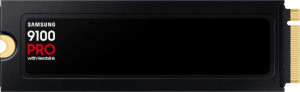
Samsung 9100 Pro 1TB
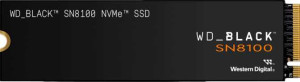
Western Digital WD Black SN8100 1TB

Samsung 9100 Pro 1TB Western Digital WD Black SN8100 1TB

Overview

When choosing between the Samsung 9100 Pro 1TB and the Western Digital WD Black SN8100 1TB, you are looking at two of the most capable PCIe 5.0 NVMe SSDs on the market today. Both drives share a strong common foundation, yet they diverge in meaningful ways across sequential and random performance, controller design, and long-term reliability ratings. This comparison breaks down every key specification to help you decide which drive truly fits your needs.

Common Features

  • Both drives use the M2 form factor.
  • Both drives feature a DRAM cache.
  • Both drives are NVMe SSDs.
  • Both drives use NVMe version 2.
  • Both drives offer 1000GB of internal storage.
  • Both drives use TLC NAND flash storage.
  • Both drives use PCIe version 5.
  • Both drives have 8 controller channels.

Main Differences

  • Sequential read speed is 14700 MB/s on Samsung 9100 Pro 1TB and 14900 MB/s on Western Digital WD Black SN8100 1TB.
  • Random read speed is 1850000 IOPS on Samsung 9100 Pro 1TB and 1600000 IOPS on Western Digital WD Black SN8100 1TB.
  • Sequential write speed is 13300 MB/s on Samsung 9100 Pro 1TB and 11000 MB/s on Western Digital WD Black SN8100 1TB.
  • Random write speed is 2600000 IOPS on Samsung 9100 Pro 1TB and 2400000 IOPS on Western Digital WD Black SN8100 1TB.
  • PassMark result is 81351 on Samsung 9100 Pro 1TB and 79571 on Western Digital WD Black SN8100 1TB.
  • The controller is the Samsung Presto (S4LY027) on Samsung 9100 Pro 1TB and the Silicon Motion SM2508 on Western Digital WD Black SN8100 1TB.
  • MTBF is 1.5 million hours on Samsung 9100 Pro 1TB and 1.8 million hours on Western Digital WD Black SN8100 1TB.
Specs Comparison
Samsung 9100 Pro 1TB

Samsung 9100 Pro 1TB

Western Digital WD Black SN8100 1TB

Western Digital WD Black SN8100 1TB

Read speed:
sequential read speed 14700 MB/s 14900 MB/s
random read speed 1850000 IOPS 1600000 IOPS

Both drives operate at the very top of consumer NVMe performance, with sequential read speeds of 14700 MB/s (Samsung 9100 Pro) and 14900 MB/s (WD Black SN8100) — a difference of just 200 MB/s, or roughly 1.4%. In practice, this gap is imperceptible during everyday workloads like booting an OS, launching applications, or transferring large files. Both figures far exceed what most workflows can saturate, meaning real-world sequential read performance is effectively a tie.

The more meaningful differentiator is random read performance. The Samsung 9100 Pro reaches 1,850,000 IOPS versus the WD Black SN8100′s 1,600,000 IOPS — a 15.6% advantage for Samsung. Random IOPS governs responsiveness under mixed, unpredictable workloads: database queries, virtualization, loading game assets with many small files, or multitasking across numerous open applications. A 250K IOPS lead is substantial enough to produce measurable latency differences in these scenarios, not just benchmark headroom.

Overall, the Samsung 9100 Pro holds a clear edge in this group. While both drives are essentially matched on sequential reads, Samsung′s significantly higher random read IOPS makes it the stronger performer for real-world, latency-sensitive tasks where storage responsiveness is the bottleneck.

Write speed:
sequential write speed 13300 MB/s 11000 MB/s
random write speed 2600000 IOPS 2400000 IOPS

Write speed is where the Samsung 9100 Pro pulls ahead more decisively. Its sequential write speed of 13300 MB/s outpaces the WD Black SN8100′s 11000 MB/s by over 20% — a gap large enough to matter when moving massive files, writing large game installs, or capturing high-bitrate video directly to the drive. For users who regularly push data onto the drive rather than just reading from it, this is a tangible real-world difference.

Random write IOPS are closer but still favor Samsung: 2,600,000 IOPS versus 2,400,000 IOPS for the SN8100, an 8.3% lead. Random writes drive performance in write-heavy sustained workloads like compiling large codebases, running virtual machines with active disk I/O, or operating as a cache or scratch disk. The gap here is less dramatic than in sequential writes, but it consistently points in the same direction.

The Samsung 9100 Pro takes a clear win in this group. The sequential write advantage is significant enough to affect real workflows, and the random write lead, while more modest, reinforces the same conclusion. The WD Black SN8100 remains competitive, but it cannot match Samsung′s write throughput at this capacity tier.

Benchmarks:
PassMark result 81351 79571

PassMark scores synthesize a range of read, write, and seek performance tests into a single composite number, making them a useful cross-check against individual spec claims. Here, the Samsung 9100 Pro scores 81,351 against the WD Black SN8100′s 79,571 — a difference of roughly 2.2%. That margin is narrow, but it is consistent with the pattern seen in the raw specs: Samsung leads across most performance dimensions, and that aggregate advantage is reflected here.

A gap of this size in PassMark typically falls within the range where real-world perceptibility is minimal for general use. However, it does confirm that Samsung′s leads in write speed and random read IOPS are not offset by weaknesses elsewhere — the overall performance profile holds up under a standardized, holistic test rather than only in isolated metrics.

The Samsung 9100 Pro edges out the SN8100 here, but the margin is slim enough that this benchmark alone would not be decisive. Its value is in corroborating the broader picture: Samsung is the more consistent all-around performer, while the WD Black SN8100 trails slightly but remains firmly in the same performance tier.

General info:
type M2 M2
SSD cache DRAM cache DRAM cache
Is an NVMe SSD
NVMe version 2 2
internal storage 1000GB 1000GB
release date February 2025 May 2025
controller Samsung Presto (S4LY027) Silicon Motion SM2508
SSD storage type TLC TLC
PCI Express (PCIe) version 5 5
Controller channels 8 8
Terabytes Written (TBW) 600 600
MTBF 1.5million hours 1.8million hours
warranty period 5 years 5 years
Has an integrated heatsink
has RGB lighting

At the platform level, these two drives are remarkably alike. Both use the M.2 form factor with PCIe 5.0 and NVMe 2.0, both pair TLC NAND with a DRAM cache, both offer 8 controller channels, and both carry identical 600 TBW endurance ratings and 5-year warranties. For a buyer evaluating foundation-level compatibility and longevity guarantees, there is nothing to separate them.

The one meaningful differentiator in this group is reliability rating. The WD Black SN8100 claims an MTBF of 1.8 million hours versus the Samsung 9100 Pro′s 1.5 million hours — a 20% higher figure. MTBF is a statistical projection rather than a guaranteed lifespan, but a gap of this magnitude does suggest WD′s validation testing targets a higher threshold of long-term operational stability. For use cases involving continuous uptime — such as a NAS, a workstation running 24/7, or a drive in a light server role — this distinction is worth noting.

The controller difference (Samsung′s in-house Presto versus Silicon Motion′s SM2508) is architecturally significant in terms of design philosophy, but its real-world impact is better reflected in the performance numbers than in this group′s specs alone. On general info, the WD Black SN8100 earns a narrow edge solely due to its higher MTBF rating; all other specs are a dead heat.

Comparison Summary & Verdict

Both the Samsung 9100 Pro 1TB and the Western Digital WD Black SN8100 1TB are high-end PCIe 5.0 NVMe drives sharing the same form factor, TLC NAND, DRAM cache, and 8-channel architecture. The Samsung 9100 Pro 1TB pulls ahead in sequential write speed (13300 MB/s vs 11000 MB/s) and both random read and write IOPS, making it the stronger choice for workloads that demand sustained write throughput and high random performance. The Western Digital WD Black SN8100 1TB counters with a slightly faster sequential read speed and a notably higher MTBF of 1.8 million hours versus 1.5 million hours, suggesting an edge in long-term reliability. Choose the Samsung if raw write performance is your priority; choose the WD Black if drive longevity and sequential read speed matter most to you.

Samsung 9100 Pro 1TB
Buy Samsung 9100 Pro 1TB if...

Buy the Samsung 9100 Pro 1TB if you prioritize superior sequential and random write speeds, making it ideal for heavy content creation or data-intensive workloads.

Western Digital WD Black SN8100 1TB
Buy Western Digital WD Black SN8100 1TB if...

Buy the Western Digital WD Black SN8100 1TB if long-term drive reliability and a higher MTBF rating are your top concerns, with no meaningful sacrifice in sequential read performance.