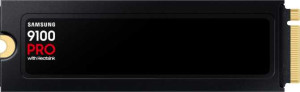
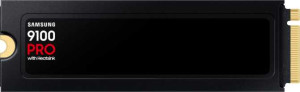
Samsung 9100 Pro 2TB
Samsung 9100 Pro 4TB

Samsung 9100 Pro 2TB Samsung 9100 Pro 4TB

Overview

When choosing between the Samsung 9100 Pro 2TB and the Samsung 9100 Pro 4TB, the decision goes well beyond raw capacity. Both drives are built on the same cutting-edge PCIe 5.0 NVMe 2 platform and share identical write performance, yet notable differences emerge in random read speeds and endurance ratings. Read on to explore how these two flagship SSDs compare across every key specification to help you find the right fit.

Common Features

  • Sequential write speed is 13400 MB/s on both Samsung 9100 Pro 2TB and Samsung 9100 Pro 4TB.
  • Random write speed is 2600000 IOPS on both Samsung 9100 Pro 2TB and Samsung 9100 Pro 4TB.
  • Both Samsung 9100 Pro 2TB and Samsung 9100 Pro 4TB use the M.2 form factor.
  • Both Samsung 9100 Pro 2TB and Samsung 9100 Pro 4TB are equipped with a DRAM cache.
  • Both Samsung 9100 Pro 2TB and Samsung 9100 Pro 4TB are NVMe SSDs.
  • Both Samsung 9100 Pro 2TB and Samsung 9100 Pro 4TB support NVMe version 2.
  • Both Samsung 9100 Pro 2TB and Samsung 9100 Pro 4TB use the Samsung Presto (S4LY027) controller.
  • Both Samsung 9100 Pro 2TB and Samsung 9100 Pro 4TB use TLC NAND flash storage.
  • Both Samsung 9100 Pro 2TB and Samsung 9100 Pro 4TB use PCIe version 5.
  • Both Samsung 9100 Pro 2TB and Samsung 9100 Pro 4TB have 8 controller channels.

Main Differences

  • Sequential read speed is 14700 MB/s on Samsung 9100 Pro 2TB and 14800 MB/s on Samsung 9100 Pro 4TB.
  • Random read speed is 1850000 IOPS on Samsung 9100 Pro 2TB and 2200000 IOPS on Samsung 9100 Pro 4TB.
  • Internal storage capacity is 2000 GB on Samsung 9100 Pro 2TB and 4000 GB on Samsung 9100 Pro 4TB.
  • Terabytes Written (TBW) endurance rating is 1200 TBW on Samsung 9100 Pro 2TB and 2400 TBW on Samsung 9100 Pro 4TB.
Specs Comparison
Samsung 9100 Pro 2TB

Samsung 9100 Pro 2TB

Samsung 9100 Pro 4TB

Samsung 9100 Pro 4TB

Read speed:
sequential read speed 14700 MB/s 14800 MB/s
random read speed 1850000 IOPS 2200000 IOPS

In sequential read performance, the two drives are essentially neck-and-neck: the 4TB model edges ahead at 14800 MB/s versus 14700 MB/s for the 2TB. A 100 MB/s gap at this tier is negligible in practice — both drives will saturate the PCIe 5.0 interface and deliver near-identical throughput when transferring large files like video assets, disk images, or game installs.

The more meaningful differentiator lies in random read performance. The 4TB variant delivers 2,200,000 IOPS compared to 1,850,000 IOPS on the 2TB — roughly a 19% advantage. Random read IOPS directly governs how quickly a drive handles the small, scattered read requests that dominate real workloads: OS boot sequences, application launches, database queries, and loading many small game assets simultaneously. That gap is large enough to produce a perceptible difference under sustained multitasking or in latency-sensitive professional environments.

Overall, the 4TB model holds a clear edge in read performance, driven almost entirely by its superior random read throughput. For users whose workloads are dominated by large sequential transfers — video editing with a single timeline, for instance — the difference will be barely felt. But for power users, content creators juggling many assets, or anyone running NVMe-intensive software, the 4TB's random read advantage translates into a meaningfully snappier experience.

Write speed:
sequential write speed 13400 MB/s 13400 MB/s
random write speed 2600000 IOPS 2600000 IOPS

Write speed is where these two drives converge entirely. Both the 2TB and 4TB models post identical figures across the board: 13400 MB/s sequential write and 2,600,000 IOPS random write. There is no ambiguity here — this is a flat tie, and no purchasing decision should hinge on write performance alone.

Those shared numbers are nonetheless impressive in absolute terms. A sequential write speed of 13400 MB/s means ingesting massive files — raw 8K footage, large virtual machine snapshots, or bulk data backups — at rates that would have been unthinkable on consumer hardware just a few years ago. Meanwhile, 2.6 million random write IOPS ensures the drive remains fluid under the kind of chaotic, mixed-workload conditions that stress lesser NVMe drives: compiling large codebases, running virtual machines, or handling simultaneous read/write operations during content creation pipelines.

With write performance as an equal between the two, it becomes a non-factor in differentiating them. Buyers should weigh other spec groups — particularly the random read advantage seen in the 4TB — when making their final decision.

General info:
type M2 M2
SSD cache DRAM cache DRAM cache
Is an NVMe SSD
NVMe version 2 2
internal storage 2000GB 4000GB
release date February 2025 February 2025
controller Samsung Presto (S4LY027) Samsung Presto (S4LY027)
SSD storage type TLC TLC
PCI Express (PCIe) version 5 5
Controller channels 8 8
Terabytes Written (TBW) 1200 2400
MTBF 1.5million hours 1.5million hours
warranty period 5 years 5 years
Has an integrated heatsink
bits of encryption supported 256 256
has RGB lighting

At their core, these two drives share the same fundamental architecture: the Samsung Presto (S4LY027) controller with 8 channels, PCIe 5.0 interface, NVMe 2.0 protocol, TLC NAND with a DRAM cache, and an M.2 form factor. This is not a case of Samsung binning different silicon for different capacities — both drives are built on an identical platform, which explains the near-parity in raw performance metrics seen across other spec groups.

The one area where the two genuinely diverge is endurance. The 4TB model carries a TBW rating of 2400, exactly double the 1200 TBW of the 2TB. This is expected — more NAND cells means more distributed write cycles — but the practical implication is significant for write-intensive users. Professionals doing daily large-file ingestion, heavy virtualization, or continuous logging workloads will find the 4TB's endurance headroom considerably more comfortable over a multi-year lifespan. For typical consumer workloads, 1200 TBW remains generous, but the gap is real and worth factoring in for longevity.

Everything else — the 1.5 million hour MTBF, 5-year warranty, 256-bit encryption, and absence of a heatsink — is identical. The 4TB holds a structural advantage here purely by virtue of its doubled endurance rating, making it the stronger long-term proposition for users who push their storage hard.

Comparison Summary & Verdict

Having examined all available specifications, both the Samsung 9100 Pro 2TB and the Samsung 9100 Pro 4TB share the same strong foundation: identical sequential and random write speeds, the same Samsung Presto controller, PCIe 5.0 interface, NVMe 2 support, and TLC NAND with DRAM cache. The distinctions, however, are significant. The 4TB model edges ahead with a higher random read speed of 2,200,000 IOPS compared to 1,850,000 IOPS, doubles the TBW endurance rating to 2,400 TBW, and naturally offers twice the storage capacity. The Samsung 9100 Pro 2TB is an excellent pick for users who need a blazing-fast NVMe 5.0 drive at a more moderate capacity, while the Samsung 9100 Pro 4TB is the stronger choice for professionals and power users who require maximum storage space, superior read throughput, and long-term endurance.

Samsung 9100 Pro 2TB
Buy Samsung 9100 Pro 2TB if...

Buy the Samsung 9100 Pro 2TB if 2TB of storage meets your needs and you want a top-tier PCIe 5.0 NVMe SSD without requiring the highest endurance rating.

Samsung 9100 Pro 4TB
Buy Samsung 9100 Pro 4TB if...

Buy the Samsung 9100 Pro 4TB if you need double the storage capacity, a higher random read speed of 2,200,000 IOPS, and a significantly greater endurance rating of 2,400 TBW.