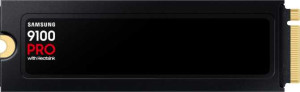
Samsung 9100 Pro 2TB
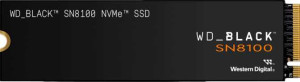
Western Digital WD Black SN8100 1TB

Samsung 9100 Pro 2TB Western Digital WD Black SN8100 1TB

Overview

Welcome to our in-depth spec comparison between the Samsung 9100 Pro 2TB and the Western Digital WD Black SN8100 1TB, two of the most powerful PCIe 5.0 NVMe SSDs available today. Both drives share a strong foundation — M2 form factor, DRAM cache, TLC NAND, and a 5-year warranty — but they diverge in meaningful ways when it comes to storage capacity, write performance, and endurance ratings. Read on to see which drive best fits your needs.

Common Features

  • Both drives use the M2 form factor.
  • Both drives feature a DRAM cache.
  • Both drives are NVMe SSDs.
  • Both drives use NVMe version 2.
  • Both drives use TLC NAND storage.
  • Both drives use PCIe version 5.
  • Both drives have 8 controller channels.
  • Both drives come with a 5-year warranty.

Main Differences

  • Sequential read speed is 14700 MB/s on Samsung 9100 Pro 2TB and 14900 MB/s on Western Digital WD Black SN8100 1TB.
  • Random read speed is 1850000 IOPS on Samsung 9100 Pro 2TB and 1600000 IOPS on Western Digital WD Black SN8100 1TB.
  • Sequential write speed is 13400 MB/s on Samsung 9100 Pro 2TB and 11000 MB/s on Western Digital WD Black SN8100 1TB.
  • Random write speed is 2600000 IOPS on Samsung 9100 Pro 2TB and 2400000 IOPS on Western Digital WD Black SN8100 1TB.
  • Internal storage capacity is 2000GB on Samsung 9100 Pro 2TB and 1000GB on Western Digital WD Black SN8100 1TB.
  • The controller is Samsung Presto (S4LY027) on Samsung 9100 Pro 2TB and Silicon Motion SM2508 on Western Digital WD Black SN8100 1TB.
  • Terabytes Written (TBW) is 1200 TB on Samsung 9100 Pro 2TB and 600 TB on Western Digital WD Black SN8100 1TB.
  • MTBF is 1.5 million hours on Samsung 9100 Pro 2TB and 1.8 million hours on Western Digital WD Black SN8100 1TB.
Specs Comparison
Samsung 9100 Pro 2TB

Samsung 9100 Pro 2TB

Western Digital WD Black SN8100 1TB

Western Digital WD Black SN8100 1TB

Read speed:
sequential read speed 14700 MB/s 14900 MB/s
random read speed 1850000 IOPS 1600000 IOPS

Both drives operate at the absolute frontier of consumer NVMe performance, and the headline sequential read figures are virtually neck-and-neck: the WD Black SN8100 1TB edges ahead at 14900 MB/s versus 14700 MB/s for the Samsung 9100 Pro 2TB — a gap of roughly 1.4% that will be imperceptible in any real-world transfer scenario.

The more meaningful differentiator lies in random read performance, where the roles reverse. The Samsung 9100 Pro pulls ahead with 1,850,000 IOPS compared to the SN8100's 1,600,000 IOPS — a gap of approximately 16%. Random IOPS governs how quickly a drive handles the thousands of small, scattered read requests that dominate everyday workloads: OS boot, application launches, game level loading, and database queries. A 250,000 IOPS advantage here translates to a noticeably snappier feel under mixed, real-world conditions far more than any sequential speed difference would.

In this group, the verdict depends on the use case. For large sequential transfers — think video editing with multi-gigabyte files — both drives are effectively tied. But for latency-sensitive or heavily multitasked workloads, the Samsung 9100 Pro holds a clear and practical edge in random read performance.

Write speed:
sequential write speed 13400 MB/s 11000 MB/s
random write speed 2600000 IOPS 2400000 IOPS

Write performance is where the Samsung 9100 Pro 2TB opens up a more decisive lead. Its sequential write speed of 13400 MB/s outpaces the WD Black SN8100 1TB's 11000 MB/s by roughly 22% — a gap substantial enough to matter when ingesting large volumes of data, such as recording high-bitrate video, copying large backups, or compiling sizeable codebases.

On the random write side, the Samsung again leads with 2,600,000 IOPS versus 2,400,000 IOPS for the SN8100 — an 8% advantage. While less dramatic than the sequential gap, higher random write IOPS directly benefits workloads that continuously scatter small writes across the drive, such as virtual machine operation, database transactions, and active swap usage under memory pressure. Sustained responsiveness under these conditions is where that margin becomes tangible.

Across both write metrics, the Samsung 9100 Pro holds a clear advantage in this group. The sequential gap is large enough to have a real impact for content creators and power users who frequently write large files, while the random write lead adds a secondary edge for sustained, mixed-workload scenarios.

General info:
type M2 M2
SSD cache DRAM cache DRAM cache
Is an NVMe SSD
NVMe version 2 2
internal storage 2000GB 1000GB
release date February 2025 May 2025
controller Samsung Presto (S4LY027) Silicon Motion SM2508
SSD storage type TLC TLC
PCI Express (PCIe) version 5 5
Controller channels 8 8
Terabytes Written (TBW) 1200 600
MTBF 1.5million hours 1.8million hours
warranty period 5 years 5 years
Has an integrated heatsink
has RGB lighting

At their architectural core, these two drives share the same fundamental blueprint: both are M.2 PCIe 5.0 NVMe 2.0 SSDs with DRAM cache, TLC NAND, and an 8-channel controller. That common foundation means neither has a structural advantage in terms of interface or cache design — the performance differences seen elsewhere in this comparison come down to controller implementation and firmware tuning rather than any fundamental architectural gap.

The most consequential divergence in this group is endurance. With a TBW rating of 1200, the Samsung 9100 Pro 2TB offers double the rated write endurance of the SN8100's 600 TBW — though it's worth noting the Samsung also has twice the storage capacity, so on a per-terabyte basis both drives rate at 600 TBW/TB, making endurance proportionally equivalent. The reliability picture shifts slightly when looking at MTBF: the WD Black SN8100 is rated to 1.8 million hours versus 1.5 million hours for the Samsung — a modest but real edge in theoretical long-term reliability for the WD drive.

Both carry a 5-year warranty and neither includes an integrated heatsink, so thermal management is equally the user's responsibility in both cases. Overall, this group reveals two well-matched drives with no dramatic general-spec advantage on either side — the Samsung's capacity and raw TBW lead is offset by its smaller MTBF figure, leaving this category effectively balanced for most buyers.

Comparison Summary & Verdict

After examining all the specifications, both the Samsung 9100 Pro 2TB and the Western Digital WD Black SN8100 1TB are elite PCIe 5.0 drives sharing the same generational platform, yet each has a distinct edge. The Samsung 9100 Pro 2TB pulls ahead in sequential and random write speeds and offers double the storage capacity alongside a significantly higher TBW endurance rating of 1200 TB, making it the stronger choice for heavy workloads and long-term reliability. The WD Black SN8100 1TB counters with a slightly faster sequential read speed and a superior MTBF of 1.8 million hours, suggesting strong hardware reliability for read-intensive tasks. Choose based on your workload priorities and capacity requirements.

Samsung 9100 Pro 2TB
Buy Samsung 9100 Pro 2TB if...

Buy the Samsung 9100 Pro 2TB if you need more storage capacity, higher write speeds, and greater long-term endurance with a TBW rating of 1200 TB.

Western Digital WD Black SN8100 1TB
Buy Western Digital WD Black SN8100 1TB if...

Buy the Western Digital WD Black SN8100 1TB if you prioritize a slightly higher sequential read speed and a superior MTBF reliability rating of 1.8 million hours.