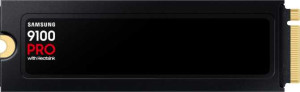
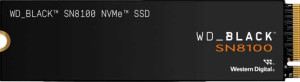
Samsung 9100 Pro 2TB
Western Digital WD Black SN8100 2TB

Samsung 9100 Pro 2TB Western Digital WD Black SN8100 2TB

Overview

When two flagship PCIe 5.0 NVMe drives go head-to-head, the details matter. This page compares the Samsung 9100 Pro 2TB and the Western Digital WD Black SN8100 2TB across their full specification sheets, putting the spotlight on areas like sequential and random performance, controller choice, and long-term reliability. Both drives share a strong common foundation, making the finer differences all the more decisive for buyers chasing peak performance.

Common Features

  • Both drives use the M.2 form factor.
  • Both drives include a DRAM cache.
  • Both drives are NVMe SSDs.
  • Both drives use NVMe version 2.
  • Both drives offer 2000GB of internal storage.
  • Both drives use TLC NAND flash storage.
  • Both drives use PCIe version 5.
  • Both drives feature an 8-channel controller.

Main Differences

  • Sequential read speed is 14700 MB/s on Samsung 9100 Pro 2TB and 14900 MB/s on Western Digital WD Black SN8100 2TB.
  • Random read speed is 1850000 IOPS on Samsung 9100 Pro 2TB and 2300000 IOPS on Western Digital WD Black SN8100 2TB.
  • Sequential write speed is 13400 MB/s on Samsung 9100 Pro 2TB and 14000 MB/s on Western Digital WD Black SN8100 2TB.
  • Random write speed is 2600000 IOPS on Samsung 9100 Pro 2TB and 2300000 IOPS on Western Digital WD Black SN8100 2TB.
  • The controller is the Samsung Presto (S4LY027) on Samsung 9100 Pro 2TB and the Silicon Motion SM2508 on Western Digital WD Black SN8100 2TB.
  • MTBF is 1.5 million hours on Samsung 9100 Pro 2TB and 1.8 million hours on Western Digital WD Black SN8100 2TB.
Specs Comparison
Samsung 9100 Pro 2TB

Samsung 9100 Pro 2TB

Western Digital WD Black SN8100 2TB

Western Digital WD Black SN8100 2TB

Read speed:
sequential read speed 14700 MB/s 14900 MB/s
random read speed 1850000 IOPS 2300000 IOPS

Both drives operate at the absolute cutting edge of consumer NVMe storage, with sequential read speeds so close — 14700 MB/s for the Samsung 9100 Pro versus 14900 MB/s for the WD Black SN8100 — that the difference is effectively imperceptible in everyday use. Large file transfers, game load times, and OS boot sequences will feel identical between the two.

The more meaningful gap emerges in random read performance, where the SN8100 pulls ahead with 2,300,000 IOPS compared to the 9100 Pro's 1,850,000 IOPS — a roughly 24% advantage. Random IOPS governs how quickly a drive handles the small, scattered read requests typical of multitasking, database access, and loading asset-heavy applications. In practice, this gives the SN8100 a tangible edge in workstation and productivity workloads where many small files are accessed simultaneously.

Overall, the WD Black SN8100 holds a clear edge in this group. While sequential speeds are essentially tied, its substantially higher random read throughput makes it the stronger performer for demanding, real-world workloads beyond simple linear transfers.

Write speed:
sequential write speed 13400 MB/s 14000 MB/s
random write speed 2600000 IOPS 2300000 IOPS

Write performance tells an interesting story here because the two drives trade blows depending on the workload type. The SN8100 leads in sequential writes at 14000 MB/s versus the 9100 Pro's 13400 MB/s — a roughly 4% difference that matters most when dumping large files to disk, such as video editing exports or full drive backups.

Flip to random writes, however, and the 9100 Pro takes a notable lead: 2,600,000 IOPS against the SN8100's 2,300,000 IOPS, a gap of around 13%. Random write IOPS directly impacts how a drive handles sustained mixed workloads — think compiling large codebases, writing database transactions, or running virtual machines — where the drive must constantly juggle many small write operations rather than one continuous stream.

This group ends in a genuine split: the SN8100 wins on sequential writes while the 9100 Pro holds the advantage in random write performance. Users who primarily move large files will favor the SN8100, while those running write-intensive, latency-sensitive workloads will benefit more from the 9100 Pro's higher IOPS ceiling.

General info:
type M2 M2
SSD cache DRAM cache DRAM cache
Is an NVMe SSD
NVMe version 2 2
internal storage 2000GB 2000GB
release date February 2025 May 2025
controller Samsung Presto (S4LY027) Silicon Motion SM2508
SSD storage type TLC TLC
PCI Express (PCIe) version 5 5
Controller channels 8 8
Terabytes Written (TBW) 1200 1200
MTBF 1.5million hours 1.8million hours
warranty period 5 years 5 years
Has an integrated heatsink
has RGB lighting

At the architectural level, these two drives are remarkably well-matched. Both are M.2 NVMe SSDs on PCIe 5.0 with NVMe 2.0, DRAM cache, TLC NAND, 8-channel controllers, and identical 1200 TBW endurance ratings — meaning neither drive has a structural advantage in terms of how long its cells are rated to last under write-heavy workloads.

The one meaningful differentiator in this group is reliability headroom: the SN8100 carries an MTBF rating of 1.8 million hours compared to the 9100 Pro's 1.5 million hours. MTBF is a statistical measure of expected component reliability under normal operating conditions, and a 20% higher figure suggests the SN8100 is rated for a somewhat more robust operational lifespan — a consideration worth noting for always-on workstation or NAS-adjacent deployments.

Both drives share the same warranty period, form factor, and core technology stack, so for most buyers the general specs are essentially a wash. The SN8100 earns a narrow edge here solely on the basis of its higher MTBF rating, though in typical consumer or prosumer use, neither drive is likely to approach either limit.

Comparison Summary & Verdict

Both the Samsung 9100 Pro 2TB and the Western Digital WD Black SN8100 2TB are built on an identical foundation: PCIe 5.0, NVMe 2, M.2 form factor, TLC NAND, DRAM cache, and 8-channel controllers. Where they diverge is telling. The WD Black SN8100 2TB leads in sequential read and write speeds as well as random read IOPS, and posts a notably higher MTBF of 1.8 million hours, making it the stronger pick for users who prioritize sustained throughput and long-term durability. The Samsung 9100 Pro 2TB, however, holds a clear edge in random write performance at 2,600,000 IOPS, which benefits workloads involving frequent small-file writes. Choose the Samsung if your workload is write-intensive at the random level; choose the WD Black SN8100 if all-around speed and reliability are your top priorities.

Samsung 9100 Pro 2TB
Buy Samsung 9100 Pro 2TB if...

Buy the Samsung 9100 Pro 2TB if your workload involves heavy random write operations, where its 2,600,000 IOPS random write speed gives it a clear lead over the competition.

Western Digital WD Black SN8100 2TB
Buy Western Digital WD Black SN8100 2TB if...

Buy the Western Digital WD Black SN8100 2TB if you want the fastest sequential and random read performance, higher sequential write speeds, and greater long-term reliability backed by a 1.8 million hour MTBF rating.