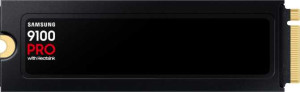
Samsung 9100 Pro 2TB (With Heatsink)
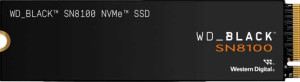
Western Digital WD Black SN8100 2TB

Samsung 9100 Pro 2TB (With Heatsink) Western Digital WD Black SN8100 2TB

Common Features

  • Both products use the M2 form factor.
  • Both products include a DRAM cache.
  • Both products are NVMe SSDs.
  • Both products support NVMe version 2.
  • Both products offer 2000GB of internal storage.
  • Both products use TLC NAND storage type.
  • Both products use PCIe version 5.
  • Both products feature an 8-channel controller.

Main Differences

  • Sequential read speed is 14700 MB/s on Samsung 9100 Pro 2TB (With Heatsink) and 14900 MB/s on Western Digital WD Black SN8100 2TB.
  • Random read speed is 1850000 IOPS on Samsung 9100 Pro 2TB (With Heatsink) and 2300000 IOPS on Western Digital WD Black SN8100 2TB.
  • Sequential write speed is 13400 MB/s on Samsung 9100 Pro 2TB (With Heatsink) and 14000 MB/s on Western Digital WD Black SN8100 2TB.
  • Random write speed is 2600000 IOPS on Samsung 9100 Pro 2TB (With Heatsink) and 2300000 IOPS on Western Digital WD Black SN8100 2TB.
  • The controller is Samsung Presto (S4LY027) on Samsung 9100 Pro 2TB (With Heatsink) and Silicon Motion SM2508 on Western Digital WD Black SN8100 2TB.
  • MTBF is 1.5 million hours on Samsung 9100 Pro 2TB (With Heatsink) and 1.8 million hours on Western Digital WD Black SN8100 2TB.
  • An integrated heatsink is included on Samsung 9100 Pro 2TB (With Heatsink) but is not present on Western Digital WD Black SN8100 2TB.
Specs Comparison
Samsung 9100 Pro 2TB (With Heatsink)

Samsung 9100 Pro 2TB (With Heatsink)

Western Digital WD Black SN8100 2TB

Western Digital WD Black SN8100 2TB

Read speed:
sequential read speed 14700 MB/s 14900 MB/s
random read speed 1850000 IOPS 2300000 IOPS

Both drives operate at the very top of the consumer NVMe performance spectrum. Sequential read speeds are virtually identical — 14,900 MB/s for the WD Black SN8100 versus 14,700 MB/s for the Samsung 9100 Pro — a difference of roughly 1.4% that will never be perceptible in real-world large-file transfers.

The more meaningful gap appears in random read performance, which governs how fast a drive handles the small, scattered reads typical of OS boot times, application launches, and game asset streaming. The SN8100 reaches 2,300,000 IOPS compared to the 9100 Pro's 1,850,000 IOPS — a 24% lead that is substantial enough to translate into a tangible responsiveness advantage under mixed, everyday workloads.

For sequential throughput alone the two drives are effectively tied. But on random reads, the WD Black SN8100 holds a clear and meaningful edge, making it the stronger choice for users whose workloads involve frequent small-file access rather than purely linear data transfers.

Write speed:
sequential write speed 13400 MB/s 14000 MB/s
random write speed 2600000 IOPS 2300000 IOPS

Write performance tells an interesting story here because the two drives trade blows depending on the metric. The SN8100 pulls ahead in sequential writes at 14,000 MB/s versus 13,400 MB/s for the Samsung 9100 Pro — a roughly 4.5% advantage that is modest but consistent, benefiting workloads like large video exports, disk imaging, or bulk file copies where sustained throughput is the bottleneck.

Flip to random writes, however, and the 9100 Pro reasserts itself with a notable lead: 2,600,000 IOPS against the SN8100's 2,300,000 IOPS — a 13% difference. Random write IOPS directly influence how snappy a drive feels during database operations, compiling code, or any scenario involving frequent small writes scattered across the drive's address space.

This group produces no single outright winner — the result depends entirely on workload type. The WD Black SN8100 is the better sequential write performer, making it more appealing for content creators moving large files. The Samsung 9100 Pro has the random write advantage, giving it an edge for power users running write-intensive applications or development environments.

General info:
type M2 M2
SSD cache DRAM cache DRAM cache
Is an NVMe SSD
NVMe version 2 2
internal storage 2000GB 2000GB
release date February 2025 May 2025
controller Samsung Presto (S4LY027) Silicon Motion SM2508
SSD storage type TLC TLC
PCI Express (PCIe) version 5 5
Controller channels 8 8
Terabytes Written (TBW) 1200 1200
MTBF 1.5million hours 1.8million hours
warranty period 5 years 5 years
Has an integrated heatsink
has RGB lighting

At the platform level, these two drives are nearly identical twins: both are M.2 PCIe 5.0 NVMe 2.0 SSDs with DRAM cache, TLC NAND, 8 controller channels, and a matched 1,200 TBW endurance rating with a 5-year warranty. For most buyers, that shared foundation means long-term durability and write endurance are a wash.

The differences worth noting are reliability rating and thermal solution. The SN8100 carries a higher MTBF of 1.8 million hours versus 1.5 million hours for the Samsung 9100 Pro — a 20% gap that is meaningful for enterprise-adjacent workloads or users who prioritize longevity assurance, even if neither drive is likely to approach those figures in consumer use. On the flip side, the 9100 Pro ships with an integrated heatsink while the SN8100 does not — a practical advantage for systems with limited airflow or motherboards lacking their own M.2 thermal pads, since PCIe 5.0 drives generate significant heat under sustained load.

Neither product holds a sweeping general advantage. The SN8100 edges ahead on rated reliability, while the Samsung 9100 Pro (With Heatsink) offers out-of-the-box thermal management that can preserve sustained performance in thermally constrained builds — a consideration as important as raw specs for real-world consistency.

Comparison Summary & Verdict

This is a specification comparison between Samsung 9100 Pro 2TB (With Heatsink) and Western Digital WD Black SN8100 2TB. Both products are M2 type SSDs with DRAM cache, and support PCI Express (PCIe) version 5. The Samsung model has a sequential read speed of 14700 MB/s and a random write speed of 2600000 IOPS, while the Western Digital model features a slightly higher sequential read speed of 14900 MB/s, but a lower random write speed of 2300000 IOPS. The controller on the Samsung is Samsung Presto (S4LY027), while the Western Digital uses Silicon Motion SM2508. Additionally, the Samsung 9100 Pro includes an integrated heatsink, which the Western Digital WD Black SN8100 lacks.