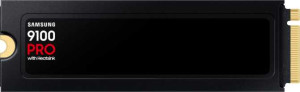
Samsung 9100 Pro 4TB
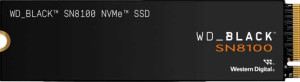
Western Digital WD Black SN8100 2TB

Samsung 9100 Pro 4TB Western Digital WD Black SN8100 2TB

Overview

Welcome to our in-depth specification comparison between the Samsung 9100 Pro 4TB and the Western Digital WD Black SN8100 2TB — two of the most powerful PCIe 5.0 NVMe SSDs on the market. Both drives share a strong common foundation, yet they diverge in meaningful ways across sequential and random performance, storage capacity, endurance ratings, and controller choices. Read on to see how these flagship drives stack up against each other.

Common Features

  • Both drives use the M.2 form factor.
  • Both drives are equipped with a DRAM cache.
  • Both drives are NVMe SSDs.
  • Both drives support NVMe version 2.
  • Both drives use TLC NAND flash storage.
  • Both drives use PCI Express (PCIe) version 5.
  • Both drives have 8 controller channels.
  • Both drives come with a 5-year warranty.

Main Differences

  • Sequential read speed is 14800 MB/s on Samsung 9100 Pro 4TB and 14900 MB/s on Western Digital WD Black SN8100 2TB.
  • Random read speed is 2200000 IOPS on Samsung 9100 Pro 4TB and 2300000 IOPS on Western Digital WD Black SN8100 2TB.
  • Sequential write speed is 13400 MB/s on Samsung 9100 Pro 4TB and 14000 MB/s on Western Digital WD Black SN8100 2TB.
  • Random write speed is 2600000 IOPS on Samsung 9100 Pro 4TB and 2300000 IOPS on Western Digital WD Black SN8100 2TB.
  • Internal storage capacity is 4000 GB on Samsung 9100 Pro 4TB and 2000 GB on Western Digital WD Black SN8100 2TB.
  • The controller is Samsung Presto (S4LY027) on Samsung 9100 Pro 4TB and Silicon Motion SM2508 on Western Digital WD Black SN8100 2TB.
  • Terabytes Written (TBW) endurance rating is 2400 TBW on Samsung 9100 Pro 4TB and 1200 TBW on Western Digital WD Black SN8100 2TB.
  • MTBF is 1.5 million hours on Samsung 9100 Pro 4TB and 1.8 million hours on Western Digital WD Black SN8100 2TB.
Specs Comparison
Samsung 9100 Pro 4TB

Samsung 9100 Pro 4TB

Western Digital WD Black SN8100 2TB

Western Digital WD Black SN8100 2TB

Read speed:
sequential read speed 14800 MB/s 14900 MB/s
random read speed 2200000 IOPS 2300000 IOPS

Both drives operate at the absolute frontier of consumer NVMe performance, and the raw numbers reflect that. The WD Black SN8100 2TB holds a marginal lead in sequential read speed at 14900 MB/s versus 14800 MB/s for the Samsung 9100 Pro 4TB, and similarly edges ahead in random read throughput at 2300000 IOPS compared to 2200000 IOPS.

In practical terms, sequential read speed at this tier matters most for large, sustained data transfers — think loading massive game worlds, moving multi-gigabyte video files, or decompressing large archives. The 100 MB/s gap between these two drives represents less than a 1% difference, which will be entirely imperceptible in real-world workloads. The random read IOPS delta of 100K is similarly narrow on a relative basis, though high IOPS figures like these benefit latency-sensitive tasks such as booting an OS, launching applications, or running database queries where many small files are accessed simultaneously.

The WD Black SN8100 2TB technically claims the edge in this category across both metrics, but the advantage is so slim that it should not be a deciding factor on its own. For all practical purposes, read performance between these two drives is effectively tied, and users will not perceive any difference in day-to-day use.

Write speed:
sequential write speed 13400 MB/s 14000 MB/s
random write speed 2600000 IOPS 2300000 IOPS

Write performance is where these two drives diverge more meaningfully — and interestingly, each product leads in a different metric. The SN8100 2TB pulls ahead in sequential write speed at 14000 MB/s versus 13400 MB/s for the Samsung 9100 Pro 4TB, a ~4.5% gap that is modest but more tangible than the read speed difference. Meanwhile, the Samsung flips the script on random writes, delivering 2600000 IOPS compared to the WD's 2300000 IOPS — a ~13% advantage that is harder to dismiss.

Sequential write speed governs how fast you can push large files onto the drive — video editing workflows, large backup operations, or transferring game libraries being prime examples. The SN8100's edge here is real but unlikely to be felt outside of sustained, heavy workloads. Random write IOPS, on the other hand, determines how efficiently a drive handles a storm of small, simultaneous write requests — a scenario common in OS-level operations, application installs, and workloads involving lots of small file transactions. The Samsung's commanding lead in this metric makes it the stronger candidate for multitasking-heavy or system-drive use cases.

The write speed category produces a split verdict. If your workload skews toward large sequential transfers, the SN8100 2TB has a slight but genuine edge. For random write-intensive tasks, the Samsung 9100 Pro 4TB holds a more significant advantage. On balance, the Samsung's random write lead represents a larger relative margin, giving it a narrow overall edge in write performance for the broadest range of real-world use cases.
General info:
type M2 M2
SSD cache DRAM cache DRAM cache
Is an NVMe SSD
NVMe version 2 2
internal storage 4000GB 2000GB
release date February 2025 May 2025
controller Samsung Presto (S4LY027) Silicon Motion SM2508
SSD storage type TLC TLC
PCI Express (PCIe) version 5 5
Controller channels 8 8
Terabytes Written (TBW) 2400 1200
MTBF 1.5million hours 1.8million hours
warranty period 5 years 5 years
Has an integrated heatsink
has RGB lighting

At the architectural level, these drives share a remarkably similar foundation: both are M.2 PCIe 5.0 NVMe 2.0 SSDs with DRAM cache, TLC NAND, and 8-channel controllers — a configuration that enables the class-leading speeds seen in their performance specs. The most obvious difference is raw capacity: the Samsung 9100 Pro offers 4TB of storage versus 2TB on the SN8100, making the Samsung the clear choice for users who need to store large game libraries, video projects, or bulk data on a single drive.

Endurance tells an interesting story. The Samsung's 2400 TBW rating is double the WD's 1200 TBW, but this is directly proportional to their respective capacities — both drives rate at 0.6 TBW per GB, meaning neither has a durability advantage on a per-gigabyte basis. Where the WD does pull ahead is in rated MTBF at 1.8 million hours versus the Samsung's 1.5 million hours, suggesting a marginal edge in projected long-term reliability, though both figures are well beyond what any consumer workload would realistically stress.

The controller choice — Samsung's in-house Presto (S4LY027) versus the third-party Silicon Motion SM2508 on the WD — is a meaningful architectural distinction, though its real-world impact is better reflected in the performance numbers than in this spec group alone. Overall, the Samsung 9100 Pro 4TB holds a clear advantage here for storage-hungry users, while the two drives are otherwise evenly matched on the fundamentals that define their class.

Comparison Summary & Verdict

Both the Samsung 9100 Pro 4TB and the Western Digital WD Black SN8100 2TB are elite PCIe 5.0 NVMe drives that share core strengths like DRAM caching, TLC NAND, and a 5-year warranty. The Samsung 9100 Pro 4TB stands out with its massive 4TB capacity, a higher 2400 TBW endurance rating, and superior random write speed at 2,600,000 IOPS — making it the stronger choice for power users who demand longevity and bulk storage. The WD Black SN8100 2TB edges ahead in sequential read and write speeds, random read performance, and boasts a higher MTBF of 1.8 million hours, making it a compelling pick for users focused on peak throughput and reliability in a 2TB footprint.

Samsung 9100 Pro 4TB
Buy Samsung 9100 Pro 4TB if...

Buy the Samsung 9100 Pro 4TB if you need maximum storage capacity and superior write endurance, with its 4TB space and 2400 TBW rating making it ideal for heavy workloads and large data sets.

Western Digital WD Black SN8100 2TB
Buy Western Digital WD Black SN8100 2TB if...

Buy the Western Digital WD Black SN8100 2TB if you prioritize peak sequential read and write throughput, higher random read performance, and a best-in-class MTBF reliability rating.