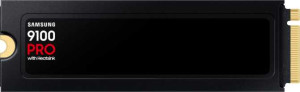
Samsung 9100 Pro 4TB
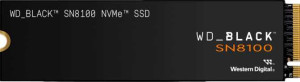
Western Digital WD Black SN8100 4TB

Samsung 9100 Pro 4TB Western Digital WD Black SN8100 4TB

Common Features

  • Both drives use the M2 form factor.
  • Both drives feature a DRAM cache.
  • Both drives are NVMe SSDs.
  • Both drives use NVMe version 2.
  • Both drives offer 4000GB of internal storage.
  • Both drives use TLC NAND flash storage.
  • Both drives use PCIe version 5.
  • Both drives have 8 controller channels.

Main Differences

  • Sequential read speed is 14800 MB/s on Samsung 9100 Pro 4TB and 14900 MB/s on Western Digital WD Black SN8100 4TB.
  • Random read speed is 2200000 IOPS on Samsung 9100 Pro 4TB and 2300000 IOPS on Western Digital WD Black SN8100 4TB.
  • Sequential write speed is 13400 MB/s on Samsung 9100 Pro 4TB and 14000 MB/s on Western Digital WD Black SN8100 4TB.
  • Random write speed is 2600000 IOPS on Samsung 9100 Pro 4TB and 2400000 IOPS on Western Digital WD Black SN8100 4TB.
  • PassMark result is 88718 on Samsung 9100 Pro 4TB and 90689 on Western Digital WD Black SN8100 4TB.
  • The controller is the Samsung Presto (S4LY027) on Samsung 9100 Pro 4TB and the Silicon Motion SM2508 on Western Digital WD Black SN8100 4TB.
Specs Comparison
Samsung 9100 Pro 4TB

Samsung 9100 Pro 4TB

Western Digital WD Black SN8100 4TB

Western Digital WD Black SN8100 4TB

Read speed:
sequential read speed 14800 MB/s 14900 MB/s
random read speed 2200000 IOPS 2300000 IOPS

Both drives operate at the absolute cutting edge of consumer NVMe performance, with sequential read speeds that are essentially identical — 14800 MB/s for the Samsung 9100 Pro versus 14900 MB/s for the WD Black SN8100. That 100 MB/s gap is less than 1% and would be imperceptible in any real-world workload, including large file transfers, game loading, or OS boot times.

The more meaningful differentiator lies in random read performance, where the SN8100 edges ahead with 2,300,000 IOPS compared to the 9100 Pro's 2,200,000 IOPS — a roughly 4.5% advantage. Random IOPS governs how quickly a drive handles the small, scattered read requests typical of database queries, application launches, and multitasking under heavy load. While both figures are exceptionally high and will saturate most real-world scenarios, the SN8100's lead here is the more tangible of the two differences.

In terms of read speed, the WD Black SN8100 holds a narrow but consistent edge across both metrics. Neither advantage is dramatic enough to be felt in everyday use, but for workloads that are genuinely IOPS-bound — such as virtualization or professional data pipelines — the SN8100's random read lead gives it a slight technical advantage in this category.

Write speed:
sequential write speed 13400 MB/s 14000 MB/s
random write speed 2600000 IOPS 2400000 IOPS

Write performance is where the two drives diverge more noticeably. The WD Black SN8100 pulls ahead on sequential writes with 14000 MB/s versus the Samsung 9100 Pro's 13400 MB/s — a gap of about 4.5%. For sustained large-file writes such as video editing timelines, backup ingestion, or bulk data migration, the SN8100's advantage translates into a measurably faster throughput ceiling.

The dynamic flips on random writes, where the Samsung 9100 Pro leads with 2,600,000 IOPS against the SN8100's 2,400,000 IOPS — roughly an 8% edge. Random write IOPS matter most under workloads that constantly update small data blocks: think databases, write-heavy virtual machines, or logging-intensive applications. The 9100 Pro's advantage here is proportionally larger than the SN8100's sequential lead, making it the stronger choice for storage workloads that are transactional rather than streaming in nature.

This group produces a genuine split verdict. The SN8100 leads on sequential write speed, while the 9100 Pro leads on random write IOPS — and by a wider margin. Users moving large files continuously will slightly favor the SN8100, while those running demanding I/O-intensive applications will find the 9100 Pro's random write performance the more impactful advantage.

Benchmarks:
PassMark result 88718 90689

PassMark's storage benchmark aggregates sequential reads and writes, random I/O, and mixed workload performance into a single composite score, making it a useful sanity check against individual spec claims. The WD Black SN8100 scores 90,689 versus the Samsung 9100 Pro's 88,718 — a difference of roughly 2.2%.

That margin is narrow enough that no single real-world task will feel noticeably faster on one drive versus the other. Where composite scores become meaningful is in confirming consistency: a drive that excels on paper in one metric but underperforms in another will see those trade-offs averaged out here. The SN8100's slightly higher result aligns with its sequential write lead observed in raw specs, while the 9100 Pro's strong random write IOPS were not quite enough to close the gap overall.

The SN8100 holds the edge in this benchmark, but the 2.2% margin should be treated as a tiebreaker rather than a decisive performance gap. Both drives land in the same performance tier, and the composite score reinforces that the differences between them are workload-specific rather than broad-based.

General info:
type M2 M2
SSD cache DRAM cache DRAM cache
Is an NVMe SSD
NVMe version 2 2
internal storage 4000GB 4000GB
release date February 2025 May 2025
controller Samsung Presto (S4LY027) Silicon Motion SM2508
SSD storage type TLC TLC
PCI Express (PCIe) version 5 5
Controller channels 8 8
Terabytes Written (TBW) 2400 2400
warranty period 5 years 5 years
Has an integrated heatsink
has RGB lighting

At the foundational level, these two drives are built on an identical platform: both are M.2 NVMe SSDs running over PCIe 5.0 with NVMe 2.0, equipped with DRAM cache, TLC NAND, and an 8-channel controller architecture. They share the same 2400 TBW endurance rating and a 5-year warranty, meaning long-term reliability and coverage are evenly matched from the outset.

The only meaningful differentiator in this group is the controller. The Samsung 9100 Pro uses Samsung's proprietary Presto (S4LY027) controller — a fully in-house design giving Samsung tight vertical integration across firmware, NAND, and silicon. The WD Black SN8100 relies on the Silicon Motion SM2508, a third-party controller that has also powered competitive flagship drives. Neither approach is inherently superior, but Samsung's in-house stack can allow for more optimized tuning specific to its own NAND, while Silicon Motion's controller is a proven commodity in the high-end segment.

Overall, this group is essentially a tie. The shared architecture, endurance, and warranty terms leave the controller as the sole distinguishing factor — and based on the provided data alone, neither controller confers an objective advantage. The real-world performance differences seen in other spec groups are a product of firmware and NAND tuning rather than any fundamental architectural divergence visible here.

Comparison Summary & Verdict

This is a specification comparison between Samsung 9100 Pro 4TB and Western Digital WD Black SN8100 4TB. Both products are M2 type SSDs with DRAM cache, NVMe version 2, and 4000GB of internal storage. However, they differ in several areas, such as sequential read speed (14800 MB/s on Samsung vs 14900 MB/s on Western Digital) and random write speed (2600000 IOPS on Samsung vs 2400000 IOPS on Western Digital). Additionally, the PassMark result is 88718 on Samsung and 90689 on Western Digital, while their controllers also vary, with Samsung using the Presto (S4LY027) and Western Digital using the Silicon Motion SM2508.