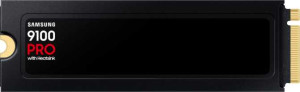
Samsung 9100 Pro 8TB
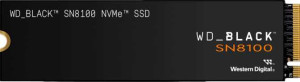
Western Digital WD Black SN8100 1TB

Samsung 9100 Pro 8TB Western Digital WD Black SN8100 1TB

Overview

Welcome to our in-depth specification comparison between the Samsung 9100 Pro 8TB and the Western Digital WD Black SN8100 1TB. Both drives share a strong PCIe 5.0 NVMe 2.0 foundation with DRAM cache and TLC storage, yet they diverge sharply in areas like storage capacity, random I/O performance, and endurance ratings. Read on to see how these two high-performance M.2 SSDs stack up across every key specification.

Common Features

  • Both drives use the M2 form factor.
  • Both drives feature a DRAM cache.
  • Both drives are NVMe SSDs.
  • Both drives use NVMe version 2.
  • Both drives use TLC storage type.
  • Both drives support PCI Express version 5.
  • Both drives have 8 controller channels.
  • Both drives come with a 5-year warranty period.

Main Differences

  • Sequential read speed is 14800 MB/s on Samsung 9100 Pro 8TB and 14900 MB/s on Western Digital WD Black SN8100 1TB.
  • Random read speed is 2200000 IOPS on Samsung 9100 Pro 8TB and 1600000 IOPS on Western Digital WD Black SN8100 1TB.
  • Sequential write speed is 13400 MB/s on Samsung 9100 Pro 8TB and 11000 MB/s on Western Digital WD Black SN8100 1TB.
  • Random write speed is 2600000 IOPS on Samsung 9100 Pro 8TB and 2400000 IOPS on Western Digital WD Black SN8100 1TB.
  • PassMark result is 82109 on Samsung 9100 Pro 8TB and 79571 on Western Digital WD Black SN8100 1TB.
  • Internal storage is 8000GB on Samsung 9100 Pro 8TB and 1000GB on Western Digital WD Black SN8100 1TB.
  • The controller is Samsung Presto (S4LY027) on Samsung 9100 Pro 8TB and Silicon Motion SM2508 on Western Digital WD Black SN8100 1TB.
  • Terabytes Written (TBW) is 4800 TB on Samsung 9100 Pro 8TB and 600 TB on Western Digital WD Black SN8100 1TB.
  • MTBF is 1.5 million hours on Samsung 9100 Pro 8TB and 1.8 million hours on Western Digital WD Black SN8100 1TB.
Specs Comparison
Samsung 9100 Pro 8TB

Samsung 9100 Pro 8TB

Western Digital WD Black SN8100 1TB

Western Digital WD Black SN8100 1TB

Read speed:
sequential read speed 14800 MB/s 14900 MB/s
random read speed 2200000 IOPS 1600000 IOPS

In sequential read performance, these two drives are essentially neck and neck. The WD Black SN8100 1TB edges ahead at 14900 MB/s versus 14800 MB/s for the Samsung 9100 Pro 8TB — a difference of just 100 MB/s, which is less than 1% and completely imperceptible in any real-world workload. Both drives operate at the cutting edge of current PCIe Gen 5 throughput, meaning large sequential transfers such as copying massive video files or loading large game assets will feel identical on either drive.

Where a more meaningful gap emerges is in random read performance. The Samsung 9100 Pro 8TB pulls ahead significantly here with 2,200,000 IOPS compared to the SN8100's 1,600,000 IOPS — a 37.5% advantage. Random IOPS matters far more than sequential speed in day-to-day computing: OS responsiveness, application launch times, database queries, and multitasking all depend on how quickly a drive can handle a flood of small, scattered read requests. This is where the 9100 Pro's advantage would actually be felt by users.

Overall, while both drives are evenly matched on sequential reads, the Samsung 9100 Pro 8TB holds a clear and practically significant edge in random read performance. Users running demanding workloads — virtualization, heavy multitasking, or professional applications — would benefit from that higher IOPS ceiling, making the 9100 Pro the stronger performer in this group.

Write speed:
sequential write speed 13400 MB/s 11000 MB/s
random write speed 2600000 IOPS 2400000 IOPS

Sequential write speed is where the Samsung 9100 Pro 8TB asserts a decisive lead. At 13400 MB/s versus the SN8100 1TB's 11000 MB/s, the 9100 Pro is roughly 22% faster when pushing large amounts of data — think exporting 4K or 8K video timelines, writing large backups, or transferring substantial files between drives. That gap is wide enough to translate into noticeable time savings in sustained write-heavy workflows.

On random writes, both drives are closer together but the 9100 Pro still holds a modest edge: 2,600,000 IOPS versus 2,400,000 IOPS for the SN8100 — an 8% difference. In practice, random write IOPS governs performance in scenarios like compiling large codebases, writing to databases, or running virtual machines. The gap here is real but less dramatic, meaning the SN8100 remains competitive for most general workloads while trailing in more intensive write scenarios.

Taken together, the Samsung 9100 Pro 8TB holds a clear advantage across both write metrics in this group. The sequential gap is particularly significant for content creators and professionals who regularly move or generate large files, while the random write lead adds further weight to the 9100 Pro's case for demanding, write-intensive environments.

Benchmarks:
PassMark result 82109 79571

PassMark's storage benchmark is a composite score that blends sequential and random read/write performance into a single number, making it a useful at-a-glance indicator of overall real-world drive capability. The Samsung 9100 Pro 8TB scores 82,109 against the WD Black SN8100 1TB's 79,571 — a difference of roughly 3.2%.

A gap of that magnitude is statistically meaningful enough to confirm the 9100 Pro as the faster drive in aggregate, but narrow enough that no user would feel it in typical daily use. Where composite benchmarks like PassMark are most useful is in validating whether a drive's individual spec claims hold up across a mixed workload — and here, both drives score exceptionally high, firmly placing them in the top tier of consumer NVMe performance.

The Samsung 9100 Pro 8TB takes the edge in this group, consistent with its leads in sequential and random write speed seen elsewhere. That said, the margin is slim enough that the SN8100 1TB is in no way a lesser performer — the benchmark essentially confirms these two drives are peers, with the 9100 Pro holding a slight but consistent overall advantage.

General info:
type M2 M2
SSD cache DRAM cache DRAM cache
Is an NVMe SSD
NVMe version 2 2
internal storage 8000GB 1000GB
release date February 2025 May 2025
controller Samsung Presto (S4LY027) Silicon Motion SM2508
SSD storage type TLC TLC
PCI Express (PCIe) version 5 5
Controller channels 8 8
Terabytes Written (TBW) 4800 600
MTBF 1.5million hours 1.8million hours
warranty period 5 years 5 years
Has an integrated heatsink
has RGB lighting

At a foundational level, these two drives share the same modern architecture: both are M.2 NVMe 2.0 SSDs running on PCIe 5.0 with DRAM cache, TLC NAND, and 8 controller channels. That common platform explains why their raw performance figures are so competitive. The meaningful differences in this group lie elsewhere — in capacity, endurance, and reliability ratings.

The most obvious divergence is storage size: the Samsung 9100 Pro offers 8TB versus the SN8100's 1TB, which naturally cascades into the endurance figures. The 9100 Pro's 4800 TBW versus the SN8100's 600 TBW looks dramatic, but both are proportional to their respective capacities — so neither drive is inherently more durable per gigabyte. What does stand out is the SN8100's slightly higher MTBF of 1.8 million hours compared to the 9100 Pro's 1.5 million hours, suggesting WD rates its drive with a marginally higher long-term reliability ceiling, though both figures are well beyond what any consumer workload would realistically stress.

Both drives carry a 5-year warranty and use proprietary or third-party controllers — Samsung's in-house Presto chip versus Silicon Motion's SM2508 — a distinction that rarely affects end users directly but reflects Samsung's deeper vertical integration. For most buyers, the choice in this group comes down to capacity need: the 9100 Pro is the clear pick for high-volume storage, while the SN8100 1TB is purpose-built for users who need a fast, compact primary drive without the premium of high capacity.

Comparison Summary & Verdict

After examining every specification, both drives prove themselves as capable PCIe 5.0 performers, but they clearly target different users. The Samsung 9100 Pro 8TB dominates in write performance, delivering superior sequential and random write speeds, and its massive 4800 TBW endurance rating makes it the obvious pick for workloads that demand high-volume, sustained data writing over years of use. By contrast, the Western Digital WD Black SN8100 1TB edges ahead in sequential read speed and posts a higher MTBF of 1.8 million hours, suggesting a slight reliability edge for read-heavy tasks. Ultimately, choose the Samsung 9100 Pro 8TB if raw throughput, write endurance, and ample storage are your priorities, and opt for the WD Black SN8100 1TB if you need a compact, high-reliability drive for a more modest storage requirement.

Samsung 9100 Pro 8TB
Buy Samsung 9100 Pro 8TB if...

Buy the Samsung 9100 Pro 8TB if you need massive storage capacity combined with superior write speeds and a significantly higher endurance rating for demanding, write-intensive workloads.

Western Digital WD Black SN8100 1TB
Buy Western Digital WD Black SN8100 1TB if...

Buy the Western Digital WD Black SN8100 1TB if you prioritize a higher MTBF reliability rating and a compact 1TB footprint for everyday high-performance use.