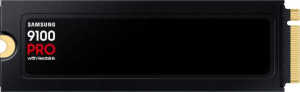
Samsung 9100 Pro 8TB (With Heatsink)
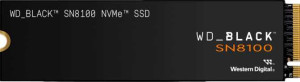
Western Digital WD Black SN8100 4TB

Samsung 9100 Pro 8TB (With Heatsink) Western Digital WD Black SN8100 4TB

Overview

Welcome to our head-to-head comparison of the Samsung 9100 Pro 8TB (With Heatsink) and the Western Digital WD Black SN8100 4TB — two of the most powerful PCIe 5.0 NVMe SSDs on the market today. Both drives share a strong foundation of common traits, yet they differ in meaningful ways across storage capacity, endurance, write performance, and benchmark results. Read on to see how these two flagship drives stack up across every key specification.

Common Features

  • Both products use the M2 form factor.
  • Both products feature a DRAM cache.
  • Both products are NVMe SSDs.
  • Both products use NVMe version 2.
  • Both products use TLC SSD storage type.
  • Both products use PCIe version 5.
  • Both products have 8 controller channels.
  • Both products come with a 5-year warranty period.

Main Differences

  • Sequential read speed is 14800 MB/s on Samsung 9100 Pro 8TB (With Heatsink) and 14900 MB/s on Western Digital WD Black SN8100 4TB.
  • Random read speed is 2200000 IOPS on Samsung 9100 Pro 8TB (With Heatsink) and 2300000 IOPS on Western Digital WD Black SN8100 4TB.
  • Sequential write speed is 13400 MB/s on Samsung 9100 Pro 8TB (With Heatsink) and 14000 MB/s on Western Digital WD Black SN8100 4TB.
  • Random write speed is 2600000 IOPS on Samsung 9100 Pro 8TB (With Heatsink) and 2400000 IOPS on Western Digital WD Black SN8100 4TB.
  • PassMark result is 82109 on Samsung 9100 Pro 8TB (With Heatsink) and 90689 on Western Digital WD Black SN8100 4TB.
  • Internal storage capacity is 8000GB on Samsung 9100 Pro 8TB (With Heatsink) and 4000GB on Western Digital WD Black SN8100 4TB.
  • The controller is Samsung Presto (S4LY027) on Samsung 9100 Pro 8TB (With Heatsink) and Silicon Motion SM2508 on Western Digital WD Black SN8100 4TB.
  • Terabytes Written (TBW) endurance rating is 4800 TB on Samsung 9100 Pro 8TB (With Heatsink) and 2400 TB on Western Digital WD Black SN8100 4TB.
  • An integrated heatsink is included with Samsung 9100 Pro 8TB (With Heatsink) but is not present on Western Digital WD Black SN8100 4TB.
Specs Comparison
Samsung 9100 Pro 8TB (With Heatsink)

Samsung 9100 Pro 8TB (With Heatsink)

Western Digital WD Black SN8100 4TB

Western Digital WD Black SN8100 4TB

Read speed:
sequential read speed 14800 MB/s 14900 MB/s
random read speed 2200000 IOPS 2300000 IOPS

In sequential read performance, these two drives are virtually neck-and-neck. The WD Black SN8100 4TB edges ahead at 14900 MB/s versus 14800 MB/s for the Samsung 9100 Pro 8TB — a difference of just 100 MB/s, or less than 1%. At this tier of performance, both drives are operating at the cutting edge of current PCIe Gen 5 bandwidth, and in practice, no real-world workload would allow a user to perceive this gap.

The random read story follows the same pattern. The SN8100 leads again with 2,300,000 IOPS compared to the 9100 Pro's 2,200,000 IOPS — a 100,000 IOPS or roughly 4.5% difference. Random read performance matters most in latency-sensitive workloads like OS responsiveness, database queries, and loading many small files simultaneously. A 4–5% advantage here is marginally more meaningful than the sequential gap, though both figures are exceptionally high and well beyond what most consumer applications can fully saturate.

Overall, the WD Black SN8100 4TB holds a technical edge in both read metrics, but the margin is so slim that it amounts to a near-tie in any practical scenario. Users choosing between these drives should weigh other spec groups — such as write performance, thermal behavior, or capacity — rather than treating this read speed difference as a decisive factor.

Write speed:
sequential write speed 13400 MB/s 14000 MB/s
random write speed 2600000 IOPS 2400000 IOPS

Write performance is where these two drives begin to diverge in an interesting way. The WD Black SN8100 4TB takes the sequential write lead at 14000 MB/s versus 13400 MB/s for the Samsung 9100 Pro 8TB — a roughly 4.5% advantage that is more tangible than the read gap. For sustained large-file transfers, video editing timelines, or backup operations involving tens or hundreds of gigabytes, the SN8100 will complete those tasks measurably faster.

Flip to random writes, however, and the Samsung reclaims the lead decisively — 2,600,000 IOPS against the SN8100's 2,400,000 IOPS, an 8.3% margin. This matters in write-heavy transactional workloads: think virtual machines writing lots of small state files, compile jobs touching thousands of incremental objects, or NVMe-accelerated database writes. The 9100 Pro's advantage here is the more operationally significant delta of the two metrics.

Write performance ends up split between the two drives, making the ″winner″ dependent on use case. The SN8100 has the edge for throughput-oriented, large-block writing, while the Samsung 9100 Pro pulls ahead where high-concurrency, small-block write responsiveness is the priority. Neither holds an across-the-board advantage in this category.

Benchmarks:
PassMark result 82109 90689

PassMark scores synthesize a range of real-world storage behaviors — sequential throughput, random access, and mixed workloads — into a single composite number, making them a useful holistic tiebreaker when individual specs tell a split story. Here, the WD Black SN8100 4TB scores 90,689 against the Samsung 9100 Pro 8TB's 82,109 — a gap of roughly 10.4%.

That margin is meaningful. A 10% composite advantage suggests the SN8100 consistently outperforms the 9100 Pro across the blend of tasks PassMark exercises, not just in one isolated metric. This aligns with the sequential write lead the SN8100 showed in its individual specs, and implies that in aggregate, everyday system responsiveness and throughput will favor the WD drive.

The PassMark result gives the SN8100 a clear overall edge in this benchmark category. For users who want a single data point that captures broad drive performance rather than cherry-picking individual metrics, this score reinforces the WD Black as the stronger all-round performer of the two — at least at the capacities being compared here.

General info:
type M2 M2
SSD cache DRAM cache DRAM cache
Is an NVMe SSD
NVMe version 2 2
internal storage 8000GB 4000GB
release date February 2025 May 2025
controller Samsung Presto (S4LY027) Silicon Motion SM2508
SSD storage type TLC TLC
PCI Express (PCIe) version 5 5
Controller channels 8 8
Terabytes Written (TBW) 4800 2400
warranty period 5 years 5 years
Has an integrated heatsink
has RGB lighting

At the foundation, these two drives share the same core architecture: both are M.2 NVMe SSDs running PCIe Gen 5 with NVMe 2.0, backed by DRAM cache, built on TLC NAND, and equipped with 8-channel controllers. That common platform explains why their raw performance numbers sit so close together. The meaningful differences emerge in capacity, endurance, and a few practical considerations.

The most significant split is storage size and longevity. The Samsung 9100 Pro ships at 8TB with a 4,800 TBW endurance rating, while the WD Black SN8100 offers 4TB and 2,400 TBW — both exactly half. This is proportional and expected, so neither drive is more durable per terabyte; the Samsung simply offers more of everything in absolute terms. For users who need a single high-capacity NVMe drive, the 9100 Pro is the only option of the two that reaches 8TB. The integrated heatsink on the Samsung is also a practical differentiator — it helps manage thermals out of the box, which matters in sustained workloads or builds with limited airflow, whereas the SN8100 relies on the system or aftermarket cooling.

Both carry identical 5-year warranties, which signals comparable manufacturer confidence in long-term reliability. The controller difference — Samsung's proprietary Presto versus Silicon Motion's SM2508 — is architecturally notable, as in-house controllers can be more tightly tuned to the NAND they accompany, though the performance data across other spec groups is the real measure of that. Overall, the Samsung 9100 Pro holds a general-info advantage for users prioritizing raw capacity and thermal management, while the WD SN8100 is the leaner, more compact option for those who don't need the extra storage headroom.
Comparison Summary & Verdict

Both drives are undeniably elite performers built on PCIe 5.0 with NVMe 2, TLC NAND, DRAM cache, and a 5-year warranty — so neither will disappoint in a high-end build. That said, their differences point to distinct user profiles. The Samsung 9100 Pro 8TB (With Heatsink) stands out for its massive 8TB capacity, industry-leading 4800 TBW endurance rating, higher random write speed of 2,600,000 IOPS, and the convenience of an integrated heatsink. The Western Digital WD Black SN8100 4TB counters with a superior PassMark score of 90,689, faster sequential read and write speeds, and higher random read throughput — making it the sharper performer in pure benchmark terms despite its smaller footprint.

Samsung 9100 Pro 8TB (With Heatsink)
Buy Samsung 9100 Pro 8TB (With Heatsink) if...

Buy the Samsung 9100 Pro 8TB (With Heatsink) if you need maximum storage capacity, superior write endurance with a 4800 TBW rating, and the added thermal protection of a built-in heatsink.

Western Digital WD Black SN8100 4TB
Buy Western Digital WD Black SN8100 4TB if...

Buy the Western Digital WD Black SN8100 4TB if you prioritize raw benchmark performance, faster sequential read and write speeds, and a higher random read throughput in a more compact, heatsink-free design.