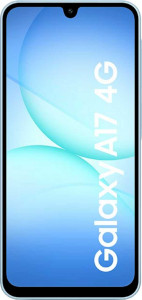
Samsung Galaxy A17 4G
Samsung Galaxy A26 5G

Samsung Galaxy A17 4G Samsung Galaxy A26 5G

Overview

Welcome to our detailed spec comparison between the Samsung Galaxy A17 4G and the Samsung Galaxy A26 5G. Both phones share a solid foundation — an OLED display, 256GB storage, 8GB RAM, and a 5000 mAh battery with 25W fast charging — but they diverge sharply when it comes to performance, connectivity, and water resistance. Whether you value raw benchmark scores, future-proof networking, or everyday value, this side-by-side breakdown will help you find the right fit.

Common Features

  • Neither product has a rugged build.
  • Neither product can be folded.
  • Both products have an OLED/AMOLED display.
  • Both products have a 6.7″ screen size.
  • Both products have a pixel density of 385 ppi.
  • Both products have a resolution of 1080 x 2340 px.
  • Both products feature Gorilla Glass Victus for damage-resistant glass protection.
  • HDR10 support is not available on either product.
  • HDR10+ support is not available on either product.
  • Both products have 256GB of internal storage and 8GB of RAM.
  • Both products have a GPU clock speed of 950 MHz.
  • Both products use big.LITTLE technology and have 8 CPU threads.
  • Both products run Android 15.
  • Both products support clipboard warnings, location privacy options, and camera/microphone privacy options.
  • Cross-site tracking blocking is not available on either product.
  • Both products have a 5000 mAh battery with 25W fast charging and no wireless charging.
  • Neither product has a 3.5mm audio jack or stereo speakers.
  • Both products support Wi-Fi 5 (802.11ac), Bluetooth 5.3, NFC, dual SIM, USB Type-C (USB 2.0), and have an external memory slot.
  • Both products have a fingerprint scanner.
  • Both products have a 50MP main camera with optical image stabilization and a 13MP front camera.

Main Differences

  • Water resistance is rated IP54 (water resistant) on Samsung Galaxy A17 4G and IP67 (waterproof) on Samsung Galaxy A26 5G.
  • Weight is 190g on Samsung Galaxy A17 4G and 200g on Samsung Galaxy A26 5G.
  • Thickness is 7.5mm on Samsung Galaxy A17 4G and 7.7mm on Samsung Galaxy A26 5G.
  • Display refresh rate is 90Hz on Samsung Galaxy A17 4G and 120Hz on Samsung Galaxy A26 5G.
  • The chipset is Mediatek Helio G99 on Samsung Galaxy A17 4G and Samsung Exynos 1380 on Samsung Galaxy A26 5G.
  • Geekbench 6 multi-core score is 1979 on Samsung Galaxy A17 4G and 2758 on Samsung Galaxy A26 5G.
  • Geekbench 6 single-core score is 729 on Samsung Galaxy A17 4G and 1007 on Samsung Galaxy A26 5G.
  • Maximum memory bandwidth is 17.1 GB/s on Samsung Galaxy A17 4G and 51.2 GB/s on Samsung Galaxy A26 5G.
  • DDR memory version is DDR4 on Samsung Galaxy A17 4G and DDR5 on Samsung Galaxy A26 5G.
  • Semiconductor size is 6nm on Samsung Galaxy A17 4G and 5nm on Samsung Galaxy A26 5G.
  • Video recording resolution is 1080p at 30fps on Samsung Galaxy A17 4G and 4K (2160p) at 30fps on Samsung Galaxy A26 5G.
  • The ultra-wide camera is 5MP on Samsung Galaxy A17 4G and 8MP on Samsung Galaxy A26 5G.
  • A built-in FM radio is present on Samsung Galaxy A17 4G but not available on Samsung Galaxy A26 5G.
  • 5G support is available on Samsung Galaxy A26 5G but not on Samsung Galaxy A17 4G.
  • Maximum download speed is 650 Mbits/s on Samsung Galaxy A17 4G and 3790 Mbits/s on Samsung Galaxy A26 5G.
  • Maximum upload speed is 150 Mbits/s on Samsung Galaxy A17 4G and 1280 Mbits/s on Samsung Galaxy A26 5G.
Specs Comparison
Samsung Galaxy A17 4G

Samsung Galaxy A17 4G

Samsung Galaxy A26 5G

Samsung Galaxy A26 5G

Design:
water resistance Water resistant Waterproof
weight 190 g 200 g
thickness 7.5 mm 7.7 mm
width 77.9 mm 77.5 mm
height 164.4 mm 164 mm
volume 96.0507 cm³ 97.867 cm³
Ingress Protection (IP) rating IP54 IP67
has a rugged build
can be folded

In terms of physical form, the two phones are remarkably close. The A17 4G measures 164.4 × 77.9 × 7.5 mm and weighs 190 g, while the A26 5G comes in at 164 × 77.5 × 7.7 mm and 200 g. That 10 g difference is barely perceptible in daily use, and neither phone can be folded or claims a rugged build, so for most users the dimensions alone will not be a deciding factor.

Where the Design group reveals a meaningful gap is in water protection. The A17 4G carries an IP54 rating, which means it can handle splashes and dust from most directions — sufficient for rain or an accidental kitchen spill, but not submersion. The A26 5G steps up to IP67, certifying it against full immersion in up to 1 meter of fresh water for 30 minutes. In practical terms this is the difference between a phone you need to keep away from sinks and pools versus one you can briefly drop in them without panic.

The A26 5G holds a clear edge in this group. Its IP67 waterproofing offers meaningfully stronger real-world protection than the A17 4G's splash-resistant IP54, and that advantage comes at the cost of only a negligible weight increase. For users who value durability and peace of mind around water, the A26 5G is the stronger choice based purely on these specs.

Display:
Display type OLED/AMOLED OLED/AMOLED
screen size 6.7" 6.7"
pixel density 385 ppi 385 ppi
resolution 1080 x 2340 px 1080 x 2340 px
refresh rate 90Hz 120Hz
has branded damage-resistant glass
Gorilla Glass version Gorilla Glass Victus Gorilla Glass Victus
supports HDR10
supports HDR10+
Always-On Display
supports Dolby Vision
Has a secondary screen
has a touch screen

Both phones share an identical display foundation: a 6.7″ OLED/AMOLED panel running at 1080 × 2340 px and 385 ppi, protected by Gorilla Glass Victus. At this pixel density, text and images appear sharp and well-defined, and the AMOLED technology ensures deep blacks, vibrant colors, and an efficient Always-On Display on both devices.

The only differentiator in this group is the refresh rate. The A17 4G tops out at 90Hz, while the A26 5G pushes to 120Hz. That 30Hz gap translates to noticeably smoother scrolling, more fluid animations, and a snappier overall feel during everyday navigation and gaming. It is not a transformative difference for static content like reading or video, but users who switch between the two will likely perceive the A26 5G's screen as more responsive.

The A26 5G holds a narrow but real edge here, with its 120Hz refresh rate being the single distinguishing factor. Everything else — size, resolution, sharpness, glass protection, and HDR support — is identical. For display-sensitive buyers, the smoother motion handling on the A26 5G tips the balance in its favor.

Performance:
internal storage 256GB 256GB
RAM 8GB 8GB
Chipset (SoC) name Mediatek Helio G99 Samsung Exynos 1380
GPU name Mali G57 Mali G68 MP5
CPU speed 2 x 2.2 & 6 x 2 GHz 4 x 2.4 & 4 x 2 GHz
Geekbench 6 result (multi) 1979 2758
Geekbench 6 result (single) 729 1007
GPU clock speed 950 MHz 950 MHz
Has integrated LTE
RAM speed 4266 MHz 3200 MHz
semiconductor size 6 nm 5 nm
Supports 64-bit
DirectX version DirectX 11 DirectX 12
Has integrated graphics
Uses big.LITTLE technology
CPU threads 8 threads 8 threads
Uses HMP
Has TrustZone
maximum memory bandwidth 17.1 GB/s 51.2 GB/s
OpenCL version 2 2
memory channels 2 4
maximum memory amount 12GB 8GB
Thermal Design Power (TDP) 5W 5W
DDR memory version 4 5

Despite matching on storage and base RAM, the processors inside these two phones tell very different stories. The A17 4G runs on a Mediatek Helio G99 built on a 6 nm process, while the A26 5G uses Samsung's own Exynos 1380 on a tighter 5 nm node. The smaller process node generally enables better power efficiency and higher sustained performance, and the benchmark results confirm this: the A26 5G scores 2758 in Geekbench 6 multi-core versus the A17 4G's 1979, a roughly 40% lead that reflects real-world advantages in multitasking, app loading, and demanding workloads.

The memory subsystem gap is equally striking. The A26 5G uses DDR5 across 4 memory channels and achieves a maximum bandwidth of 51.2 GB/s — nearly three times the A17 4G's 17.1 GB/s over 2 channels. Higher bandwidth means the processor stalls less waiting for data, which benefits everything from gaming to photo processing. The A26 5G also supports DirectX 12 versus DirectX 11 on the A17 4G, giving it a more capable graphics API for future game compatibility.

The A26 5G wins this category decisively. Across CPU throughput, memory bandwidth, process node efficiency, and graphics API support, it outclasses the A17 4G on every meaningful performance dimension. The A17 4G's slightly faster individual RAM speed and higher maximum memory ceiling are minor footnotes that do not offset the overall performance gap.

Cameras:
megapixels (main camera) 50 & 5 & 2 MP 50 & 8 & 2 MP
wide aperture (main camera) 1.8 & 2.2 & 2.4f 1.8 & 2.2 & 2.4f
Has a dual-lens (or multi-lens) main camera
megapixels (front camera) 13MP 13MP
has built-in optical image stabilization
video recording (main camera) 1080 x 30 fps 2160 x 30 fps
Has a dual-tone LED flash
number of flash LEDs 1 1
has a BSI sensor
has a CMOS sensor
has continuous autofocus when recording movies
Has phase-detection autofocus for photos
supports slow-motion video recording
has a built-in HDR mode
has manual exposure
has a flash
optical zoom 0x 0x
has manual ISO
has a serial shot mode
has manual focus
has a front camera
Has laser autofocus
Shoots 360° panorama
has manual white balance
shoots raw
has touch autofocus
has manual shutter speed
can create panoramas in-camera
wide aperture (front camera) 2f 2.2f
Has timelapse function
Has a front-facing LED flash
has a dual-lens (or multi-lens) front camera
supports HDR10 recording
supports Dolby Vision recording
has a front-facing camera under the display
Has a RGB LED flash
has 3D photo/video recording capabilities

The camera hardware on these two phones overlaps heavily. Both feature a triple rear system led by a 50 MP main sensor with OIS, a 2 MP depth lens, phase-detection autofocus, and an identical 13 MP front camera. The shooting feature set — manual controls, slow-motion, timelapse, HDR mode — is also identical across the board, so for still photography the everyday experience will be very similar.

Two specs separate them. The ultrawide lens steps up from 5 MP on the A17 4G to 8 MP on the A26 5G, which means wider shots carry more detail and hold up better when cropped. More significantly, the A26 5G can record video at 4K (2160p) at 30 fps, while the A17 4G is capped at 1080p at 30 fps. For anyone shooting footage they intend to edit, display on a large screen, or keep as a long-term archive, that is a substantial gap — 4K contains roughly four times the pixel data of 1080p.

The A26 5G takes this category. Its 4K video recording capability is the headline advantage, and the higher-resolution ultrawide adds further separation. The A17 4G does hold a marginally wider front-camera aperture (f/2.0 vs f/2.2), which can aid low-light selfies slightly, but that narrow edge does not offset the A26 5G's advantages for users who prioritize video quality and versatile wide-angle shooting.

Operating system:
Android version Android 15 Android 15
has clipboard warnings
has location privacy options
has camera/microphone privacy options
has Mail Privacy Protection
has theme customization
can block app tracking
blocks cross-site tracking
has on-device machine learning
has notification permissions
has media picker
Can play games while they download
has dark mode
has Wi-Fi password sharing
has battery health check
has an extra dim mode
has focus modes
has dynamic theming
can offload apps
Has customizable notifications
has Live Text
has full-page screenshots
supports split screen
gets direct OS updates
has PiP
Can be used as a PC
Has sharing intents
has a child lock
Supports widgets
Is free and open source
Has offline voice recognition
has voice commands
Tracks the current position of a mobile device
is a multi-user system
has Quick Start

This is a clean sweep for parity. Both phones run Android 15 and share an absolutely identical feature set across every single spec in this group — privacy controls, dark mode, dynamic theming, split-screen, Picture-in-Picture, widgets, offline voice recognition, multi-user support, and more. There is not a single differentiating data point between them here.

This category is a complete tie. Buyers who prioritize software features and OS capabilities will find no reason to choose one over the other based on this group alone.

Battery:
battery power 5000 mAh 5000 mAh
has wireless charging
Supports fast charging
charging speed 25W 25W
has a removable battery
has a battery level indicator
has a rechargeable battery

Battery is another category where these two phones are mirror images of each other. Both carry a 5000 mAh cell, support 25W fast charging, and lack wireless charging or a removable battery — there is no distinguishing factor anywhere in this group.

A 5000 mAh capacity is a solid mid-range offering that comfortably supports a full day of mixed use for most people, and 25W wired charging will replenish the battery meaningfully in around an hour. Neither phone pushes into the faster charging tiers seen on some competitors, but the spec is consistent and practical for daily life. This category is a complete tie — battery considerations give buyers no reason to favor one device over the other.

Audio:
has a socket for a 3.5 mm audio jack
has stereo speakers
has aptX
has LDAC
has aptX HD
has aptX Adaptive
has aptX Lossless
Has a radio

Audio is a notably sparse category for both phones. Neither offers a 3.5 mm headphone jack, stereo speakers, or any high-resolution Bluetooth codec — no aptX, LDAC, or their variants. For users who care about wired listening or elevated wireless audio quality, both devices fall short equally.

The one point of difference is the built-in FM radio, which the A17 4G includes and the A26 5G does not. It is a modest feature by modern standards, but it has real value in areas with poor data connectivity or during emergencies when streaming is unavailable — and it costs nothing in battery or data to use.

The A17 4G takes a narrow win here solely on the strength of its FM radio. For most users the audio profile of these two phones is otherwise identical and equally limited, but for anyone who values offline radio access, the A17 4G is the only option between the two.

Connectivity & Features:
release date September 2025 March 2025
has 5G support
Wi-Fi version Wi-Fi 4 (802.11n), Wi-Fi 5 (802.11ac) Wi-Fi 4 (802.11n), Wi-Fi 5 (802.11ac)
SIM cards 2 SIM 2 SIM
Bluetooth version 5.3 5.3
has an external memory slot
Has USB Type-C
USB version 2 2
has NFC
download speed 650 MBits/s 3790 MBits/s
upload speed 150 MBits/s 1280 MBits/s
Has a fingerprint scanner
has emergency SOS via satellite
has crash detection
is DLNA-certified
has a gyroscope
supports ANT+
Has a heart rate monitor
has GPS
has a compass
supports Wi-Fi
Has an infrared sensor
has an accelerometer
has a cellular module
Has a barometer
has an HDMI output
Uses 3D facial recognition
Has an iris scanner
Stylus included
supports Galileo
Has motion tracking
Has optical tracking
Has a built-in projector

Much of the connectivity stack is shared between these two phones — both offer dual SIM, NFC, Bluetooth 5.3, Wi-Fi 5, USB Type-C, expandable storage, and an identical sensor suite including GPS, gyroscope, accelerometer, and compass. For everyday tasks like contactless payments, file transfers, and location services, the experience will be indistinguishable.

The defining difference in this group is cellular generation. The A17 4G is limited to 4G LTE, with download speeds capped at 650 Mbits/s and upload at 150 Mbits/s. The A26 5G supports 5G, unlocking theoretical download speeds of 3790 Mbits/s and uploads of 1280 Mbits/s — roughly six times faster on downloads and over eight times on uploads where 5G coverage is available. Beyond raw speed, 5G networks also offer lower latency, which benefits real-time applications like gaming, video calls, and cloud streaming. Crucially, as 4G networks are gradually deprioritized by carriers in many markets, the A26 5G also offers better long-term network compatibility.

The A26 5G wins this category clearly. Its 5G support is not just a speed upgrade today — it is a futureproofing advantage that becomes increasingly relevant as networks evolve. The A17 4G's connectivity spec set is functional but represents a ceiling the A26 5G simply does not have.

Miscellaneous:
has a video light
Has sapphire glass display
Has a curved display
Has an e-paper display

The Miscellaneous group offers no differentiation whatsoever. Both the Samsung Galaxy A17 4G and the A26 5G share an identical profile here — each has a video light, and neither features a sapphire glass display, curved display, or e-paper display. This is a complete tie, and buyers will find nothing in this category to separate the two devices.

Comparison Summary & Verdict

After examining every spec, a clear picture emerges for each device. The Samsung Galaxy A26 5G is the stronger all-round performer: it brings a 120Hz OLED display, a more powerful Exynos 1380 chipset with noticeably higher Geekbench scores, 4K video recording, DDR5 memory, and crucially, IP67 waterproofing and 5G connectivity — making it the better long-term investment for demanding users. The Samsung Galaxy A17 4G, on the other hand, holds its own for budget-conscious buyers: it is slightly lighter, includes a built-in FM radio, and still delivers a competent 90Hz OLED screen and 50MP main camera. Choose the A17 4G if cost-efficiency is your priority; choose the A26 5G if you want a more future-proof device with superior performance and durability.

Samsung Galaxy A17 4G
Buy Samsung Galaxy A17 4G if...

Buy the Samsung Galaxy A17 4G if you want a lighter, more affordable handset that still delivers a solid OLED display and includes FM radio for everyday use.

Samsung Galaxy A26 5G
Buy Samsung Galaxy A26 5G if...

Buy the Samsung Galaxy A26 5G if you want stronger performance, a smoother 120Hz display, 4K video recording, IP67 waterproofing, and 5G-ready connectivity for long-term use.