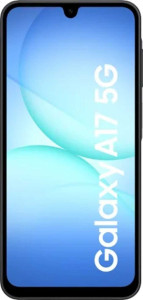
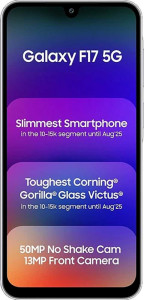
Samsung Galaxy A17 5G
Samsung Galaxy F17

Samsung Galaxy A17 5G Samsung Galaxy F17

Overview

Welcome to our detailed spec comparison between the Samsung Galaxy A17 5G and the Samsung Galaxy F17. Both devices share the same sleek design, vibrant OLED display, and capable Exynos 1330 chipset, making this a remarkably close head-to-head. The real question comes down to RAM and internal storage — two factors that can meaningfully shape your day-to-day experience. Read on to find out which of these two Samsung mid-rangers is the right fit for you.

Common Features

  • Both phones have an IP54 rating and are water resistant.
  • Both phones weigh 192 g.
  • Both phones are 7.5 mm thick.
  • Both phones share the same dimensions of 164.4 mm height and 77.9 mm width.
  • Both phones feature an OLED/AMOLED display.
  • The screen size is 6.7″ on both phones.
  • Both phones have a pixel density of 385 ppi with a 1080 x 2340 px resolution.
  • Both phones offer a 90Hz display refresh rate.
  • Typical brightness is 800 nits on both phones.
  • Both phones are protected by Gorilla Glass Victus.
  • Both phones are powered by the Samsung Exynos 1330 chipset built on a 5 nm process.
  • Both phones use a Mali G68 MP2 GPU running at 800 MHz.
  • Both phones have a triple rear camera system with 50, 5, and 2 MP sensors.
  • Both phones have a 13 MP front camera.
  • Optical image stabilization is available on both phones.
  • Both phones record video at up to 1080p at 30 fps.
  • Both phones run Android 15.
  • Both phones have a 5000 mAh battery with 25W fast charging support.
  • Wireless charging is not available on either phone.
  • Both phones support 5G, NFC, Bluetooth 5.3, Wi-Fi 5 (802.11ac), USB Type-C, dual SIM, and have an external memory slot.
  • A 3.5 mm audio jack is not present on either phone.
  • Stereo speakers are not available on either phone.

Main Differences

  • Internal storage is 256 GB on Samsung Galaxy A17 5G and 128 GB on Samsung Galaxy F17.
  • RAM is 8 GB on Samsung Galaxy A17 5G and 6 GB on Samsung Galaxy F17.
Specs Comparison
Samsung Galaxy A17 5G

Samsung Galaxy A17 5G

Samsung Galaxy F17

Samsung Galaxy F17

Design:
water resistance Water resistant Water resistant
weight 192 g 192 g
thickness 7.5 mm 7.5 mm
width 77.9 mm 77.9 mm
height 164.4 mm 164.4 mm
volume 96.0507 cm³ 96.0507 cm³
Ingress Protection (IP) rating IP54 IP54
has a rugged build
can be folded

In terms of design, the Samsung Galaxy A17 5G and the Samsung Galaxy F17 are completely identical across every measurable dimension. Both share the exact same 164.4 × 77.9 × 7.5 mm footprint, a weight of 192 g, and a volume of 96.05 cm³. In practice, this means users would find both phones equally comfortable — or equally large — in hand, with no physical distinction between the two builds.

Both devices carry an IP54 rating, meaning they offer the same level of protection: resistance to dust ingress and splashing water from any direction. This is a meaningful everyday assurance — accidental rain exposure or a kitchen splash will not damage either phone — but it falls short of the stricter IP67/IP68 ratings found on premium devices, which can handle full submersion. Neither phone features a rugged build or a foldable form factor, placing both firmly in the standard candy-bar smartphone category.

With every single design spec being a perfect match, this category is an unequivocal tie. There is no design-based reason to choose one over the other — the decision must rest entirely on other specification groups such as performance, display, or camera.

Display:
Display type OLED/AMOLED OLED/AMOLED
screen size 6.7" 6.7"
pixel density 385 ppi 385 ppi
resolution 1080 x 2340 px 1080 x 2340 px
refresh rate 90Hz 90Hz
brightness (typical) 800 nits 800 nits
has branded damage-resistant glass
Gorilla Glass version Gorilla Glass Victus Gorilla Glass Victus
supports HDR10
supports HDR10+
Always-On Display
supports Dolby Vision
Has a secondary screen
has a touch screen

Both the Samsung Galaxy A17 5G and the Samsung Galaxy F17 feature a 6.7-inch OLED/AMOLED panel running at 1080 × 2340 px with a pixel density of 385 ppi — sharp enough that individual pixels are imperceptible under normal use. The 90Hz refresh rate delivers noticeably smoother scrolling and animations compared to a standard 60Hz display, which is a meaningful quality-of-life upgrade for everyday tasks like browsing and social media.

At 800 nits typical brightness, both screens offer adequate visibility in most indoor and moderately lit outdoor environments, though they may struggle under direct harsh sunlight. The inclusion of Always-On Display on both devices adds practical convenience, letting users check notifications and time without waking the screen. Screen durability is equally matched, with Gorilla Glass Victus protecting both panels — one of the more resilient protective glass options available, offering solid resistance against drops and scratches.

Much like the design category, the display comparison ends in a complete tie. Every spec — panel technology, size, resolution, refresh rate, brightness, and glass protection — is identical. Neither device offers any display-related advantage over the other, so prospective buyers should look to other categories to differentiate between the two.

Performance:
internal storage 256GB 128GB
RAM 8GB 6GB
Chipset (SoC) name Samsung Exynos 1330 Samsung Exynos 1330
GPU name Mali G68 MP2 Mali G68 MP2
CPU speed 2 x 2.4 & 6 x 2 GHz 2 x 2.4 & 6 x 2 GHz
GPU clock speed 800 MHz 800 MHz
Has integrated LTE
RAM speed 3200 MHz 3200 MHz
semiconductor size 5 nm 5 nm
Supports 64-bit
DirectX version DirectX 12 DirectX 12
Has integrated graphics
OpenGL ES version 3.2 3.2
Uses big.LITTLE technology
CPU threads 8 threads 8 threads
Has NX bit
maximum memory bandwidth 51.2 GB/s 51.2 GB/s
OpenCL version 2 2
maximum memory amount 8GB 8GB
GPU turbo 950 MHz 950 MHz
Thermal Design Power (TDP) 5W 5W
DDR memory version 5 5

Under the hood, both phones are built on the same foundation: the Samsung Exynos 1330 chipset, fabricated on a 5 nm process. This means identical CPU architecture, the same Mali G68 MP2 GPU, and equivalent clock speeds across the board. Day-to-day processing tasks, gaming performance, and power efficiency will feel indistinguishable between the two devices — any benchmark difference would be negligible in real-world use.

Where the two diverge is in memory and storage configuration. The Galaxy A17 5G ships with 8 GB of RAM and 256 GB of internal storage, while the Galaxy F17 comes with 6 GB of RAM and 128 GB of storage. The extra 2 GB of RAM on the A17 5G is practically meaningful — it allows more apps to remain active in the background simultaneously, reducing reload times when multitasking. The doubled storage is equally significant for users who store large photo libraries, downloaded media, or offline content without relying on a microSD card.

The Galaxy A17 5G holds a clear edge in this category. The underlying silicon is identical, so the performance gap is purely a matter of configuration — but more RAM and more storage are tangible, everyday advantages that translate directly into a smoother and more spacious user experience over the life of the device.

Cameras:
megapixels (main camera) 50 & 5 & 2 MP 50 & 5 & 2 MP
wide aperture (main camera) 1.8 & 2.2 & 2.4f 1.8 & 2.2 & 2.4f
Has a dual-lens (or multi-lens) main camera
megapixels (front camera) 13MP 13MP
has built-in optical image stabilization
video recording (main camera) 1080 x 30 fps 1080 x 30 fps
Has a dual-tone LED flash
number of flash LEDs 1 1
has a BSI sensor
has a CMOS sensor
has continuous autofocus when recording movies
Has phase-detection autofocus for photos
supports slow-motion video recording
has a built-in HDR mode
has manual exposure
has a flash
optical zoom 0x 0x
has manual ISO
has a serial shot mode
has manual focus
has a front camera
Has laser autofocus
Shoots 360° panorama
has manual white balance
shoots raw
has touch autofocus
has manual shutter speed
can create panoramas in-camera
wide aperture (front camera) 2f 2f
Has timelapse function
Has a front-facing LED flash
has a dual-lens (or multi-lens) front camera
supports HDR10 recording
supports Dolby Vision recording
has a front-facing camera under the display
Has a RGB LED flash
has 3D photo/video recording capabilities

The camera systems on the Galaxy A17 5G and the Galaxy F17 are spec-for-spec identical. Both feature a triple rear camera setup led by a 50 MP main sensor with an f/1.8 aperture, accompanied by a 5 MP and a 2 MP auxiliary lens. The wide main aperture is a genuine advantage for low-light photography, allowing more light to reach the sensor. Both also include optical image stabilization (OIS), which meaningfully reduces blur from hand tremor during handheld shots and video recording — a feature not always guaranteed at this price tier.

Video capability tops out at 1080p at 30 fps on both devices, which is competent for everyday sharing but falls short of the 4K recording found on higher-end phones. On the front, each phone carries a 13 MP selfie camera with an f/2.0 aperture. Manual controls — including ISO, exposure, focus, and white balance — are available on both, giving enthusiast users a degree of creative control beyond the automatic modes. Slow-motion, timelapse, HDR, and panorama round out a well-matched feature set on either device.

This category is a straight tie. Every hardware spec and software camera feature is mirrored perfectly across both phones. Camera quality and versatility will be indistinguishable in real-world use, and neither device offers any photographic advantage over the other.

Operating system:
Android version Android 15 Android 15
has clipboard warnings
has location privacy options
has camera/microphone privacy options
has Mail Privacy Protection
has theme customization
can block app tracking
blocks cross-site tracking
has on-device machine learning
has notification permissions
has media picker
Can play games while they download
has dark mode
has Wi-Fi password sharing
has battery health check
has an extra dim mode
has focus modes
has dynamic theming
can offload apps
Has customizable notifications
has Live Text
has full-page screenshots
supports split screen
gets direct OS updates
has PiP
Can be used as a PC
Has sharing intents
has a child lock
Supports widgets
Is free and open source
Has offline voice recognition
has voice commands
Tracks the current position of a mobile device
is a multi-user system
has Quick Start

Running Android 15 out of the box, both the Galaxy A17 5G and the Galaxy F17 arrive with Samsung's most current software experience. Android 15 brings meaningful refinements in privacy controls, and both phones fully reflect this — offering granular camera and microphone permissions, location privacy options, and app tracking controls that give users genuine oversight over how their data is accessed. These are not superficial additions; they represent the kind of system-level protections that matter increasingly as apps become more aggressive in data collection.

The day-to-day software experience is equally matched. Both support split-screen multitasking, Picture-in-Picture, dynamic theming, dark mode, and customizable notifications — a well-rounded feature set for productivity and personalization. Notably, neither device receives direct OS updates, meaning both depend on Samsung's own update rollout schedule rather than getting patches straight from Google. This is a shared limitation worth keeping in mind for long-term software support expectations.

As with every category so far, the operating system comparison yields a complete tie. The software stack is byte-for-byte identical — same Android version, same feature set, same limitations. No advantage exists on either side, and the overall software experience will be entirely indistinguishable between the two devices.

Battery:
battery power 5000 mAh 5000 mAh
has wireless charging
Supports fast charging
charging speed 25W 25W
has reverse wireless charging
has a removable battery
has a battery level indicator
has a rechargeable battery

A 5000 mAh battery is a solid capacity for a mid-range smartphone of this size — comfortably enough for a full day of mixed use, and often stretching into a second day for lighter users. Both the Galaxy A17 5G and the Galaxy F17 carry this exact same cell, so battery endurance will be functionally identical on either device, all else being equal.

Charging is equally matched at 25W fast charging on both phones. While not the fastest available — flagship devices increasingly offer 45W or higher — 25W is a practical middle ground that can meaningfully top up the battery in a reasonable timeframe. Neither device supports wireless charging or reverse wireless charging, which keeps both firmly in the standard wired-only category. The battery is also non-removable on both, which is the norm for modern smartphones.

This category is another definitive tie. Capacity, charging speed, and every other battery-related attribute are a perfect match. Buyers prioritizing longevity or charging convenience will find no reason to favor one model over the other based on these specs alone.

Audio:
has a socket for a 3.5 mm audio jack
has stereo speakers
has aptX
has LDAC
has aptX HD
has aptX Adaptive
has aptX Lossless
Has a radio

The audio hardware on both the Galaxy A17 5G and the Galaxy F17 is sparse — and notably, identically so. Neither device includes a 3.5 mm headphone jack, which means wired listening requires a USB-C adapter. While this has become increasingly common across the mid-range segment, it is still a practical inconvenience for users who own traditional wired headphones or earphones.

Wireless audio quality is also constrained on both phones. The absence of any high-resolution Bluetooth codecs — no aptX, no LDAC, no aptX HD or Adaptive — means that even with quality Bluetooth headphones, audio will be limited to standard SBC or AAC transmission. Audiophiles or anyone invested in a high-end wireless audio setup will not be able to unlock the full potential of their headphones on either device. There are also no stereo speakers and no FM radio on either model.

Unsurprisingly, this category is a tie — though it is worth framing as a shared limitation rather than a strength. Both phones offer the same constrained audio experience, and users for whom sound quality is a priority should factor this equally as a drawback of both devices.

Connectivity & Features:
release date August 2025 September 2025
has 5G support
Wi-Fi version Wi-Fi 4 (802.11n), Wi-Fi 5 (802.11ac) Wi-Fi 4 (802.11n), Wi-Fi 5 (802.11ac)
SIM cards 2 SIM 2 SIM
Bluetooth version 5.3 5.3
has an external memory slot
Has USB Type-C
USB version 2 2
has NFC
download speed 2550 MBits/s 2550 MBits/s
upload speed 1280 MBits/s 1280 MBits/s
Has a fingerprint scanner
has emergency SOS via satellite
has crash detection
is DLNA-certified
has a gyroscope
supports ANT+
Has a heart rate monitor
has GPS
has a compass
supports Wi-Fi
Has an infrared sensor
has an accelerometer
has a cellular module
Has a barometer
has an HDMI output
Uses 3D facial recognition
Has an iris scanner
Stylus included
supports Galileo
Has motion tracking
Has optical tracking
Has a built-in projector

Connectivity on both the Galaxy A17 5G and the Galaxy F17 is well-equipped for the mid-range tier. Both support 5G, Wi-Fi 5 (802.11ac), and Bluetooth 5.3 — a combination that ensures fast wireless data, capable home network speeds, and stable, energy-efficient peripheral connections. Bluetooth 5.3 in particular offers improved connection reliability and reduced latency compared to older versions, which matters for wireless audio and accessories. NFC is present on both as well, enabling contactless payments and quick pairing workflows.

Sensor coverage is solid and identical across the board. Both phones include a fingerprint scanner, gyroscope, accelerometer, compass, GPS, and Galileo satellite support — the latter broadening positioning accuracy beyond standard GPS networks. The inclusion of an external memory slot on both devices is a notable practical plus, allowing users to expand storage independently of the base configuration. On the other hand, USB remains at version 2.0, meaning data transfers via cable will be slower than what USB 3.x-equipped devices can offer.

Once again, this category ends in a tie. The connectivity and sensor feature sets are a complete mirror image between the two devices, with no distinguishing advantage on either side. Users evaluating these phones on the basis of connectivity will find the experience entirely equivalent.

Miscellaneous:
has a video light
Has sapphire glass display
Has a curved display
Has an e-paper display

The miscellaneous specs for the Galaxy A17 5G and the Galaxy F17 are few but consistent across both devices. Both include a video light — essentially the rear flash functioning as a torch during video recording — a small but practical feature for shooting in low-light environments. Neither device features a curved display, which means users get a flat panel that is generally easier to apply screen protectors to and less prone to accidental edge touches.

The absence of sapphire glass on both is worth a brief note: sapphire is an ultra-hard display material typically reserved for luxury or rugged devices, so its omission here is entirely expected at this price tier and not a meaningful differentiator. Similarly, neither phone uses an e-paper display, which is a niche technology suited to specific use cases like e-readers rather than mainstream smartphones.

This category, like several before it, is a tie in every respect. The data points here are limited in scope, and with both phones sharing identical attributes across all of them, there is nothing in this group that shifts the overall comparison in either direction.

Comparison Summary & Verdict

After examining every specification, the Samsung Galaxy A17 5G and the Samsung Galaxy F17 are nearly identical twins — sharing the same 6.7″ OLED display, Exynos 1330 processor, triple-camera setup, 5000 mAh battery with 25W fast charging, and Android 15. The sole but meaningful distinction lies in RAM and storage: the Galaxy A17 5G offers 8GB of RAM and 256GB of internal storage, while the Galaxy F17 comes with 6GB of RAM and 128GB of storage. For users who multitask heavily, store large media libraries, or simply want more headroom without relying on a memory card, the A17 5G holds a clear edge. The Galaxy F17 remains a compelling option for those with lighter usage needs who may find its configuration perfectly sufficient at a potentially lower price point.

Samsung Galaxy A17 5G
Buy Samsung Galaxy A17 5G if...

Buy the Samsung Galaxy A17 5G if you want more multitasking power and onboard storage, thanks to its 8GB of RAM and 256GB of internal memory.

Samsung Galaxy F17
Buy Samsung Galaxy F17 if...

Buy the Samsung Galaxy F17 if your daily usage is light to moderate and 6GB of RAM paired with 128GB of storage meets your needs, potentially at a more accessible price.