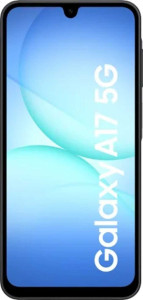
Samsung Galaxy A17 5G
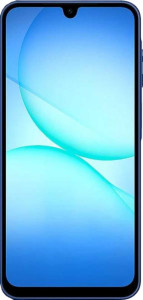
Samsung Galaxy M17 5G

Samsung Galaxy A17 5G Samsung Galaxy M17 5G

Overview

Welcome to our detailed spec comparison between the Samsung Galaxy A17 5G and the Samsung Galaxy M17 5G. These two mid-range 5G smartphones share a remarkably similar foundation, from their OLED displays and Exynos 1330 chipsets to their 5000 mAh batteries. Yet subtle distinctions in internal storage and camera aperture may influence your final decision. Read on as we break down every specification side by side.

Common Features

  • Both phones are water resistant with an IP54 ingress protection rating.
  • Both phones weigh 192 g.
  • Both phones are 7.5 mm thick.
  • Both phones measure 77.9 mm in width and 164.4 mm in height.
  • Both phones feature an OLED/AMOLED display.
  • Both phones have a 6.7″ screen size with a resolution of 1080 x 2340 px and a pixel density of 385 ppi.
  • Both phones support a 90Hz refresh rate.
  • Both phones offer a typical brightness of 800 nits.
  • Both phones are protected by Gorilla Glass Victus.
  • Both phones are powered by the Samsung Exynos 1330 chipset built on a 5 nm process.
  • Both phones come with 8GB of RAM running at 3200 MHz.
  • Both phones feature a triple rear camera system with 50, 5, and 2 MP sensors.
  • Both phones include optical image stabilization on the main camera.
  • Both phones have a 13 MP front camera.
  • Both phones run Android 15.
  • Both phones have a 5000 mAh battery with 25W fast charging support.
  • Both phones lack wireless charging and reverse wireless charging.
  • Neither phone includes a 3.5 mm audio jack or stereo speakers.
  • Both phones support 5G, NFC, Bluetooth 5.3, Wi-Fi 5 (802.11ac), USB Type-C, and dual SIM.
  • Both phones have an external memory slot.

Main Differences

  • Internal storage is 256GB on Samsung Galaxy A17 5G and 128GB on Samsung Galaxy M17 5G.
  • The aperture of the third rear camera lens is f/2.4 on Samsung Galaxy A17 5G and f/2.2 on Samsung Galaxy M17 5G.
Specs Comparison
Samsung Galaxy A17 5G

Samsung Galaxy A17 5G

Samsung Galaxy M17 5G

Samsung Galaxy M17 5G

Design:
water resistance Water resistant Water resistant
weight 192 g 192 g
thickness 7.5 mm 7.5 mm
width 77.9 mm 77.9 mm
height 164.4 mm 164.4 mm
volume 96.0507 cm³ 96.0507 cm³
Ingress Protection (IP) rating IP54 IP54
has a rugged build
can be folded

In terms of design, the Samsung Galaxy A17 5G and Samsung Galaxy M17 5G are completely identical across every measurable dimension. Both share the same 164.4 × 77.9 × 7.5 mm footprint, the same 192 g weight, and an identical volume of 96.05 cm³. In practice, this means picking up either device will feel exactly the same in hand — neither offers a slimmer profile, a lighter feel, or a more compact form factor.

Both phones carry an IP54 rating, meaning they offer equivalent protection against dust ingress and water splashing from any direction. This is a meaningful real-world feature — users can feel confident using either device in light rain or near a sink — but neither reaches the higher waterproofing standards (such as IP67 or IP68) found on premium devices. Neither model has a rugged build or a foldable form factor, placing both squarely in the standard candy-bar smartphone category.

The verdict here is an absolute tie. There is not a single design spec — size, weight, water resistance, or build type — that differentiates the A17 5G from the M17 5G. If design is your primary decision factor, you will need to look at other specification groups to find a meaningful distinction between these two devices.

Display:
Display type OLED/AMOLED OLED/AMOLED
screen size 6.7" 6.7"
pixel density 385 ppi 385 ppi
resolution 1080 x 2340 px 1080 x 2340 px
refresh rate 90Hz 90Hz
brightness (typical) 800 nits 800 nits
has branded damage-resistant glass
Gorilla Glass version Gorilla Glass Victus Gorilla Glass Victus
supports HDR10
supports HDR10+
Always-On Display
supports Dolby Vision
Has a secondary screen
has a touch screen

Both the Galaxy A17 5G and Galaxy M17 5G feature a 6.7-inch AMOLED panel running at 1080 × 2340 px with a pixel density of 385 ppi — sharp enough that individual pixels are virtually imperceptible at normal viewing distances. The AMOLED technology ensures deep blacks, vivid colors, and power efficiency when displaying dark content, all of which translate directly to a more enjoyable everyday experience for media consumption and general use.

A 90Hz refresh rate gives scrolling and animations a noticeably smoother feel compared to standard 60Hz displays, without the battery cost of a 120Hz panel. At 800 nits typical brightness, both screens hold up reasonably well in moderately bright outdoor conditions. Screen durability is also identical — Gorilla Glass Victus is among the toughest mainstream protective glass available, offering strong resistance to drops and scratches. The presence of Always-On Display on both models adds practical convenience, letting users check time and notifications without fully waking the screen.

As with the Design category, this is a complete tie. Every display specification — panel type, size, resolution, refresh rate, brightness, glass protection, and software features — is identical between the two devices. Neither phone holds any display advantage over the other.

Performance:
internal storage 256GB 128GB
RAM 8GB 8GB
Chipset (SoC) name Samsung Exynos 1330 Samsung Exynos 1330
GPU name Mali G68 MP2 Mali G68 MP2
CPU speed 2 x 2.4 & 6 x 2 GHz 2 x 2.4 & 6 x 2 GHz
GPU clock speed 800 MHz 800 MHz
Has integrated LTE
RAM speed 3200 MHz 3200 MHz
semiconductor size 5 nm 5 nm
Supports 64-bit
DirectX version DirectX 12 DirectX 12
Has integrated graphics
OpenGL ES version 3.2 3.2
Uses big.LITTLE technology
CPU threads 8 threads 8 threads
Has NX bit
maximum memory bandwidth 51.2 GB/s 51.2 GB/s
OpenCL version 2 2
maximum memory amount 8GB 8GB
GPU turbo 950 MHz 950 MHz
Thermal Design Power (TDP) 5W 5W
DDR memory version 5 5

Under the hood, the Galaxy A17 5G and Galaxy M17 5G are powered by the same Samsung Exynos 1330 chipset, built on a 5 nm process. This modern fabrication node delivers a solid balance of performance and energy efficiency for a mid-range device. The 8-core CPU configuration — two performance cores at 2.4 GHz and six efficiency cores at 2.0 GHz using big.LITTLE architecture — handles everyday multitasking, streaming, and light gaming without breaking a sweat, while keeping power consumption in check during less demanding tasks.

Graphics workloads are handled by the Mali G68 MP2 GPU, with a boost clock of 950 MHz and support for DirectX 12 and OpenGL ES 3.2. Both phones carry 8 GB of LPDDR5 RAM running at 3200 MHz, which is ample for smooth multitasking and keeps app reloads to a minimum. With a memory bandwidth of 51.2 GB/s, the shared hardware platform delivers consistent, predictable performance across both models.

The sole differentiator in this category is internal storage: the A17 5G ships with 256 GB versus the M17 5G's 128 GB. In practical terms, 256 GB accommodates significantly more photos, videos, apps, and offline content before requiring any housekeeping — a meaningful advantage for heavy users. This gives the Galaxy A17 5G a clear edge in performance specs, not because of raw processing power, but because of the substantially greater on-device storage headroom it provides.

Cameras:
megapixels (main camera) 50 & 5 & 2 MP 50 & 5 & 2 MP
wide aperture (main camera) 1.8 & 2.2 & 2.4f 1.8 & 2.2 & 2.2f
Has a dual-lens (or multi-lens) main camera
megapixels (front camera) 13MP 13MP
has built-in optical image stabilization
video recording (main camera) 1080 x 30 fps 1080 x 30 fps
Has a dual-tone LED flash
number of flash LEDs 1 1
has a BSI sensor
has a CMOS sensor
has continuous autofocus when recording movies
Has phase-detection autofocus for photos
supports slow-motion video recording
has a built-in HDR mode
has manual exposure
has a flash
optical zoom 0x 0x
has manual ISO
has a serial shot mode
has manual focus
has a front camera
Has laser autofocus
Shoots 360° panorama
has manual white balance
shoots raw
has touch autofocus
has manual shutter speed
can create panoramas in-camera
wide aperture (front camera) 2f 2f
Has timelapse function
Has a front-facing LED flash
has a dual-lens (or multi-lens) front camera
supports HDR10 recording
supports Dolby Vision recording
has a front-facing camera under the display
Has a RGB LED flash
has 3D photo/video recording capabilities

The camera hardware on the Galaxy A17 5G and Galaxy M17 5G is nearly identical: both feature a triple-lens rear system led by a 50 MP main sensor at f/1.8, paired with a 5 MP and a 2 MP auxiliary lens. The wide f/1.8 aperture on the primary sensor is the most impactful figure here — it allows more light to reach the sensor, which directly improves low-light performance and produces a shallower depth of field for portrait-style shots. Both phones also include optical image stabilization (OIS), which reduces blur from hand movement during photos and video, a genuinely useful feature at this price tier.

The one measurable difference between the two lies in the aperture of the third lens: the M17 5G offers f/2.2 on its auxiliary lens compared to the A17 5G's f/2.4. A wider aperture on a secondary or macro-type lens means marginally more light intake, which can result in slightly less noise in close-up or depth-sensing shots. However, given that 2 MP auxiliary lenses primarily serve depth-mapping or macro roles rather than delivering standalone image quality, the real-world impact of this difference is minimal for most users.

On the front, both devices share a 13 MP f/2.0 selfie camera with no flash, and video is capped at 1080p at 30fps on both. The Galaxy M17 5G technically holds a marginal edge due to its slightly wider third-lens aperture, but the gap is so narrow in practice that this category is effectively a tie for the overwhelming majority of shooting scenarios.

Operating system:
Android version Android 15 Android 15
has clipboard warnings
has location privacy options
has camera/microphone privacy options
has Mail Privacy Protection
has theme customization
can block app tracking
blocks cross-site tracking
has on-device machine learning
has notification permissions
has media picker
Can play games while they download
has dark mode
has Wi-Fi password sharing
has battery health check
has an extra dim mode
has focus modes
has dynamic theming
can offload apps
Has customizable notifications
has Live Text
has full-page screenshots
supports split screen
gets direct OS updates
has PiP
Can be used as a PC
Has sharing intents
has a child lock
Supports widgets
Is free and open source
Has offline voice recognition
has voice commands
Tracks the current position of a mobile device
is a multi-user system
has Quick Start

Running Android 15 out of the box, both the Galaxy A17 5G and Galaxy M17 5G arrive with Samsung's most current software foundation. Android 15 brings a refined privacy model, and both phones implement it fully — users get granular controls over location, camera, and microphone access on a per-app basis, as well as app tracking blocks. For privacy-conscious users, this is a meaningful baseline that covers the core concerns around data exposure without requiring any third-party tools.p>

Beyond privacy, the shared feature set is extensive and practically useful. Dynamic theming, dark mode, and full notification customization cater to personalization, while productivity-oriented features like split-screen multitasking, Picture-in-Picture, and the ability to offload unused apps round out a capable daily-driver experience. On-device machine learning powers features like Live Text — allowing users to interact with text found in photos — without sending data to the cloud, which is both a privacy and performance win. Neither device supports direct OS updates (bypassing the manufacturer update layer), which is a minor long-term consideration for update speed.

There is nothing to separate these two phones on software: every single OS feature and privacy capability listed is identical across both models. This category is an unambiguous tie, and software experience should play no role in choosing between the A17 5G and M17 5G.

Battery:
battery power 5000 mAh 5000 mAh
has wireless charging
Supports fast charging
charging speed 25W 25W
has reverse wireless charging
has a removable battery
has a battery level indicator
has a rechargeable battery

A 5000 mAh battery is a well-established sweet spot for mid-range smartphones — large enough to comfortably last a full day of mixed use for most people, and often stretching into a second day for lighter users. Paired with the power-efficient Exynos 1330 chipset and AMOLED display shared by both devices, this capacity should translate to reliable endurance in real-world use. Both the Galaxy A17 5G and Galaxy M17 5G carry this exact same battery, so neither has any stamina advantage over the other.

Charging comes in at 25W on both phones, which represents a reasonable — if not class-leading — speed for this segment. At 25W, a full charge from near-empty typically takes around 70–90 minutes, which is fast enough to top up meaningfully during a short break. Neither model supports wireless charging or reverse wireless charging, which is a notable omission for users who have invested in a wireless charging ecosystem, but not unusual at this price tier.

Every battery specification — capacity, charging speed, and feature set — is identical between the two devices. This is another clear tie, and battery life or charging capabilities offer no basis for choosing one model over the other.

Audio:
has a socket for a 3.5 mm audio jack
has stereo speakers
has aptX
has LDAC
has aptX HD
has aptX Adaptive
has aptX Lossless
Has a radio

Audio is arguably the weakest category for both devices, and the specs make that clear. Neither the Galaxy A17 5G nor the Galaxy M17 5G includes a 3.5 mm headphone jack, meaning wired listening requires a USB-C adapter — an added inconvenience that many users at this price point would reasonably expect to avoid. More notably, neither phone offers stereo speakers, so all audio output is channeled through a single speaker, which limits the immersiveness of media playback compared to devices with a dual-speaker setup.

On the wireless audio front, the absence of high-resolution codecs — no aptX, aptX HD, LDAC, or any of their variants — means Bluetooth audio is limited to standard quality. For casual listening this is unlikely to matter, but users with premium wireless headphones capable of high-res audio transmission will not be able to take full advantage of that hardware. There is also no built-in FM radio on either device.

With every audio specification being identical — and uniformly limited — this category is a tie, though it is worth noting that both phones make the same trade-offs. Audio-focused users should factor these shared omissions into their decision, as neither model offers an advantage here.

Connectivity & Features:
release date August 2025 October 2025
has 5G support
Wi-Fi version Wi-Fi 4 (802.11n), Wi-Fi 5 (802.11ac) Wi-Fi 4 (802.11n), Wi-Fi 5 (802.11ac)
SIM cards 2 SIM 2 SIM
Bluetooth version 5.3 5.3
has an external memory slot
Has USB Type-C
USB version 2 2
has NFC
download speed 2550 MBits/s 2550 MBits/s
upload speed 1280 MBits/s 1280 MBits/s
Has a fingerprint scanner
has emergency SOS via satellite
has crash detection
is DLNA-certified
has a gyroscope
supports ANT+
Has a heart rate monitor
has GPS
has a compass
supports Wi-Fi
Has an infrared sensor
has an accelerometer
has a cellular module
Has a barometer
has an HDMI output
Uses 3D facial recognition
Has an iris scanner
Stylus included
supports Galileo
Has motion tracking
Has optical tracking
Has a built-in projector

Connectivity fundamentals are well-covered on both the Galaxy A17 5G and Galaxy M17 5G. Both support 5G, Wi-Fi 5 (802.11ac), and Bluetooth 5.3, forming a solid wireless trifecta for modern use. Bluetooth 5.3 in particular brings improved connection stability and more efficient power consumption compared to older versions — a benefit for users who rely heavily on wireless audio or accessories. The dual-SIM capability adds flexibility for users who want to separate personal and work lines, or take advantage of local data plans while traveling.

Both phones include NFC, enabling contactless payments and quick device pairing — a genuinely useful everyday feature. An external memory slot is also present on both, which partially offsets the storage difference noted in the Performance category; the M17 5G's 128 GB base can be expanded via microSD. The USB-C port runs at USB 2.0 speeds, which is functional but limits wired data transfer rates compared to USB 3.x — not a dealbreaker for most users, but worth noting for those who frequently move large files. Location support covers GPS, Galileo, and a compass, offering reliable positioning across multiple satellite systems.

Every connectivity and feature spec is identical across both models, making this yet another tie. Neither phone carves out any advantage here, whether in wireless standards, sensors, or peripheral support.

Miscellaneous:
has a video light
Has sapphire glass display
Has a curved display
Has an e-paper display

The Miscellaneous category covers a handful of niche hardware traits, and the data here is straightforward. Both the Galaxy A17 5G and Galaxy M17 5G include a video light — essentially the rear flash doubling as a torch during video recording — which is a standard and expected feature on any modern smartphone. Neither device features a curved display, which keeps the screen flush and flat, reducing accidental edge touches and making screen protectors easier to apply.

The absence of sapphire glass on both phones is unsurprising given their mid-range positioning — sapphire glass remains largely exclusive to premium and rugged devices due to its significantly higher cost. Similarly, neither model uses an e-paper display, which is a highly specialized technology found only in niche productivity or e-reader hybrid devices, so its absence is entirely expected here.

With no differences whatsoever across any of these specs, this category is a tie. The traits covered are largely confirmations of standard mid-range hardware conventions rather than meaningful differentiators, and neither the A17 5G nor the M17 5G stands apart from the other in any respect here.

Comparison Summary & Verdict

The Samsung Galaxy A17 5G and Samsung Galaxy M17 5G are nearly identical devices, sharing the same Exynos 1330 chipset, 6.7″ 90Hz OLED display, IP54 water resistance, and 5000 mAh battery with 25W fast charging. The meaningful distinctions are narrow but practical. The A17 5G offers 256GB of internal storage, making it the stronger pick for users who store large amounts of media, games, or files locally. The M17 5G comes with 128GB of storage but gains a slightly wider f/2.2 aperture on its third rear lens, which may offer a marginal low-light edge in certain shooting scenarios. If storage capacity is your priority, the A17 5G is the clear choice. If you need less storage and value that small optical difference, the M17 5G delivers.

Samsung Galaxy A17 5G
Buy Samsung Galaxy A17 5G if...

Buy the Samsung Galaxy A17 5G if you need more onboard storage, as its 256GB capacity gives you significantly more room for apps, photos, and files compared to the M17 5G.

Samsung Galaxy M17 5G
Buy Samsung Galaxy M17 5G if...

Buy the Samsung Galaxy M17 5G if 128GB of storage meets your needs and you prefer the marginally wider f/2.2 aperture on the third rear camera lens.