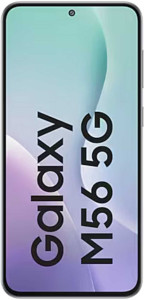
The connectivity foundation is well-matched: both phones support 5G, Wi-Fi 6, Bluetooth 5.3, USB Type-C, GPS, and Galileo. Sensors like the gyroscope, accelerometer, and compass are present on both. Where the two diverge, however, the differences carry genuine day-to-day weight. The A36 5G includes NFC, which the M56 5G entirely lacks — meaning the A36 5G supports contactless payments, transit cards, and quick device pairing, while the M56 5G cannot perform any of these functions.
SIM flexibility is another area where the A36 5G pulls ahead. It supports eSIM alongside physical SIM cards, offering up to two eSIMs — a major convenience for frequent travelers or users who want to manage multiple numbers without carrying a second physical SIM. The M56 5G is limited to two physical SIMs only, with no eSIM capability. On the cellular speed side, the M56 5G does hold an advantage in download speed at 3790 Mbits/s versus 2900 Mbits/s, though the A36 5G edges ahead in upload at 1600 Mbits/s versus 1280 Mbits/s — differences that are unlikely to be felt in real-world 5G usage but are worth noting.
The A36 5G has a clear connectivity advantage. The addition of NFC and eSIM support are practical, high-utility features that affect daily use in a way that a marginal cellular speed difference does not. For users who rely on mobile payments or dual-number flexibility, the M56 5G's omissions here are meaningful limitations.