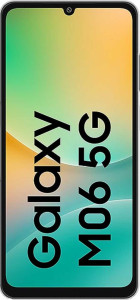
Samsung Galaxy M06 5G
Vivo Y19 5G

Samsung Galaxy M06 5G Vivo Y19 5G

Overview

Welcome to our in-depth comparison of the Samsung Galaxy M06 5G and the Vivo Y19 5G — two budget-friendly 5G smartphones that share a surprising amount of common ground. Both pack the same chipset, display, and storage configuration, yet diverge in meaningful ways across camera design, battery and charging, water resistance, and software. Read on to discover which of these devices better fits your needs.

Common Features

  • Both phones use an LCD IPS display type.
  • Both phones have a 6.74″ screen size.
  • Both phones have a pixel density of 260 ppi.
  • Both phones share a 720 x 1600 px resolution.
  • Both phones offer a 90Hz refresh rate.
  • Damage-resistant glass branding is not present on either phone.
  • HDR10 support is not available on either phone.
  • HDR10+ support is not available on either phone.
  • Both phones are powered by the MediaTek Dimensity 6300 chipset.
  • Both phones have 6GB of RAM and 128GB of internal storage.
  • Both phones use an Arm Mali-G57 MC2 GPU running at 950 MHz.
  • Both phones achieve a Geekbench 6 multi-core score of 2012 and a single-core score of 782.
  • Both phones record main camera video at 1080p 30 fps.
  • Optical image stabilization is not available on either phone.
  • Both phones support phase-detection autofocus for photos.
  • Both phones support continuous autofocus during video recording.
  • Both phones support slow-motion video recording.
  • Both phones run on Android and include clipboard warnings, location privacy options, and camera/microphone privacy options.
  • Cross-site tracking blocking is not available on either phone.
  • Both phones support fast charging but do not support wireless charging.
  • Neither phone has a removable battery.
  • Both phones feature stereo speakers.
  • LDAC and aptX Lossless audio are not supported on either phone.
  • Both phones support 5G, Wi-Fi 4 and Wi-Fi 5, dual SIM, external memory, USB Type-C 2.0, and a 3300 Mbits/s download speed.
  • NFC is not available on either phone.
  • Both phones lack a curved display, e-paper display, or sapphire glass.

Main Differences

  • Water resistance is present on the Vivo Y19 5G but not available on the Samsung Galaxy M06 5G.
  • Weight is 191 g on the Samsung Galaxy M06 5G and 199 g on the Vivo Y19 5G.
  • Thickness is 8 mm on the Samsung Galaxy M06 5G and 8.19 mm on the Vivo Y19 5G.
  • Width is 77.4 mm on the Samsung Galaxy M06 5G and 76.95 mm on the Vivo Y19 5G.
  • Main camera resolution is 50 MP on the Samsung Galaxy M06 5G and 13 & 0.08 MP on the Vivo Y19 5G.
  • Main camera aperture is f/1.8 on the Samsung Galaxy M06 5G and f/3 & f/2.2 on the Vivo Y19 5G.
  • A multi-lens main camera is present on the Vivo Y19 5G but not on the Samsung Galaxy M06 5G.
  • Front camera resolution is 8 MP on the Samsung Galaxy M06 5G and 5 MP on the Vivo Y19 5G.
  • Front camera aperture is f/2 on the Samsung Galaxy M06 5G and f/2.2 on the Vivo Y19 5G.
  • The number of flash LEDs is 1 on the Samsung Galaxy M06 5G and 2 on the Vivo Y19 5G.
  • Built-in HDR mode is present on the Vivo Y19 5G but not available on the Samsung Galaxy M06 5G.
  • Android version is Android 15 on the Samsung Galaxy M06 5G and Android 14 on the Vivo Y19 5G.
  • App offloading is supported on the Samsung Galaxy M06 5G but not available on the Vivo Y19 5G.
  • Battery capacity is 5000 mAh on the Samsung Galaxy M06 5G and 5500 mAh on the Vivo Y19 5G.
  • Charging speed is 25W on the Samsung Galaxy M06 5G and 15W on the Vivo Y19 5G.
  • A 3.5 mm audio jack is present on the Vivo Y19 5G but not available on the Samsung Galaxy M06 5G.
  • Bluetooth version is 5.3 on the Samsung Galaxy M06 5G and 5.2 on the Vivo Y19 5G.
Specs Comparison
Samsung Galaxy M06 5G

Samsung Galaxy M06 5G

Vivo Y19 5G

Vivo Y19 5G

Design:
water resistance None Water resistant
weight 191 g 199 g
thickness 8 mm 8.19 mm
width 77.4 mm 76.95 mm
height 167.4 mm 167.3 mm
volume 103.65408 cm³ 105.43588965 cm³
has a rugged build
can be folded

In terms of physical dimensions, these two phones are remarkably close. Both stand at essentially the same height (~167 mm) and share a similar width, making them near-identical in hand feel. The Samsung Galaxy M06 5G is marginally thinner at 8 mm versus the Vivo Y19 5G's 8.19 mm, and also slightly lighter at 191 g compared to 199 g — a difference small enough that most users would not notice it in daily use.

Where the two devices meaningfully diverge is durability. The Vivo Y19 5G offers water resistance, while the Samsung Galaxy M06 5G has none. In practical terms, this means the Vivo can better handle rain, splashes, or accidental spills — a genuine day-to-day advantage for users who are active outdoors or prone to liquid exposure. Neither phone carries a rugged build certification, so the Vivo's water resistance is not a full ruggedization, but it is still a meaningful protective edge over no resistance at all.

Overall, the Vivo Y19 5G holds a clear design advantage in this group. The Samsung M06 5G's marginal gains in thinness and weight are too small to matter in real-world handling, while water resistance is a tangible, practical feature that directly impacts longevity and peace of mind.

Display:
Display type LCD, IPS LCD, IPS
screen size 6.74" 6.74"
pixel density 260 ppi 260 ppi
resolution 720 x 1600 px 720 x 1600 px
refresh rate 90Hz 90Hz
has branded damage-resistant glass
supports HDR10
supports HDR10+
Always-On Display
supports Dolby Vision
Has a secondary screen
has a touch screen

The display specs for these two phones are, point for point, identical. Both feature a 6.74″ IPS LCD panel with a 720 x 1600 px resolution, landing at 260 ppi — a pixel density that is adequate for everyday use at typical viewing distances, though noticeably below the sharpness of Full HD displays found on more premium devices.

The shared 90Hz refresh rate is a welcome inclusion at this price tier, delivering visibly smoother scrolling and animations compared to standard 60Hz screens. Neither phone compensates for the LCD panel type with any HDR support — no HDR10, HDR10+, or Dolby Vision — meaning color depth and contrast will reflect the inherent limitations of IPS LCD technology rather than any enhanced tone-mapping pipeline.

This group is a complete tie. There is no basis to favor one phone over the other on display alone — every measurable spec is shared, and the buying decision here should be driven entirely by other specification groups.

Performance:
internal storage 128GB 128GB
RAM 6GB 6GB
Chipset (SoC) name MediaTek Dimensity 6300 MediaTek Dimensity 6300
GPU name Arm Mali-G57 MC2 Arm Mali-G57 MC2
CPU speed 2 x 2.4 & 6 x 2 GHz 2 x 2.4 & 6 x 2 GHz
Geekbench 6 result (multi) 2012 2012
Geekbench 6 result (single) 782 782
GPU clock speed 950 MHz 950 MHz
Has integrated LTE
RAM speed 2133 MHz 2133 MHz
semiconductor size 6 nm 6 nm
Supports 64-bit
DirectX version DirectX 12 DirectX 12
Has integrated graphics
Uses big.LITTLE technology
CPU threads 8 threads 8 threads
Uses HMP
maximum memory bandwidth 17.07 GB/s 17.07 GB/s
L2 cache 1 MB 1 MB
L1 cache 512 KB 512 KB
maximum memory amount 12GB 12GB
uses multithreading
DDR memory version 4 4
L3 cache 2 MB 2 MB

Both phones are powered by the exact same silicon — the MediaTek Dimensity 6300, built on a 6 nm process. This is a capable mid-range chipset that balances efficiency and performance well for its class, pairing an octa-core CPU with two performance cores clocked at 2.4 GHz alongside six efficiency cores at 2.0 GHz. The Geekbench 6 scores — 782 single-core and 2012 multi-core — are identical across both devices, confirming there is no tuning or configuration difference between them at the SoC level.

Storage and memory configuration is equally matched: both ship with 6 GB of DDR4 RAM and 128 GB of internal storage. The shared Mali-G57 MC2 GPU with a 950 MHz clock and DirectX 12 support puts both phones in the same bracket for casual gaming and graphics workloads — sufficient for most everyday titles, but not suited to demanding 3D games at high settings.

Much like the display group, performance is a complete tie — every spec, benchmark, and configuration is shared. Neither phone holds any processing or memory advantage over the other, and performance should not factor into choosing between them.

Cameras:
megapixels (main camera) 50 MP 13 & 0.08 MP
wide aperture (main camera) 1.8f 3 & 2.2f
Has a dual-lens (or multi-lens) main camera
megapixels (front camera) 8MP 5MP
has built-in optical image stabilization
video recording (main camera) 1080 x 30 fps 1080 x 30 fps
Has a dual-tone LED flash
number of flash LEDs 1 2
has a BSI sensor
has a CMOS sensor
has continuous autofocus when recording movies
Has phase-detection autofocus for photos
supports slow-motion video recording
has a built-in HDR mode
has manual exposure
has a flash
optical zoom 0x 0x
has manual ISO
has a serial shot mode
has manual focus
has a front camera
Has laser autofocus
Shoots 360° panorama
has manual white balance
shoots raw
has touch autofocus
has manual shutter speed
can create panoramas in-camera
wide aperture (front camera) 2f 2.2f
Has timelapse function
Has a front-facing LED flash
has a dual-lens (or multi-lens) front camera
supports HDR10 recording
supports Dolby Vision recording
has a front-facing camera under the display
Has a RGB LED flash
has 3D photo/video recording capabilities

The main camera difference here is significant. The Samsung Galaxy M06 5G features a single 50 MP sensor with a wide f/1.8 aperture, while the Vivo Y19 5G opts for a dual-camera setup led by a 13 MP primary lens at a much narrower f/3.0 aperture. The resolution gap alone is substantial — 50 MP captures considerably more detail and offers far greater flexibility for cropping — but the aperture difference is arguably even more impactful in real-world shooting. An f/1.8 lens admits roughly 2.5x more light than an f/3.0 lens, translating to meaningfully better low-light and indoor photography on the M06 5G.

The Vivo's second lens, rated at just 0.08 MP, functions effectively as a depth sensor rather than a true second camera — so the ″dual-camera″ label adds limited practical versatility. The Vivo does counter with a built-in HDR mode and two flash LEDs versus the M06 5G's one, which can improve flash coverage and exposure balance in dark scenes. On the front, Samsung again leads with an 8 MP f/2.0 selfie camera compared to Vivo's 5 MP f/2.2, offering both higher resolution and a slightly wider aperture for self-portraits.

The Samsung Galaxy M06 5G holds a clear camera advantage in this group. Its 50 MP main sensor and f/1.8 aperture outclass the Vivo's primary shooter in both resolution and light-gathering ability — two factors that directly define photo quality across the widest range of shooting conditions.

Operating system:
Android version Android 15 Android 14
has clipboard warnings
has location privacy options
has camera/microphone privacy options
has Mail Privacy Protection
has theme customization
can block app tracking
blocks cross-site tracking
has on-device machine learning
has notification permissions
has media picker
Can play games while they download
has dark mode
has Wi-Fi password sharing
has battery health check
has an extra dim mode
has focus modes
has dynamic theming
can offload apps
Has customizable notifications
has Live Text
has full-page screenshots
supports split screen
gets direct OS updates
has PiP
Can be used as a PC
Has sharing intents
has a child lock
Supports widgets
Is free and open source
Has offline voice recognition
has voice commands
Tracks the current position of a mobile device
is a multi-user system
has Quick Start

The most concrete distinction in this group is the Android version: the Samsung Galaxy M06 5G ships with Android 15, while the Vivo Y19 5G runs Android 14. A newer Android version means access to the latest platform-level security patches, privacy enhancements, and system behaviors out of the box — without waiting for an OTA update that may or may not arrive promptly, particularly given that neither phone receives direct OS updates.

The only other functional difference is app offloading — available on the M06 5G but absent on the Vivo Y19 5G. This feature allows unused apps to be temporarily removed from storage while retaining their data, freeing up space without requiring a full uninstall. On a 128 GB device it is a convenience rather than a necessity, but it is a useful storage management tool the Vivo simply does not offer. Everything else — privacy controls, dark mode, split-screen, PiP, dynamic theming, and the full suite of productivity and accessibility features — is shared identically between both phones.

The Samsung Galaxy M06 5G has a clear edge in this group. Running a full Android generation ahead at launch, combined with the added utility of app offloading, gives it a tangible software advantage — especially relevant given that neither device is positioned to receive timely OS upgrades going forward.

Battery:
battery power 5000 mAh 5500 mAh
has wireless charging
Supports fast charging
charging speed 25W 15W
has a removable battery
has a battery level indicator
has a rechargeable battery

Battery is where these two phones make a genuine trade-off against each other. The Vivo Y19 5G carries a larger 5500 mAh cell versus the Samsung Galaxy M06 5G's 5000 mAh — a 10% capacity advantage that, on an identical chipset and display, realistically translates to a noticeable extension in screen-on time between charges. For users who prioritize going longer between top-ups, this gap is meaningful.

The M06 5G counters with faster replenishment: its 25W charging significantly outpaces the Vivo's 15W. In practical terms, 25W can deliver a substantial charge in a short break, while 15W demands considerably more patience for a full cycle. Neither phone supports wireless charging, so the wired speed difference is the only charging variable in play.

This group has no straightforward winner — it is a genuine trade-off between endurance and charging speed. Users who rarely have access to a charger during the day will favor the Vivo Y19 5G's larger battery, while those who prefer quick top-ups and can plug in more regularly will find the M06 5G's 25W charging more practical.

Audio:
has a socket for a 3.5 mm audio jack
has stereo speakers
has LDAC
has aptX Lossless

Both phones deliver stereo speakers — a welcome feature at this price tier that makes a tangible difference for media consumption, gaming, and speakerphone calls compared to mono setups. Neither device supports high-fidelity Bluetooth codecs like LDAC or aptX Lossless, so wireless audio quality will be capped at standard levels on both.

The single differentiator in this group carries real-world weight: the Vivo Y19 5G retains a 3.5 mm headphone jack, while the Samsung Galaxy M06 5G omits it entirely. For users who rely on wired headphones or earphones — whether for audio quality, convenience, or simply avoiding the need to charge yet another accessory — this is a meaningful practical distinction. It also removes the dependency on dongles or Bluetooth for private listening on the M06 5G.

The Vivo Y19 5G has a clear audio advantage here. Stereo speakers are equally matched across both devices, but the presence of a headphone jack on the Vivo addresses a broader range of use cases and user preferences — a feature whose absence on the M06 5G is a limitation with no compensating audio upgrade to offset it.

Connectivity & Features:
release date February 2025 April 2025
has 5G support
Wi-Fi version Wi-Fi 4 (802.11n), Wi-Fi 5 (802.11ac) Wi-Fi 4 (802.11n), Wi-Fi 5 (802.11ac)
SIM cards 2 SIM 2 SIM
Bluetooth version 5.3 5.2
has an external memory slot
Has USB Type-C
USB version 2 2
has NFC
download speed 3300 MBits/s 3300 MBits/s
Has a fingerprint scanner
has emergency SOS via satellite
has crash detection
is DLNA-certified
has a gyroscope
supports ANT+
Has a heart rate monitor
has GPS
has a compass
supports Wi-Fi
Has an infrared sensor
has an accelerometer
has a cellular module
Has a barometer
has an HDMI output
Uses 3D facial recognition
Has an iris scanner
Stylus included
supports Galileo
Has motion tracking
Has optical tracking
Has a built-in projector

Across the broad connectivity landscape, these two phones are strikingly well-matched. Both support 5G, dual SIM, Wi-Fi 5 (802.11ac), USB Type-C (USB 2.0), expandable storage via microSD, and an identical peak download speed of 3300 Mbits/s. For everyday tasks — streaming, browsing, file transfers, and cellular connectivity — users of either phone will have an effectively identical experience.

The sole technical distinction in this group is the Bluetooth version: the Samsung Galaxy M06 5G ships with Bluetooth 5.3 versus the Vivo Y19 5G's Bluetooth 5.2. Version 5.3 introduced refinements to connection reliability and energy efficiency over 5.2, but the practical difference for typical use cases such as audio streaming or peripheral pairing is minimal. Neither phone features NFC, which is a shared limitation worth noting for users who rely on contactless payments or quick device pairing.

This group is effectively a near-complete tie. The M06 5G's Bluetooth 5.3 is a marginal technical advantage over 5.2, but the gap is too small to meaningfully influence a buying decision. Shared absences — most notably no NFC on either device — are the more consequential takeaway for users who need that functionality.

Miscellaneous:
has a video light
Has sapphire glass display
Has a curved display
Has an e-paper display

The miscellaneous spec group offers no basis for differentiation whatsoever. Every data point — the presence of a video light, the absence of sapphire glass, a curved display, and an e-paper display — is identical across both the Samsung Galaxy M06 5G and the Vivo Y19 5G.

This is a complete tie. No feature in this group favors either device, and it should carry no weight in the buying decision.

Comparison Summary & Verdict

After examining every specification, it is clear that both phones are closely matched at their core, sharing the same MediaTek Dimensity 6300 chipset, 6.74″ 90Hz LCD display, and 128GB of storage. However, their differences reveal two distinct personalities. The Samsung Galaxy M06 5G stands out with a sharper 50 MP main camera, faster 25W charging, a newer Android 15 OS, and a lighter 191 g body — making it the stronger pick for camera enthusiasts and users who value quick top-ups and up-to-date software. The Vivo Y19 5G, on the other hand, counters with a larger 5500 mAh battery, water resistance, a 3.5 mm headphone jack, dual-LED flash, and a built-in HDR camera mode — appealing to users who prioritize endurance, durability, and versatile connectivity.

Samsung Galaxy M06 5G
Buy Samsung Galaxy M06 5G if...

Buy the Samsung Galaxy M06 5G if you want a sharper 50 MP camera, faster 25W charging, and the latest Android 15 experience in a lighter body.

Vivo Y19 5G
Buy Vivo Y19 5G if...

Buy the Vivo Y19 5G if you prioritize a larger 5500 mAh battery, water resistance, and the convenience of a 3.5 mm headphone jack.