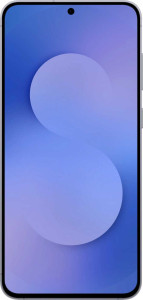
Shared across both phones is a solid baseline: 5G, Bluetooth 5.4, NFC, GPS with Galileo support, a barometer, and a full suite of motion sensors. For most everyday connectivity tasks, both phones are equally capable. The divergences, however, stack up consistently in one direction.
The Galaxy S25 pulls ahead in three meaningful areas. First, it supports Wi-Fi 7 (802.11be), the latest wireless standard offering significantly higher throughput and lower latency on compatible routers, while the FE tops out at Wi-Fi 6E. Second, the S25's USB port is USB 3.2 versus the FE's USB 2.0 — a generational gap that matters when transferring large files like 4K video or RAW photo bursts, where USB 3.2 can be many times faster. Third, the S25 accommodates 2 physical SIMs and 2 eSIMs simultaneously, compared to the FE's single SIM and single eSIM slot — a practical advantage for frequent travelers or users managing personal and work lines. The cellular speed gap (10,000 vs 9,640 Mbits/s download; 3,500 vs 2,550 Mbits/s upload) is also notable on the upload side, where the S25 holds a meaningful lead for tasks like cloud backups or live streaming.
The Galaxy S25 is the clear winner in this category. Wi-Fi 7 support future-proofs the device as compatible infrastructure becomes more widespread, the USB 3.2 port is a genuine workflow advantage for power users, and the dual-SIM/dual-eSIM flexibility adds real utility for anyone managing multiple lines. The FE matches the S25 on the fundamentals but trails on every point of differentiation.