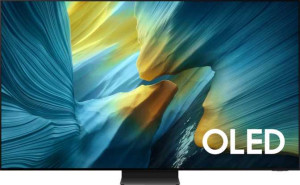
The most fundamental difference here is panel technology. The Samsung QA77S95F uses OLED, which delivers perfect blacks and infinite contrast by turning individual pixels completely off, while the TCL 85C7K relies on QLED Mini-LED, a backlit LCD that uses quantum dots and a dense array of local dimming zones to boost brightness and color. In practice, the Samsung will produce deeper shadows and more precise HDR highlights in dark scenes, whereas the TCL can push higher peak brightness levels — a real advantage in bright living rooms. The TCL also counters with Dolby Vision support, a dynamic HDR format the Samsung lacks entirely; for users streaming heavily from Netflix or Apple TV+, where Dolby Vision is the dominant premium HDR format, this is a tangible real-world gap.
On raw numbers, the Samsung edges out the TCL in refresh rate (165Hz vs 144Hz) and pixel density (57 ppi vs 52 ppi), the latter a direct consequence of fitting the same 4K resolution into a smaller 77-inch panel versus an 85-inch one. The higher pixel density means marginally sharper image detail at equivalent viewing distances, though both are within a range where differences are subtle from a typical sofa. The faster refresh rate gives the Samsung a slight advantage for gaming and fast-motion content. Both share identical adaptive sync support (AMD FreeSync Premium Pro), the same 10-bit depth, 1070 million colors, and identical 178° viewing angles, so those axes are a wash.
Overall, neither product is a clean winner — the choice hinges on use case. The Samsung QA77S95F holds the edge for cinematic picture quality thanks to OLED's contrast superiority and higher pixel density, plus a faster refresh rate for gamers. But the TCL 85C7K has a meaningful advantage for bright-room viewing, a larger screen, and critically, Dolby Vision compatibility that the Samsung cannot match. Buyers who prioritize HDR streaming ecosystems or screen real estate should weigh the TCL seriously despite its LCD-based panel.