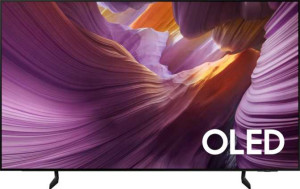
Samsung QN55S85FAF 55"
TCL 55C7K 55"

Samsung QN55S85FAF 55" TCL 55C7K 55"

Overview

Welcome to our detailed spec comparison between the Samsung QN55S85FAF 55″ and the TCL 55C7K 55″. Both TVs deliver a 4K UHD picture at 54.6″ with HDR10 and HDR10+ support, yet they take strikingly different approaches to display technology, design philosophy, and connectivity. Whether you care most about picture quality, refresh rate, or audio performance, this side-by-side breakdown will help you understand exactly where these two 55-inch sets diverge before you commit.

Common Features

  • Both TVs have a 4K (UHD) display resolution.
  • Both TVs share the same physical screen size of 54.6″.
  • Both TVs have a resolution of 3840 x 2160 px.
  • Both TVs have a pixel density of 81 ppi.
  • Both TVs support 1070 million display colors.
  • Both TVs feature a 10-bit bit depth.
  • HDR10 support is available on both products.
  • HDR10+ support is available on both products.
  • Bluetooth connectivity is available on both TVs.
  • Both TVs use HDMI 2.1 and include 4 HDMI ports.
  • Wi-Fi support is available on both TVs.
  • Both TVs include 1 RJ45 port.
  • Miracast support is available on both products.
  • Neither TV has an external memory slot.
  • Neither TV has a VGA connector.
  • Both TVs include AMD FreeSync and AMD FreeSync Premium adaptive synchronization.
  • Digital Out support is available on both TVs.
  • SRS TheaterSound HD is not available on either TV.
  • Stereo speakers are present on both TVs.
  • Dolby Atmos support is available on both products.
  • Dolby Audio support is available on both products.
  • Dolby Virtual support is not available on either TV.
  • Both TVs support HDMI ARC and HDMI eARC.
  • Both TVs support VESA mounting.
  • AirPlay support is available on both TVs.
  • Both TVs have a built-in smart TV platform.
  • Google Assistant compatibility is present on both TVs.
  • Neither TV is compatible with Siri or Apple HomeKit.
  • Remote smartphone support is available on both TVs.
  • Neither TV includes a rechargeable remote control.
  • USB recording support is available on both TVs.
  • Both TVs have a standby power consumption of 0.5W.
  • Both TVs support the same DVB standards: DVB-T, DVB-T2, DVB-C, DVB-S, and DVB-S2.

Main Differences

  • The display type is OLED/AMOLED on Samsung QN55S85FAF 55″ and QLED, LED-backlit, LCD, Mini-LED on TCL 55C7K 55″.
  • The refresh rate is 120Hz on Samsung QN55S85FAF 55″ and 144Hz on TCL 55C7K 55″.
  • Dolby Vision support is present on TCL 55C7K 55″ but not available on Samsung QN55S85FAF 55″.
  • AMD FreeSync Premium Pro adaptive synchronization is available on TCL 55C7K 55″ but not on Samsung QN55S85FAF 55″.
  • The Wi-Fi version includes Wi-Fi 4 and Wi-Fi 5 on Samsung QN55S85FAF 55″, while TCL 55C7K 55″ additionally supports Wi-Fi 6 (802.11ax).
  • The Bluetooth version is 5.3 on Samsung QN55S85FAF 55″ and 5.4 on TCL 55C7K 55″.
  • The number of USB ports is 2 on Samsung QN55S85FAF 55″ and 3 on TCL 55C7K 55″.
  • A 3.5 mm audio jack socket is present on TCL 55C7K 55″ but not available on Samsung QN55S85FAF 55″.
  • A built-in subwoofer is present on TCL 55C7K 55″ but not on Samsung QN55S85FAF 55″.
  • The width is 1224.6 mm on Samsung QN55S85FAF 55″ and 1226 mm on TCL 55C7K 55″.
  • The weight is 12600 g on Samsung QN55S85FAF 55″ and 14500 g on TCL 55C7K 55″.
  • The thickness is 33.9 mm on Samsung QN55S85FAF 55″ and 55.9 mm on TCL 55C7K 55″.
  • The height is 706.2 mm on Samsung QN55S85FAF 55″ and 710 mm on TCL 55C7K 55″.
  • The volume is 29317.144428 cm³ on Samsung QN55S85FAF 55″ and 48658.714 cm³ on TCL 55C7K 55″.
  • The maximum operating temperature is 40 °C on Samsung QN55S85FAF 55″ and 35 °C on TCL 55C7K 55″.
  • The lowest potential operating temperature is 10 °C on Samsung QN55S85FAF 55″ and 5 °C on TCL 55C7K 55″.
  • Alexa compatibility is present on Samsung QN55S85FAF 55″ but not available on TCL 55C7K 55″.
  • The operating power consumption is 114W on Samsung QN55S85FAF 55″ and 76W on TCL 55C7K 55″.
Specs Comparison
Samsung QN55S85FAF 55"

Samsung QN55S85FAF 55"

TCL 55C7K 55"

TCL 55C7K 55"

Display:
display resolution 4K (UHD) 4K (UHD)
Display type OLED/AMOLED QLED, LED-backlit, LCD, Mini-LED
screen size 54.6" 54.6"
resolution 3840 x 2160 px 3840 x 2160 px
pixel density 81 ppi 81 ppi
display colors 1070 million 1070 million
bit depth 10-bit 10-bit
refresh rate 120Hz 144Hz
supports HDR10
supports HDR10+
supports Dolby Vision
supports HLG
Adaptive synchronization AMD FreeSync, AMD FreeSync Premium AMD FreeSync, AMD FreeSync Premium, AMD FreeSync Premium Pro
has anti-reflection coating
has an ambient light sensor
maximum horizontal viewing angle 178º 178º
maximum vertical viewing angle 178º 178º

Both the Samsung QN55S85FAF and the TCL 55C7K share the same physical footprint and fundamental 4K resolution specs — identical screen size, 3840 x 2160 px resolution, 81 ppi pixel density, 10-bit color depth, and 1.07 billion displayable colors. However, the core technology behind each panel is fundamentally different. The Samsung uses an OLED/AMOLED panel, which delivers per-pixel light control, resulting in true blacks and virtually infinite contrast ratios. The TCL relies on a QLED Mini-LED LCD panel, which uses thousands of local dimming zones to approximate deep blacks — capable of very high peak brightness, but without the absolute black levels that OLED can achieve.

On motion handling, the TCL edges ahead with a 144Hz refresh rate versus the Samsung's 120Hz, which can translate to marginally smoother motion in fast-paced gaming or sports content. This also pairs with the TCL's support for AMD FreeSync Premium Pro — a step above the FreeSync Premium found on both TVs — adding low-framerate compensation (LFC) and HDR variable refresh rate support, making it a stronger pick for high-end PC gaming setups. On the HDR front, the TCL additionally supports Dolby Vision, a dynamically mastered HDR format with broad streaming platform adoption, while the Samsung omits it entirely — a notable gap for users who consume a lot of Netflix or Apple TV+ content.

In summary, the TCL 55C7K holds a clear edge on paper for versatility: it wins on refresh rate, adaptive sync capability, and HDR format coverage. The Samsung QN55S85FAF counters with the inherent strengths of OLED — superior contrast and black levels — which no amount of local dimming can fully replicate. The right choice depends on priorities: OLED's picture quality purity versus the TCL's broader feature set for gaming and streaming compatibility.

Connectivity:
Has Bluetooth
HDMI version HDMI 2.1 HDMI 2.1
HDMI ports 4 4
supports Wi-Fi
Wi-Fi version Wi-Fi 4 (802.11n), Wi-Fi 5 (802.11ac) Wi-Fi 4 (802.11n), Wi-Fi 5 (802.11ac), Wi-Fi 6 (802.11ax)
Bluetooth version 5.3 5.4
USB ports 2 3
RJ45 ports 1 1
supports Miracast
has a socket for a 3.5 mm audio jack
has an external memory slot
has a VGA connector
DVB standards DVB-T, DVB-T2, DVB-S, DVB-S2, DVB-C DVB-T, DVB-T2, DVB-C, DVB-S, DVB-S2
has a DVI connector

At the foundation, both TVs are well-matched: four HDMI 2.1 ports, a single RJ45 Ethernet jack, Wi-Fi, Bluetooth, and Miracast wireless casting are shared across the board. HDMI 2.1 is the critical spec here — it supports 4K at 120Hz and higher bandwidth, making all four ports genuinely useful for next-gen consoles and high-refresh-rate PC connections on either TV.

The differences emerge in the details. The TCL 55C7K supports Wi-Fi 6 (802.11ax), which the Samsung lacks entirely. In a congested home network with many simultaneous devices, Wi-Fi 6 offers meaningfully lower latency and more stable throughput — relevant for 4K streaming and online gaming. The TCL also carries a newer Bluetooth 5.4 versus the Samsung's 5.3, a minor generational step that brings marginal improvements in connection efficiency, though the practical difference in day-to-day use is minimal. More tangibly, the TCL adds a third USB port and, notably, a 3.5mm headphone jack — a convenience the Samsung omits entirely, which matters for users who want to plug in wired headphones directly without an adapter or separate audio device.

The TCL 55C7K takes the edge in connectivity. Wi-Fi 6 support is a future-proof advantage in increasingly crowded wireless environments, the extra USB port adds peripheral flexibility, and the headphone jack is a simple but practical inclusion that the Samsung QN55S85FAF simply does not offer.

Audio:
supports Digital Out
has SRS TheaterSound HD
has stereo speakers
has Dolby Atmos
has Dolby Audio
supports Dolby Virtual
has a subwoofer
HDMI ARC / eARC HDMI ARC, HDMI eARC HDMI ARC, HDMI eARC

Audio is where these two TVs are remarkably close. Both deliver stereo speakers, full Dolby Atmos and Dolby Audio decoding, Digital Out, and both HDMI ARC and eARC — the latter being particularly useful for passing high-bitrate audio formats like Dolby TrueHD to a soundbar or AV receiver without quality loss.

The single differentiator in this category is the TCL 55C7K's built-in subwoofer. A dedicated subwoofer handles low-frequency reproduction that stereo drivers in a flat-panel TV typically struggle to reproduce — meaning deeper bass response for movies, music, and games without requiring an external speaker system. The Samsung QN55S85FAF relies solely on its stereo configuration, which, while capable of Atmos object-based audio processing, cannot physically replicate the same low-end weight.

For users who plan to pair their TV with a soundbar or full audio system regardless, this distinction is largely irrelevant — eARC on both sets ensures clean external audio passthrough. But for those who intend to rely primarily on the TV's built-in speakers, the TCL holds a practical edge in audio thanks to that integrated subwoofer.

Design:
width 1224.6 mm 1226 mm
weight 12600 g 14500 g
thickness 33.9 mm 55.9 mm
height 706.2 mm 710 mm
volume 29317.144428 cm³ 48658.714 cm³
Supports VESA mount
maximum operating temperature 40 °C 35 °C
lowest potential operating temperature 10 °C 5 °C

Footprint-wise, these two TVs are nearly identical — same 55-inch screen class, within millimeters of each other in width and height. Both support VESA mounting, so wall installation is equally viable on either. Where they diverge significantly is in depth and weight. The Samsung QN55S85FAF measures just 33.9 mm thick compared to the TCL 55C7K's 55.9 mm — a 65% difference that is directly attributable to their panel technologies. OLED panels are inherently thinner than the Mini-LED LCD assembly in the TCL, which requires a backlight layer and additional chassis depth.

The weight gap is equally notable: the Samsung comes in at 12,600 g versus the TCL's 14,500 g, a nearly 2 kg difference. For wall mounting, lighter is meaningfully easier to handle during installation and places less long-term stress on mounts and wall fixings. The Samsung's slimmer profile also contributes to a more flush appearance on the wall — a relevant consideration for living spaces where aesthetics matter.

On operating temperature range, the Samsung tolerates up to 40°C while the TCL tops out at 35°C, and the TCL can operate at a lower minimum of 5°C versus the Samsung's 10°C — marginal differences unlikely to matter in typical home environments. Overall, the Samsung holds a clear design advantage: it is substantially slimmer, lighter, and better suited for a clean wall-mounted installation.

Features:
release date March 2025 March 2025
has AirPlay
has built-in smart TV
compatible with Google Assistant
works with Alexa
works with Siri/Apple HomeKit
supports a remote smartphone
has a rechargeable remote control
supports USB recording
operating power consumption 114W 76W
standby power consumption 0.5W 0.5W
has a search browser
has a sleep timer
has a child lock
has voice commands

Smart platform capabilities are broadly comparable: both TVs ship with a built-in smart TV interface, AirPlay, Google Assistant, smartphone remote support, USB recording, and standard convenience features like sleep timer and child lock. For most users, the day-to-day smart TV experience will feel functionally similar on either set.

Two differences stand out. First, the Samsung QN55S85FAF adds Alexa compatibility — useful for households already embedded in Amazon's ecosystem, where voice control extends naturally to smart home devices and routines. The TCL 55C7K lacks this integration entirely. Second, and more practically significant, is power consumption: the Samsung draws 114W during operation compared to the TCL's 76W — a 50% gap. Over extended daily use, this difference compounds; at typical viewing hours, the TCL would consume meaningfully less electricity over the course of a year, which has both cost and environmental implications.

The verdict here is split by priority. The Samsung edges ahead on voice assistant breadth with Alexa support, making it the stronger choice for Amazon smart home users. But the TCL has a notable efficiency advantage with its substantially lower operating wattage — a practical long-term consideration that the Samsung cannot match in this category.

Comparison Summary & Verdict

After a thorough comparison, it is clear that both TVs serve overlapping audiences but excel in different areas. The Samsung QN55S85FAF 55″ stands out with its OLED/AMOLED panel, delivering the self-emissive pixel performance that enthusiasts prize, while its remarkably slim 33.9 mm thickness and lighter 12.6 kg body make it ideal for wall-mount living rooms where aesthetics matter. It also operates at a higher 40 °C maximum temperature and consumes 114W, reflecting its premium panel. The TCL 55C7K 55″, by contrast, counters with a 144Hz refresh rate, Dolby Vision support, Wi-Fi 6, a built-in subwoofer, and a more energy-efficient 76W operating draw, making it a compelling pick for gamers and home-theater users who want richer HDR format coverage and smoother motion without breaking the budget.

Samsung QN55S85FAF 55
Buy Samsung QN55S85FAF 55" if...

Buy the Samsung QN55S85FAF 55" if you prioritize a premium OLED/AMOLED panel with exceptional contrast, a significantly slimmer and lighter design, and Alexa voice assistant integration.

TCL 55C7K 55
Buy TCL 55C7K 55" if...

Buy the TCL 55C7K 55" if you want a higher 144Hz refresh rate, Dolby Vision HDR support, Wi-Fi 6 connectivity, a built-in subwoofer, and lower energy consumption for everyday use.