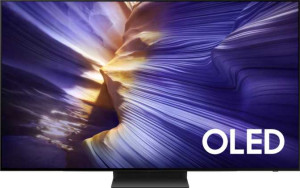
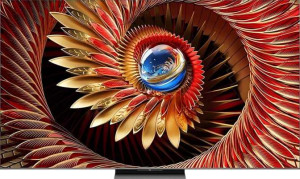
The most consequential difference in this group is panel technology. The Samsung QN83S90FAE uses an OLED/AMOLED panel, which produces light on a per-pixel basis, enabling true blacks and near-infinite contrast. The TCL 85C8K uses a Mini-LED, QLED-backlit LCD panel, which relies on thousands of small LEDs behind the screen to approximate local dimming. In practice, OLED will deliver more precise shadow detail and no blooming around bright objects on dark backgrounds — a real advantage for cinematic or dark-room viewing. Mini-LED QLED, however, can push higher peak brightness in well-lit rooms and avoids OLED's theoretical risk of burn-in with static content.
On HDR format support, the TCL holds a notable edge: it supports Dolby Vision, while the Samsung does not. Since Dolby Vision is a dynamic, scene-by-scene metadata format supported by Netflix, Disney+, and Apple TV+, its absence on the Samsung means some streamed content will fall back to HDR10 or HDR10+. Both sets support HDR10, HDR10+, and HLG, and share identical specs on resolution (3840 x 2160), bit depth (10-bit), refresh rate (144Hz), color volume (1070 million colors), adaptive sync (AMD FreeSync Premium Pro), viewing angles (178º both axes), and ambient light sensing — so these are non-factors in choosing between them.
The TCL also offers a marginally larger screen (85″ vs 82.5″) at a fractionally lower pixel density (52 ppi vs 53 ppi), a difference imperceptible at normal viewing distances. Overall, the Samsung has the advantage in pure contrast and black-level performance thanks to OLED, while the TCL counters with Dolby Vision support and a larger panel. For users who prioritize streaming ecosystem compatibility and screen size, the TCL has the edge; for those who value absolute picture depth and dark-scene fidelity, the Samsung's OLED panel is the stronger choice.