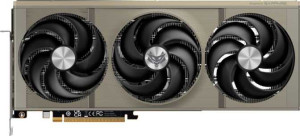
Sapphire Nitro+ Radeon RX 9070 XT
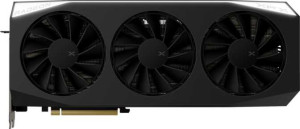
XFX Mercury Radeon RX 9070 XT Gaming Edition

Sapphire Nitro+ Radeon RX 9070 XT XFX Mercury Radeon RX 9070 XT Gaming Edition

Overview

Welcome to our in-depth spec comparison between the Sapphire Nitro+ Radeon RX 9070 XT and the XFX Mercury Radeon RX 9070 XT Gaming Edition — two AMD RDNA 4.0-based cards built on the same 4 nm process with 16 GB of GDDR6 memory. While they share a strong common foundation, key battlegrounds emerge around GPU turbo clock speeds, raw compute throughput, port configurations, power consumption, and physical dimensions. Read on to find out which card suits your needs best.

Common Features

  • Both cards share a base GPU clock speed of 1660 MHz.
  • Both cards have a GPU memory speed of 2518 MHz.
  • Both cards feature 4096 shading units.
  • Both cards include 256 texture mapping units (TMUs).
  • Both cards have 128 render output units (ROPs).
  • Double Precision Floating Point (DPFP) support is available on both cards.
  • Both cards have an effective memory speed of 20000 MHz.
  • Both cards come with 16GB of VRAM.
  • Both cards use GDDR6 memory.
  • Both cards feature a 256-bit memory bus width.
  • ECC memory support is available on both cards.
  • Both cards support DirectX 12 Ultimate.
  • Both cards support OpenGL version 4.6.
  • Both cards support OpenCL version 2.2.
  • Multi-display technology support is available on both cards.
  • Ray tracing support is available on both cards.
  • 3D support is available on both cards.
  • DLSS support is not available on either card.
  • FSR4 support is available on both cards.
  • Both cards feature an HDMI 2.1b output.
  • Neither card includes USB-C ports, DVI outputs, or mini DisplayPort outputs.
  • Both cards are built on the RDNA 4.0 GPU architecture.
  • Both cards use PCIe version 5.
  • Both cards are manufactured on a 4 nm semiconductor process.
  • Both cards contain 53,900 million transistors.
  • Neither card features air-water cooling.

Main Differences

  • GPU turbo clock speed is 3060 MHz on Sapphire Nitro+ Radeon RX 9070 XT and 2970 MHz on XFX Mercury Radeon RX 9070 XT Gaming Edition.
  • Pixel rate is 391.7 GPixel/s on Sapphire Nitro+ Radeon RX 9070 XT and 380.2 GPixel/s on XFX Mercury Radeon RX 9070 XT Gaming Edition.
  • Floating-point performance is 50.14 TFLOPS on Sapphire Nitro+ Radeon RX 9070 XT and 48.66 TFLOPS on XFX Mercury Radeon RX 9070 XT Gaming Edition.
  • Texture rate is 783.4 GTexels/s on Sapphire Nitro+ Radeon RX 9070 XT and 760.3 GTexels/s on XFX Mercury Radeon RX 9070 XT Gaming Edition.
  • Maximum memory bandwidth is 644.6 GB/s on Sapphire Nitro+ Radeon RX 9070 XT and 640 GB/s on XFX Mercury Radeon RX 9070 XT Gaming Edition.
  • HDMI port count is 2 on Sapphire Nitro+ Radeon RX 9070 XT and 1 on XFX Mercury Radeon RX 9070 XT Gaming Edition.
  • DisplayPort output count is 2 on Sapphire Nitro+ Radeon RX 9070 XT and 3 on XFX Mercury Radeon RX 9070 XT Gaming Edition.
  • Thermal Design Power (TDP) is 330W on Sapphire Nitro+ Radeon RX 9070 XT and 304W on XFX Mercury Radeon RX 9070 XT Gaming Edition.
  • Card width is 330.8 mm on Sapphire Nitro+ Radeon RX 9070 XT and 360 mm on XFX Mercury Radeon RX 9070 XT Gaming Edition.
  • Card height is 128.5 mm on Sapphire Nitro+ Radeon RX 9070 XT and 155 mm on XFX Mercury Radeon RX 9070 XT Gaming Edition.
Specs Comparison
Sapphire Nitro+ Radeon RX 9070 XT

Sapphire Nitro+ Radeon RX 9070 XT

XFX Mercury Radeon RX 9070 XT Gaming Edition

XFX Mercury Radeon RX 9070 XT Gaming Edition

Performance:
GPU clock speed 1660 MHz 1660 MHz
GPU turbo 3060 MHz 2970 MHz
pixel rate 391.7 GPixel/s 380.2 GPixel/s
floating-point performance 50.14 TFLOPS 48.66 TFLOPS
texture rate 783.4 GTexels/s 760.3 GTexels/s
GPU memory speed 2518 MHz 2518 MHz
shading units 4096 4096
texture mapping units (TMUs) 256 256
render output units (ROPs) 128 128
Has Double Precision Floating Point (DPFP)

Both cards share the same foundation: identical base clocks of 1660 MHz, the same 4096 shading units, 256 TMUs, 128 ROPs, and equal memory speeds of 2518 MHz. This means the underlying GPU silicon and memory subsystem are equivalent, and any performance gap between them comes down entirely to how aggressively each card's boost behavior is tuned.

That gap is meaningful but not dramatic. The Sapphire Nitro+ reaches a peak boost of 3060 MHz, versus 2970 MHz on the XFX Mercury — a 90 MHz advantage, roughly 3%. This directly cascades into every throughput metric: the Nitro+ leads in floating-point performance (50.14 TFLOPS vs 48.66 TFLOPS), texture fill rate (783.4 GTexels/s vs 760.3 GTexels/s), and pixel output rate (391.7 GPixel/s vs 380.2 GPixel/s). In practice, a ~3% compute advantage rarely produces a visible framerate difference in most gaming scenarios, but it can matter at the margins — particularly in compute-heavy workloads, ray tracing, or GPU-accelerated tasks where every TFLOP counts.

The Sapphire Nitro+ RX 9070 XT holds a clear, if modest, performance edge in this group, driven entirely by its higher boost clock. Both cards support Double Precision Floating Point, so neither has an advantage there. For pure gaming use the difference will be subtle, but users prioritizing maximum out-of-the-box GPU throughput — or those running GPU compute tasks alongside gaming — will find the Nitro+ the stronger choice based strictly on these specs.
Memory:
effective memory speed 20000 MHz 20000 MHz
maximum memory bandwidth 644.6 GB/s 640 GB/s
VRAM 16GB 16GB
GDDR version GDDR6 GDDR6
memory bus width 256-bit 256-bit
Supports ECC memory

On memory configuration, these two cards are essentially mirrors of each other. Both feature 16GB of GDDR6 across a 256-bit bus at an effective speed of 20000 MHz, and both support ECC memory — a feature typically associated with professional and compute workloads, where data integrity under sustained GPU load matters. For gamers, ECC support is a non-factor, but it signals that either card can double as a light workstation GPU without compromise.

The only numerical difference in this group is maximum memory bandwidth: 644.6 GB/s on the Nitro+ versus 640 GB/s on the XFX Mercury — a gap of under 1%. This tiny discrepancy is a direct downstream consequence of the Nitro+'s higher boost clock seen in the Performance group, not a difference in memory hardware itself. In real-world terms, both cards will move texture data, framebuffers, and compute payloads at effectively the same rate; no benchmark or application would expose a meaningful difference at this margin.

This group is a practical tie. With identical VRAM capacity, bus width, memory type, and speed, users can expect the same memory-bound behavior from both cards — whether that's handling high-resolution texture packs, running large AI inference models locally, or maintaining smooth performance at 4K. Neither card holds a memory advantage worth factoring into a purchase decision.

Features:
DirectX version DirectX 12 Ultimate DirectX 12 Ultimate
OpenGL version 4.6 4.6
OpenCL version 2.2 2.2
Supports multi-display technology
supports ray tracing
Supports 3D
supports DLSS
has FSR4
has XeSS (XMX)
AMD SAM / Intel Resizable BAR AMD SAM AMD SAM
has LHR
has RGB lighting
supported displays 4 4

Feature parity is absolute here — every single spec in this group is identical across both cards. The highlights worth understanding: both support DirectX 12 Ultimate and ray tracing, meaning neither cuts corners on modern rendering pipelines. DirectX 12 Ultimate is the current gold standard for PC gaming, and ray tracing support ensures compatibility with lighting and shadow systems in titles that use it, without requiring a workaround or software fallback.

On the upscaling front, both cards carry FSR4 — AMD's latest spatial upscaling technology — while lacking DLSS and XeSS, which is expected given their AMD origin. FSR4 represents a meaningful generational step in AMD's upscaling quality and is the primary tool users will rely on to boost framerates at higher resolutions. Both also support AMD SAM (Smart Access Memory), which allows a compatible AMD CPU to access the full GPU frame buffer directly, delivering a modest but real performance uplift in supported titles. Multi-monitor users will find both cards cap out at 4 supported displays, which covers virtually all desktop and productivity setups.

This group is a complete tie with no differentiator between the two products. Whichever card a buyer chooses, they are getting an identical software and API feature set — the decision ultimately rests on the performance and physical design differences found in other spec groups.

Ports:
has an HDMI output
HDMI ports 2 1
HDMI version HDMI 2.1b HDMI 2.1b
DisplayPort outputs 2 3
USB-C ports 0 0
DVI outputs 0 0
mini DisplayPort outputs 0 0

Both cards top out at four display outputs and share the same HDMI 2.1b standard, which supports 4K at high refresh rates and 8K output. The real difference lies in how that connectivity is distributed. The Sapphire Nitro+ offers 2 HDMI + 2 DisplayPort, while the XFX Mercury flips the balance to 1 HDMI + 3 DisplayPort.

For most users this distinction is a matter of ecosystem fit rather than capability. Someone running a mixed setup — say, a TV and a gaming monitor both connected via HDMI — will find the Nitro+'s dual HDMI layout more convenient, eliminating the need for an adapter. Conversely, users with multiple DisplayPort monitors, which is common in professional multi-screen or high-refresh-rate gaming setups, will appreciate the XFX Mercury's three DisplayPort outputs for cleaner, direct cabling.

Neither layout is objectively superior — the ″better″ card here depends entirely on the user's existing display hardware. The Nitro+ edges ahead for HDMI-heavy environments, while the XFX Mercury suits DisplayPort-centric setups. Users whose monitors span both connection types, or who use only one or two displays, will find no meaningful difference between the two.

General info:
GPU architecture RDNA 4.0 RDNA 4.0
release date March 2025 March 2025
Thermal Design Power (TDP) 330W 304W
PCI Express (PCIe) version 5 5
semiconductor size 4 nm 4 nm
number of transistors 53900 million 53900 million
Has air-water cooling
width 330.8 mm 360 mm
height 128.5 mm 155 mm

Sharing the same RDNA 4.0 architecture, 4nm process node, and identical transistor count of 53.9 billion, both cards are built from the same silicon — a fact that explains much of the parity seen in other spec groups. PCIe 5.0 support is present on both, ensuring neither will face any bandwidth bottleneck on current or near-future motherboards.

Where this group gets interesting is power and physical footprint. The Sapphire Nitro+ draws up to 330W TDP versus the XFX Mercury's 304W — a 26W difference that directly explains how the Nitro+ achieves its higher boost clocks from the same chip. More power headroom allows Sapphire to push the GPU harder, but it also means slightly higher electricity consumption and greater heat output, which places more demand on system cooling and power supply headroom. Users with tightly specified PSUs should take note. On the physical side, the XFX Mercury is considerably larger: 360mm long and 155mm tall compared to the Nitro+'s 330.8mm × 128.5mm. That 30mm length difference is non-trivial — compact and mid-tower cases with restricted GPU clearance may not fit the Mercury at all.

The verdict here splits by use case. The Nitro+ has an advantage for builds prioritizing case compatibility and lower power draw demands, while the XFX Mercury's larger cooler may translate to different thermal behavior under sustained load — though thermal data is not provided in these specs. Buyers should verify GPU clearance for the Mercury before purchasing, and those with smaller cases or more modest PSUs will find the Nitro+ the more accommodating option.

Comparison Summary & Verdict

Both cards deliver a near-identical feature set — RDNA 4.0 architecture, FSR4 support, ray tracing, and DirectX 12 Ultimate — making the choice come down to finer details. The Sapphire Nitro+ Radeon RX 9070 XT edges ahead with a higher GPU turbo clock of 3060 MHz, better floating-point performance at 50.14 TFLOPS, and an extra HDMI port, making it the stronger pick for pure performance and multi-display HDMI setups. The XFX Mercury Radeon RX 9070 XT Gaming Edition counters with a notably lower TDP of 304W, a third DisplayPort output, and a more compact footprint in height — advantages that matter in power-conscious builds or multi-monitor DisplayPort rigs. Neither card is objectively superior across the board; your ideal choice depends on your priorities.

Sapphire Nitro+ Radeon RX 9070 XT
Buy Sapphire Nitro+ Radeon RX 9070 XT if...

Buy the Sapphire Nitro+ Radeon RX 9070 XT if you want the highest GPU turbo clock speed and raw compute performance, or if you need two HDMI outputs for your display setup.

XFX Mercury Radeon RX 9070 XT Gaming Edition
Buy XFX Mercury Radeon RX 9070 XT Gaming Edition if...

Buy the XFX Mercury Radeon RX 9070 XT Gaming Edition if you prioritize lower power consumption at 304W and need three DisplayPort outputs for a multi-monitor configuration.