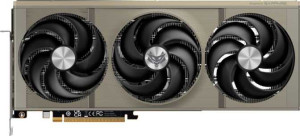
Sapphire Nitro+ Radeon RX 9070 XT
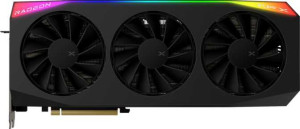
XFX Mercury Radeon RX 9070 XT OC Gaming Edition

Sapphire Nitro+ Radeon RX 9070 XT XFX Mercury Radeon RX 9070 XT OC Gaming Edition

Overview

When two premium graphics cards share the same GPU core, silicon, and feature set, the differences come down to the finer details. This comparison pits the Sapphire Nitro+ Radeon RX 9070 XT against the XFX Mercury Radeon RX 9070 XT OC Gaming Edition, examining key battlegrounds including clock speeds and raw throughput, display port configurations, thermal design power, and physical dimensions — giving you the clarity needed to choose the right card for your rig.

Common Features

  • Both cards share the same GPU memory speed of 2518 MHz.
  • Both cards have 4096 shading units.
  • Both cards feature 256 texture mapping units (TMUs).
  • Both cards have 128 render output units (ROPs).
  • Double Precision Floating Point (DPFP) is supported on both cards.
  • Both cards have an effective memory speed of 20000 MHz.
  • Both cards come with 16GB of VRAM.
  • Both cards use GDDR6 memory.
  • Both cards feature a 256-bit memory bus width.
  • ECC memory is supported on both cards.
  • Both cards support DirectX 12 Ultimate.
  • Both cards support OpenGL version 4.6.
  • Both cards support OpenCL version 2.2.
  • Multi-display technology is supported on both cards.
  • Ray tracing is supported on both cards.
  • 3D support is available on both cards.
  • DLSS is not supported on either card.
  • FSR4 is available on both cards.
  • Both cards include an HDMI 2.1b output.
  • Neither card features USB-C ports, DVI outputs, or mini DisplayPort outputs.
  • Both cards are built on the RDNA 4.0 GPU architecture.
  • Both cards use PCIe version 5.
  • Both cards are manufactured on a 4 nm semiconductor process.
  • Both cards have 53900 million transistors.
  • Neither card features air-water cooling.

Main Differences

  • GPU base clock speed is 1660 MHz on Sapphire Nitro+ Radeon RX 9070 XT and 1870 MHz on XFX Mercury Radeon RX 9070 XT OC Gaming Edition.
  • GPU turbo clock speed is 3060 MHz on Sapphire Nitro+ Radeon RX 9070 XT and 3100 MHz on XFX Mercury Radeon RX 9070 XT OC Gaming Edition.
  • Pixel rate is 391.7 GPixel/s on Sapphire Nitro+ Radeon RX 9070 XT and 396.8 GPixel/s on XFX Mercury Radeon RX 9070 XT OC Gaming Edition.
  • Floating-point performance is 50.14 TFLOPS on Sapphire Nitro+ Radeon RX 9070 XT and 50.79 TFLOPS on XFX Mercury Radeon RX 9070 XT OC Gaming Edition.
  • Texture rate is 783.4 GTexels/s on Sapphire Nitro+ Radeon RX 9070 XT and 793.6 GTexels/s on XFX Mercury Radeon RX 9070 XT OC Gaming Edition.
  • Maximum memory bandwidth is 644.6 GB/s on Sapphire Nitro+ Radeon RX 9070 XT and 640 GB/s on XFX Mercury Radeon RX 9070 XT OC Gaming Edition.
  • HDMI port count is 2 on Sapphire Nitro+ Radeon RX 9070 XT and 1 on XFX Mercury Radeon RX 9070 XT OC Gaming Edition.
  • DisplayPort output count is 2 on Sapphire Nitro+ Radeon RX 9070 XT and 3 on XFX Mercury Radeon RX 9070 XT OC Gaming Edition.
  • Thermal Design Power (TDP) is 330W on Sapphire Nitro+ Radeon RX 9070 XT and 304W on XFX Mercury Radeon RX 9070 XT OC Gaming Edition.
  • Card width is 330.8 mm on Sapphire Nitro+ Radeon RX 9070 XT and 360 mm on XFX Mercury Radeon RX 9070 XT OC Gaming Edition.
  • Card height is 128.5 mm on Sapphire Nitro+ Radeon RX 9070 XT and 155 mm on XFX Mercury Radeon RX 9070 XT OC Gaming Edition.
Specs Comparison
Sapphire Nitro+ Radeon RX 9070 XT

Sapphire Nitro+ Radeon RX 9070 XT

XFX Mercury Radeon RX 9070 XT OC Gaming Edition

XFX Mercury Radeon RX 9070 XT OC Gaming Edition

Performance:
GPU clock speed 1660 MHz 1870 MHz
GPU turbo 3060 MHz 3100 MHz
pixel rate 391.7 GPixel/s 396.8 GPixel/s
floating-point performance 50.14 TFLOPS 50.79 TFLOPS
texture rate 783.4 GTexels/s 793.6 GTexels/s
GPU memory speed 2518 MHz 2518 MHz
shading units 4096 4096
texture mapping units (TMUs) 256 256
render output units (ROPs) 128 128
Has Double Precision Floating Point (DPFP)

Both the Sapphire Nitro+ RX 9070 XT and the XFX Mercury RX 9070 XT OC share the same fundamental compute architecture: identical 4096 shading units, 256 TMUs, 128 ROPs, and 2518 MHz memory speed. This means their theoretical ceiling for parallelism, memory bandwidth, and rasterization throughput is built on the exact same silicon foundation. Both also support Double Precision Floating Point (DPFP), which matters for compute workloads beyond gaming.

Where they diverge is in clock configuration. The XFX Mercury ships with a notably higher base clock of 1870 MHz versus the Sapphire Nitro+'s 1660 MHz — a 210 MHz gap that translates directly into more consistent performance floors under sustained load, since the GPU is less likely to throttle below that baseline. The turbo clocks are closer (3100 MHz vs 3060 MHz), but the XFX still holds a 40 MHz edge at peak. These clock advantages cascade into the derived metrics: the XFX leads in floating-point performance (50.79 vs 50.14 TFLOPS), texture rate (793.6 vs 783.4 GTexels/s), and pixel rate (396.8 vs 391.7 GPixel/s).

In practice, the real-world rendering difference between these two cards will be marginal — we're talking roughly 1–1.3% across compute and throughput metrics. However, the XFX Mercury's significantly higher base clock is the more meaningful differentiator: it suggests better out-of-the-box factory tuning and potentially more stable frame delivery under thermal pressure. The XFX Mercury RX 9070 XT OC holds a narrow but consistent performance edge across every measured dimension in this group.

Memory:
effective memory speed 20000 MHz 20000 MHz
maximum memory bandwidth 644.6 GB/s 640 GB/s
VRAM 16GB 16GB
GDDR version GDDR6 GDDR6
memory bus width 256-bit 256-bit
Supports ECC memory

At the memory level, these two cards are remarkably close. Both carry 16GB of GDDR6 across a 256-bit bus at an effective speed of 20000 MHz, and both support ECC memory — a feature typically associated with professional workloads that ensures data integrity by detecting and correcting bit-level errors, useful for creators running compute or simulation tasks alongside gaming.

The only measurable difference is in maximum memory bandwidth: the Sapphire Nitro+ edges out at 644.6 GB/s versus 640 GB/s for the XFX Mercury — a gap of roughly 0.7%. In practice, this discrepancy is far too small to produce any perceivable difference in gaming frame rates, texture streaming, or even GPU-compute throughput. It's likely a rounding artifact stemming from slightly different internal timing configurations rather than a meaningful design distinction.

For memory, this is effectively a tie. Both cards deliver the same capacity, bus width, and memory standard, which is what actually defines the memory subsystem's character — the bandwidth figure is too close to tip the scales in either direction. Buyers should not factor memory specs into their decision between these two models.

Features:
DirectX version DirectX 12 Ultimate DirectX 12 Ultimate
OpenGL version 4.6 4.6
OpenCL version 2.2 2.2
Supports multi-display technology
supports ray tracing
Supports 3D
supports DLSS
has FSR4
has XeSS (XMX)
AMD SAM / Intel Resizable BAR AMD SAM AMD SAM
has LHR
has RGB lighting
supported displays 4 4

Feature parity between these two cards is absolute. Every capability listed — from DirectX 12 Ultimate and ray tracing support to FSR4, AMD SAM, and multi-display output across up to 4 screens — is identical. This is expected given they share the same GPU architecture, but it's worth unpacking what the shared feature set actually delivers. DirectX 12 Ultimate is the current gold standard for gaming APIs, enabling hardware-accelerated ray tracing and mesh shading in supported titles. FSR4, AMD's latest upscaling technology, provides AI-driven image reconstruction that can meaningfully boost frame rates with minimal visual quality loss — a significant asset for high-resolution gaming.

Notably, neither card supports DLSS, which is exclusive to NVIDIA hardware. That's an architectural constraint, not a product-level difference. The absence of XeSS (XMX) is similarly platform-bound. Buyers coming from an NVIDIA ecosystem who rely on DLSS should weigh this carefully, but within the AMD ecosystem, FSR4 is the direct competitive answer, and both cards deliver it equally.

This group is an unambiguous tie. There is no feature available on one card that isn't present on the other, making software capabilities a completely neutral factor in choosing between the Sapphire Nitro+ and the XFX Mercury. The decision must rest entirely on other spec groups.

Ports:
has an HDMI output
HDMI ports 2 1
HDMI version HDMI 2.1b HDMI 2.1b
DisplayPort outputs 2 3
USB-C ports 0 0
DVI outputs 0 0
mini DisplayPort outputs 0 0

Both cards top out at 4 total display outputs and share the same HDMI 2.1b standard — capable of driving 4K at 144Hz or 8K at 60Hz — so maximum display count and peak connectivity bandwidth are identical. Where they diverge is in how that total is split between port types. The Sapphire Nitro+ goes 2 HDMI + 2 DisplayPort, while the XFX Mercury opts for 1 HDMI + 3 DisplayPort.

This distinction is more practical than it might initially appear. Users running a mixed setup — say, a gaming monitor via DisplayPort alongside a TV or capture device that only accepts HDMI — will find the Sapphire Nitro+'s dual HDMI layout more convenient, eliminating the need for an adapter. Conversely, the XFX Mercury's three DisplayPort outputs cater better to users building a multi-monitor PC workstation or triple-display gaming rig, where DisplayPort daisy-chaining and higher refresh rate monitor compatibility are priorities.

Neither layout is objectively superior — it depends entirely on the user's display ecosystem. However, since HDMI-only devices (TVs, projectors, some monitors) are common in consumer setups, the Sapphire Nitro+ holds a slight edge in connectivity flexibility for the broader audience, while the XFX Mercury is the stronger pick for dedicated multi-monitor DisplayPort configurations.

General info:
GPU architecture RDNA 4.0 RDNA 4.0
release date March 2025 March 2025
Thermal Design Power (TDP) 330W 304W
PCI Express (PCIe) version 5 5
semiconductor size 4 nm 4 nm
number of transistors 53900 million 53900 million
Has air-water cooling
width 330.8 mm 360 mm
height 128.5 mm 155 mm

Sharing the same RDNA 4.0 architecture, 4nm process node, and identical transistor count of 53.9 billion, these two cards are cut from precisely the same cloth at the silicon level. PCIe 5.0 support is equally matched and future-proofs both cards for next-generation motherboard bandwidth, though current games don't yet stress even PCIe 4.0 to its limits.

The most consequential difference here is power consumption. The Sapphire Nitro+ carries a 330W TDP against the XFX Mercury's 304W — a 26W gap that is far from trivial. Over extended gaming sessions, that difference adds up in electricity cost and heat output. It also means the XFX Mercury places a lighter load on the PSU, which could be relevant for system builders working close to their power supply's rated capacity. Crucially, recall from the Performance group that the XFX Mercury achieves slightly higher clock speeds despite drawing less power, suggesting it has a more efficient out-of-the-box tuning profile.

Physical size tells the opposite story. The XFX Mercury is noticeably larger — 360mm wide and 155mm tall versus the Sapphire Nitro+'s 330.8mm x 128.5mm — making case compatibility a real consideration. The Nitro+ will fit more comfortably in mid-tower and smaller form-factor builds. On balance, the XFX Mercury holds an edge on efficiency, but the Sapphire Nitro+ wins on physical footprint, and for builders with compact cases, that may be the deciding factor in this group.

Comparison Summary & Verdict

Both cards deliver the same RDNA 4.0 foundation, 16GB of GDDR6 memory, ray tracing, FSR4, and a full suite of modern API support — making either a strong choice for high-end PC gaming. The XFX Mercury RX 9070 XT OC Gaming Edition pulls ahead in raw performance with its higher base and turbo clock speeds, slightly better pixel and texture rates, and a notably lower TDP of 304W versus 330W, making it the more performance-per-watt-efficient option. It also offers three DisplayPort outputs, suiting users with multi-monitor setups. The Sapphire Nitro+ RX 9070 XT, on the other hand, is the better pick for users who need dual HDMI outputs — useful for connecting TVs or mixed display setups — and its more compact footprint makes it a stronger candidate for smaller chassis builds.

Sapphire Nitro+ Radeon RX 9070 XT
Buy Sapphire Nitro+ Radeon RX 9070 XT if...

Buy the Sapphire Nitro+ Radeon RX 9070 XT if you need two HDMI outputs for a mixed display or TV setup, or if a more compact card size is a priority for your case.

XFX Mercury Radeon RX 9070 XT OC Gaming Edition
Buy XFX Mercury Radeon RX 9070 XT OC Gaming Edition if...

Buy the XFX Mercury Radeon RX 9070 XT OC Gaming Edition if you want higher clock speeds, greater power efficiency at 304W TDP, and three DisplayPort outputs for a multi-monitor arrangement.