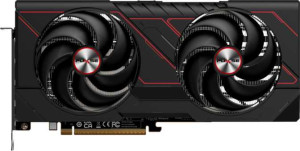
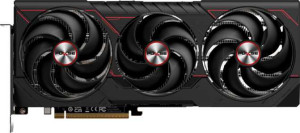
Both cards are built on the RDNA 4.0 architecture and connect via PCIe 5.0, so the generational foundation is identical. What stands out, however, is a subtle but meaningful silicon difference: the RX 9070 XT is manufactured on a 4 nm process node versus 5 nm for the base RX 9070, despite both containing the same 53,900 million transistors. A smaller node typically allows for higher clock speeds or improved power efficiency at equivalent performance — context that helps explain how the XT achieves its significantly higher turbo clocks while still fitting the same transistor count into a denser die.
Power consumption is where these two cards diverge most consequentially in this group. The RX 9070 XT carries a 304W TDP versus 220W for the 9070 — a 38% increase in thermal load. In practice, this means the XT demands a more capable PSU, generates more heat, and requires better case airflow to maintain stable operation. Neither card uses liquid cooling, so adequate air cooling headroom in the chassis is equally important for both, but significantly more critical for the XT. Users in compact or thermally constrained builds should weigh this carefully.
Physically, the XT is also longer at 320 mm versus 280 mm, while both share the same 120.3 mm height. That 40 mm length difference can matter in mid-tower or smaller cases with tight GPU clearance limits. For this group, the RX 9070 holds a practical advantage in terms of power efficiency and physical footprint — the XT's 4 nm process is a technical edge, but its substantially higher TDP and larger size make the base model the more system-friendly option where power and space are constraints.