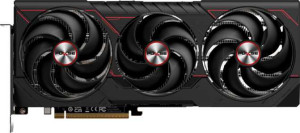
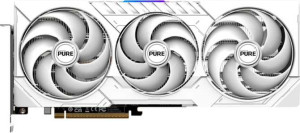
At their core, both the Sapphire Pulse and Pure RX 9070 XT share identical silicon configurations: 4096 shading units, 256 TMUs, 128 ROPs, and the same base clock of 1660 MHz — meaning the underlying GPU die and memory subsystem (2518 MHz effective memory speed) are functionally equivalent. The real divergence lives in the boost clock ceiling, where the Pure edges out the Pulse at 3010 MHz versus 2970 MHz, a 40 MHz difference that cascades into slightly higher derived throughput figures across the board.
That 40 MHz gap translates directly into a 49.32 TFLOPS floating-point rating for the Pure versus 48.66 TFLOPS for the Pulse — roughly a 1.4% difference. The texture rate and pixel rate follow the same proportional spread: 770.6 GTexels/s and 385.3 GPixel/s on the Pure versus 760.3 GTexels/s and 380.2 GPixel/s on the Pulse. In practice, a sub-2% throughput delta is unlikely to be perceptible in typical gaming workloads, as real-world frame rates are rarely limited by raw shader or texture throughput alone at this performance tier.
Based strictly on these specs, the Pure RX 9070 XT holds a narrow but consistent performance edge, driven entirely by its higher turbo clock. The Pulse is not meaningfully slower — the gap is marginal enough that cooling behavior, power delivery stability, and sustained boost clock maintenance under load (none of which are captured here) could easily close or even reverse it in practice. For a user prioritizing raw specification headroom, the Pure wins this group; for most buyers, the difference is academic.