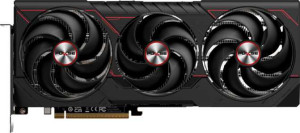
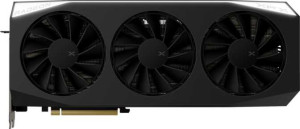
In the Performance category, the Sapphire Pulse RX 9070 XT and the XFX Mercury RX 9070 XT Gaming Edition are built on an identical silicon foundation — and the numbers confirm this without exception. Both cards share the same 1660 MHz base clock and 2970 MHz boost clock, the same 4096 shading units, 256 TMUs, and 128 ROPs, yielding an identical 48.66 TFLOPS of floating-point performance, 380.2 GPixel/s pixel rate, and 760.3 GTexels/s texture rate. Even GPU memory speed is locked at 2518 MHz on both designs.
What these figures mean in practice is that both cards will deliver the same raw throughput in rendering workloads, compute tasks, and gaming scenarios. The 48.66 TFLOPS figure places this GPU firmly in the high-performance tier, and the 760 GTexel/s texture rate ensures complex scenes with high-resolution assets are handled with equal capability on either board. The shared ROPs count of 128 means fill-rate and anti-aliasing performance will be indistinguishable between the two.
This is a clear performance tie. Every measurable GPU performance metric is identical across both products. Any real-world difference in framerates or compute throughput between them will fall within margin-of-error noise. Buyers choosing between these two cards should shift their evaluation entirely to other factors — cooling design, acoustics, build quality, price, and warranty — since performance alone offers no basis for differentiation.