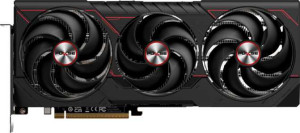
Sapphire Pulse Radeon RX 9070 XT
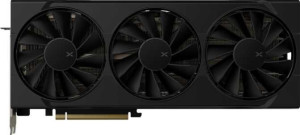
XFX Swift Radeon RX 9070 XT Triple Fan Gaming Edition

Sapphire Pulse Radeon RX 9070 XT XFX Swift Radeon RX 9070 XT Triple Fan Gaming Edition

Overview

Welcome to our in-depth spec comparison between the Sapphire Pulse Radeon RX 9070 XT and the XFX Swift Radeon RX 9070 XT Triple Fan Gaming Edition. Both cards share the same RDNA 4.0 architecture and identical core performance figures, making the choice between them far from obvious. The real battlegrounds lie in port configuration, physical dimensions, memory bandwidth, and aesthetic features like RGB lighting. Read on to find out which card suits your setup best.

Common Features

  • Both cards have a base GPU clock speed of 1660 MHz.
  • Both cards have a GPU turbo speed of 2970 MHz.
  • Both cards deliver a pixel rate of 380.2 GPixel/s.
  • Both cards offer a floating-point performance of 48.66 TFLOPS.
  • Both cards have a texture rate of 760.3 GTexels/s.
  • Both cards have a GPU memory speed of 2518 MHz.
  • Both cards have 4096 shading units.
  • Both cards have 256 texture mapping units (TMUs).
  • Both cards have an effective memory speed of 20000 MHz.
  • Both cards feature 16GB of VRAM.
  • Both cards use GDDR6 memory.
  • Both cards have a 256-bit memory bus width.
  • ECC memory support is available on both cards.
  • Both cards support DirectX 12 Ultimate.
  • Both cards support OpenGL version 4.6.
  • Both cards support OpenCL version 2.2.
  • Multi-display technology support is available on both cards.
  • Ray tracing support is available on both cards.
  • 3D support is available on both cards.
  • DLSS support is not available on either card.
  • FSR4 support is available on both cards.
  • Both cards have an HDMI output using HDMI version 2.1b.
  • Neither card has USB-C ports, DVI outputs, or mini DisplayPort outputs.
  • Both cards are built on the RDNA 4.0 GPU architecture.
  • Both cards have a Thermal Design Power (TDP) of 304W.
  • Both cards use PCIe version 5.
  • Both cards are manufactured on a 4 nm semiconductor process.
  • Both cards have 53900 million transistors.
  • Neither card uses air-water cooling.

Main Differences

  • Maximum memory bandwidth is 644.6 GB/s on Sapphire Pulse Radeon RX 9070 XT and 640 GB/s on XFX Swift Radeon RX 9070 XT Triple Fan Gaming Edition.
  • RGB lighting is present on XFX Swift Radeon RX 9070 XT Triple Fan Gaming Edition but not available on Sapphire Pulse Radeon RX 9070 XT.
  • HDMI port count is 2 on Sapphire Pulse Radeon RX 9070 XT and 1 on XFX Swift Radeon RX 9070 XT Triple Fan Gaming Edition.
  • DisplayPort output count is 2 on Sapphire Pulse Radeon RX 9070 XT and 3 on XFX Swift Radeon RX 9070 XT Triple Fan Gaming Edition.
  • Card width is 320 mm on Sapphire Pulse Radeon RX 9070 XT and 325 mm on XFX Swift Radeon RX 9070 XT Triple Fan Gaming Edition.
  • Card height is 120.3 mm on Sapphire Pulse Radeon RX 9070 XT and 150 mm on XFX Swift Radeon RX 9070 XT Triple Fan Gaming Edition.
Specs Comparison
Sapphire Pulse Radeon RX 9070 XT

Sapphire Pulse Radeon RX 9070 XT

XFX Swift Radeon RX 9070 XT Triple Fan Gaming Edition

XFX Swift Radeon RX 9070 XT Triple Fan Gaming Edition

Performance:
GPU clock speed 1660 MHz 1660 MHz
GPU turbo 2970 MHz 2970 MHz
pixel rate 380.2 GPixel/s 380.2 GPixel/s
floating-point performance 48.66 TFLOPS 48.66 TFLOPS
texture rate 760.3 GTexels/s 760.3 GTexels/s
GPU memory speed 2518 MHz 2518 MHz
shading units 4096 4096
texture mapping units (TMUs) 256 256
render output units (ROPs) 128 128
Has Double Precision Floating Point (DPFP)

In the Performance category, the Sapphire Pulse RX 9070 XT and the XFX Swift RX 9070 XT are built on an identical GPU configuration. Both cards share the same base and boost clocks — 1660 MHz and 2970 MHz respectively — and draw on the same pool of 4096 shading units, 256 TMUs, and 128 ROPs. This means the raw throughput figures are a perfect match: 48.66 TFLOPS of floating-point performance, a texture rate of 760.3 GTexels/s, and a pixel fill rate of 380.2 GPixel/s. Memory subsystem speed is likewise identical at 2518 MHz.

What do these numbers mean in practice? The 2970 MHz turbo clock is competitive for the current mid-to-high-end tier, and the 48.66 TFLOPS figure translates to strong rasterization performance in modern titles. The 128 ROPs are particularly relevant for high-resolution gaming, as render output units directly govern how fast pixels are written to the framebuffer — a wider ROP count reduces bottlenecks at 1440p and 4K. Both cards also support Double Precision Floating Point, which matters for compute workloads and certain professional applications, though it is less of a factor for pure gaming.

The verdict for this group is a complete tie. Every single performance specification is numerically identical between the two cards. Any real-world difference in frame rates or compute throughput would come down to thermal headroom and power delivery — factors governed by cooling and board design rather than the GPU configuration itself, and not reflected in these specs. Neither card holds a performance edge based solely on this data.

Memory:
effective memory speed 20000 MHz 20000 MHz
maximum memory bandwidth 644.6 GB/s 640 GB/s
VRAM 16GB 16GB
GDDR version GDDR6 GDDR6
memory bus width 256-bit 256-bit
Supports ECC memory

Both the Sapphire Pulse RX 9070 XT and the XFX Swift RX 9070 XT arrive with the same foundational memory setup: 16GB of GDDR6 across a 256-bit bus, running at an effective speed of 20000 MHz. The 16GB VRAM pool is a meaningful asset at this tier — it provides comfortable headroom for high-resolution textures, complex scene geometry, and emerging workloads like local AI inference that are increasingly VRAM-hungry.

Where a subtle but measurable difference surfaces is in maximum memory bandwidth: the Sapphire Pulse edges ahead at 644.6 GB/s versus 640 GB/s for the XFX Swift. Both figures are derived from the same bus width and effective clock, so this gap — roughly 0.7% — likely reflects a minor variance in how each board's memory controller is tuned or rated. In practice, a difference this small will not produce any perceptible performance delta in gaming or compute tasks; bandwidth bottlenecks only become relevant when the gap is substantially larger.

Both cards also support ECC memory, which enables error correction for compute and professional use cases where data integrity matters. For gaming, this is largely inconsequential, but it does broaden each card's appeal for workstation-adjacent tasks. Overall, the memory group is effectively a tie — the Sapphire Pulse holds a marginal bandwidth figure on paper, but the real-world implications are negligible.

Features:
DirectX version DirectX 12 Ultimate DirectX 12 Ultimate
OpenGL version 4.6 4.6
OpenCL version 2.2 2.2
Supports multi-display technology
supports ray tracing
Supports 3D
supports DLSS
has FSR4
has XeSS (XMX)
AMD SAM / Intel Resizable BAR AMD SAM AMD SAM
has LHR
has RGB lighting
supported displays 4 4

On the software and API front, these two cards are inseparable. Both support DirectX 12 Ultimate — the current gold standard for modern PC gaming, enabling hardware ray tracing, mesh shaders, and variable rate shading. Ray tracing support is confirmed for both, and critically, both carry FSR4, AMD's latest upscaling generation, which is a meaningful asset for boosting frame rates at higher resolutions with improved image quality over its predecessors. Neither card supports DLSS, which is expected given these are AMD products, and XeSS (XMX) is likewise absent on both.

AMD SAM (Smart Access Memory) is enabled on both, allowing a compatible AMD CPU to access the full VRAM pool rather than a limited 256MB window — a feature that can yield measurable frame rate gains in SAM-optimized titles. The four-display output ceiling is shared as well, covering virtually all multi-monitor configurations a user would realistically build.

The sole differentiator in this group is RGB lighting: the XFX Swift RX 9070 XT includes it, while the Sapphire Pulse does not. This is purely an aesthetic distinction with no bearing on performance or functionality — it matters only to builders who prioritize a lit, themed system aesthetic. For feature-driven decision-making, this group is essentially a tie, with the XFX Swift holding a minor edge for those who specifically want RGB.

Ports:
has an HDMI output
HDMI ports 2 1
HDMI version HDMI 2.1b HDMI 2.1b
DisplayPort outputs 2 3
USB-C ports 0 0
DVI outputs 0 0
mini DisplayPort outputs 0 0

Both cards offer four total display outputs and share the same HDMI 2.1b standard — a capable spec that supports 4K at high refresh rates and 8K output. Where they diverge is in how that port budget is split. The Sapphire Pulse RX 9070 XT goes with 2 HDMI + 2 DisplayPort, while the XFX Swift RX 9070 XT opts for 1 HDMI + 3 DisplayPort.

This distinction is more meaningful than it might first appear. Users running a mixed setup — say, a gaming monitor via DisplayPort alongside a TV or capture device that only accepts HDMI — will find the Sapphire Pulse's dual HDMI configuration more convenient, eliminating the need for adapters. Conversely, users building a three-screen DisplayPort array, which is common in sim racing or productivity multi-monitor rigs, will prefer the XFX Swift's three native DisplayPort outputs. Neither layout is objectively superior; it comes down entirely to the user's specific display ecosystem.

Neither card includes USB-C, DVI, or mini DisplayPort outputs, so those are non-factors. The edge goes to whichever card aligns with the buyer's display connections: the Sapphire Pulse suits HDMI-heavy setups, and the XFX Swift better serves DisplayPort-dominant configurations. For users with a single primary monitor, the difference is irrelevant.

General info:
GPU architecture RDNA 4.0 RDNA 4.0
release date March 2025 March 2025
Thermal Design Power (TDP) 304W 304W
PCI Express (PCIe) version 5 5
semiconductor size 4 nm 4 nm
number of transistors 53900 million 53900 million
Has air-water cooling
width 320 mm 325 mm
height 120.3 mm 150 mm

At their core, these two cards are built on the same silicon: the RDNA 4.0 architecture, fabbed on a 4nm process with 53.9 billion transistors, connected via PCIe 5.0, and rated at an identical 304W TDP. The 4nm node is significant — it underpins the efficiency and density gains that RDNA 4.0 delivers over its predecessor, and the shared transistor count confirms both cards are running the same die without any binning differences reflected here.

The practical differentiator in this group is physical size. The Sapphire Pulse RX 9070 XT measures 320mm × 120.3mm, while the XFX Swift RX 9070 XT is slightly larger at 325mm × 150mm. The length gap is minor — 5mm — but the height difference is more notable: nearly 30mm taller. That extra height can matter in cases with tight PCIe slot clearance or where the card risks conflicting with RAM slots, M.2 drives, or other components in compact or mid-tower builds.

Neither card uses liquid cooling, so both rely on air coolers to manage that 304W thermal load — how effectively each achieves that is a function of cooler design, not reflected in these specs. On the general info dimension, the Sapphire Pulse holds a practical edge for smaller builds due to its more compact footprint, while the XFX Swift's larger frame may accommodate a bigger heatsink, though that inference goes beyond what the data here confirms.

Comparison Summary & Verdict

After a thorough look at the specs, both cards are closely matched at their core, sharing the same GPU, 48.66 TFLOPS of floating-point performance, 16GB of GDDR6 memory, and a 304W TDP. The differences come down to form factor and connectivity preferences. The Sapphire Pulse Radeon RX 9070 XT is the more compact option at 120.3mm tall with a slightly higher memory bandwidth of 644.6 GB/s, and it offers two HDMI 2.1b ports — a clear advantage for users running dual HDMI displays. The XFX Swift Radeon RX 9070 XT Triple Fan Gaming Edition, on the other hand, wins on DisplayPort connectivity with three outputs, adds RGB lighting for aesthetically conscious builders, and still delivers rock-solid performance. Choose the Sapphire Pulse for a smaller, HDMI-centric build, and the XFX Swift if you need more DisplayPort outputs or want a card that lights up your case.

Sapphire Pulse Radeon RX 9070 XT
Buy Sapphire Pulse Radeon RX 9070 XT if...

Buy the Sapphire Pulse Radeon RX 9070 XT if you need two HDMI outputs for a dual-display setup, prefer a more compact card, or want a marginally higher memory bandwidth without RGB lighting.

XFX Swift Radeon RX 9070 XT Triple Fan Gaming Edition
Buy XFX Swift Radeon RX 9070 XT Triple Fan Gaming Edition if...

Buy the XFX Swift Radeon RX 9070 XT Triple Fan Gaming Edition if you rely on DisplayPort connectivity with three outputs, or want RGB lighting to complement a visually styled PC build.