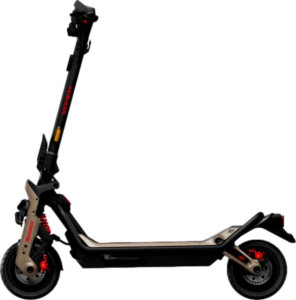
The most striking design difference between these two scooters is their weight. The Segway SuperScooter GT3 Pro tips the scales at 53,100 g — more than double the Xiaomi Electric Scooter 5 Pro's 22,400 g. In real-world terms, this gap is enormous: carrying the GT3 Pro up stairs, loading it into a car, or navigating tight urban spaces requires significant physical effort, while the Xiaomi remains genuinely portable by comparison. This weight difference alone shapes who each scooter is realistically suited for.
Dimensionally, the GT3 Pro is also the larger machine — 1,388 mm tall and 1,360 mm wide versus the Xiaomi's 1,271 mm and 1,192 mm. Combined with its larger 11-inch wheels (vs. 10-inch on the Xiaomi), the GT3 Pro has a more planted, road-going stance that can improve stability at speed and over rough terrain. Both scooters fold, feature pneumatic tires, suspension, front and rear lights, and a companion app — so the core design checklist is identical. The meaningful split is in scale.
On weather resistance, the GT3 Pro holds an IPX6 rating versus the Xiaomi's IPX5. IPX6 withstands powerful water jets, while IPX5 handles lower-pressure streams — a modest but real advantage if you regularly ride in heavy rain. Overall, the GT3 Pro has the edge in robustness and stability, but the Xiaomi 5 Pro wins decisively on portability, making it the more practical daily commuter for riders who need to carry or store their scooter frequently.