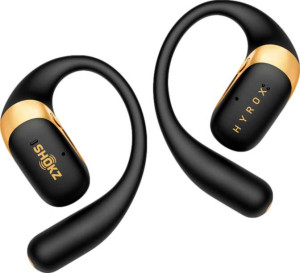
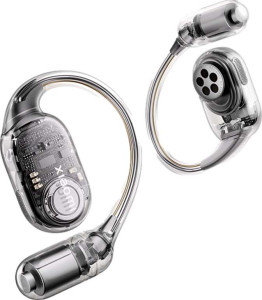
Shokz OpenFit 2 Plus
Xiaomi OpenWear Stereo Pro

Shokz OpenFit 2 Plus Xiaomi OpenWear Stereo Pro

Overview

Welcome to our in-depth spec comparison between the Shokz OpenFit 2 Plus and the Xiaomi OpenWear Stereo Pro — two open-ear wireless earbuds vying for your attention. Both share a cable-free design with wingtips and fast charging, yet they diverge in meaningful ways across battery endurance, audio codec support, and charging convenience. Read on to discover which of these earbuds best fits your lifestyle and listening needs.

Common Features

  • Both products use an open-ear fit design.
  • Neither product has wires or cables.
  • Neither product is a neckband earbud design.
  • Both products include wingtips.
  • Neither product features RGB lighting.
  • Both products have stereo speakers.
  • Neither product has a UV light.
  • Neither product has a display.
  • Neither product has active noise cancellation (ANC).
  • Neither product has passive noise reduction.
  • Both products have a lowest frequency of 20 Hz.
  • Neither product supports spatial audio.
  • Neither product has Dolby Atmos.
  • Neither product has a neodymium magnet.
  • Neither product has a solar power battery.
  • Both products have a battery level indicator.
  • Both products have a rechargeable battery.
  • Neither product supports fast pairing.
  • Both products have USB Type-C connectivity.
  • Neither product supports LDAC.
  • Neither product supports Bluetooth LE Audio.
  • Neither product supports aptX Adaptive, aptX Low Latency, aptX HD, or aptX.
  • Neither product has an ambient sound mode.
  • Neither product has in/on-ear detection.
  • Both products support fast charging.
  • Neither product can read notifications.
  • Neither product has a built-in translator.
  • Both products have a mute function.
  • Both products can be used as a headset.
  • Both products have a control panel placed on the device.
  • Both products have a noise-canceling microphone.

Main Differences

  • The Ingress Protection rating is IP55 on Shokz OpenFit 2 Plus and IP54 on Xiaomi OpenWear Stereo Pro.
  • The Shokz OpenFit 2 Plus is water resistant, while the Xiaomi OpenWear Stereo Pro is sweat resistant.
  • The highest frequency is 20000 Hz on Shokz OpenFit 2 Plus and 40000 Hz on Xiaomi OpenWear Stereo Pro.
  • Battery life is 11 hours on Shokz OpenFit 2 Plus and 7.5 hours on Xiaomi OpenWear Stereo Pro.
  • Battery life of the charging case is 37 hours on Shokz OpenFit 2 Plus and 31 hours on Xiaomi OpenWear Stereo Pro.
  • Charge time is 2 hours on Shokz OpenFit 2 Plus and 1.5 hours on Xiaomi OpenWear Stereo Pro.
  • Wireless charging is available on Shokz OpenFit 2 Plus but not on Xiaomi OpenWear Stereo Pro.
  • LDHC support is present on Xiaomi OpenWear Stereo Pro but not available on Shokz OpenFit 2 Plus.
  • AAC support is present on Xiaomi OpenWear Stereo Pro but not available on Shokz OpenFit 2 Plus.
Specs Comparison
Shokz OpenFit 2 Plus

Shokz OpenFit 2 Plus

Xiaomi OpenWear Stereo Pro

Xiaomi OpenWear Stereo Pro

Design:
Fit Open-ear Open-ear
Ingress Protection (IP) rating IP55 IP54
water resistance Water resistant Sweat resistant
has no wires or cables
are neckband earbuds
wingtips included
has RGB lighting
has stereo speakers
has UV light
Has a display

Both the Shokz OpenFit 2 Plus and the Xiaomi OpenWear Stereo Pro share the same fundamental design philosophy: open-ear, fully wireless fit with wingtips for stability and stereo audio — making them close competitors on paper. Neither features RGB lighting or a display, keeping the focus squarely on audio utility rather than aesthetics.

The most meaningful distinction in this group lies in water resistance. The OpenFit 2 Plus carries an IP55 rating, while the OpenWear Stereo Pro is rated IP54. The difference is in the second digit: a ″5″ vs ″4″ for water jet protection, meaning the Shokz can handle low-pressure water jets from any direction, whereas the Xiaomi is only rated against water splashes. This is also reflected in their descriptors — ″water resistant″ versus merely ″sweat resistant″ — suggesting the OpenFit 2 Plus is the more suitable choice for outdoor runs in light rain or more demanding sweat conditions.

Overall, the Shokz OpenFit 2 Plus holds a narrow but practical edge in design durability. For users who exercise outdoors or in wet environments, that IP55 rating offers meaningfully more confidence. For gym-only or dry-condition use, the difference becomes negligible and the two products are otherwise evenly matched in form factor.

Sound quality:
has active noise cancellation (ANC)
has passive noise reduction
lowest frequency 20 Hz 20 Hz
highest frequency 20000 Hz 40000 Hz
supports spatial audio
has Dolby Atmos
has Dirac Virtuo
has a neodymium magnet

On the noise isolation front, neither the Shokz OpenFit 2 Plus nor the Xiaomi OpenWear Stereo Pro offers active noise cancellation or passive noise reduction — an expected trade-off with open-ear designs that prioritize ambient awareness over isolation. Similarly, neither supports spatial audio, Dolby Atmos, or any proprietary audio enhancement processing, placing them on equal footing for immersive audio features.

The one measurable differentiator in this group is the frequency range. Both start at 20 Hz on the low end, covering the full threshold of human hearing. However, the Xiaomi extends up to 40,000 Hz compared to the Shokz's 20,000 Hz ceiling. In practice, humans cannot consciously hear above roughly 20 kHz, so that extended range has no direct perceptual benefit for standard listening. The argument for ultra-high-frequency reproduction typically centers on subtle harmonic interactions that some audiophiles believe contribute to perceived ″air″ and detail — though this remains debated and is difficult to verify without blind testing.

For the vast majority of users, this difference will be imperceptible in real-world listening. The Xiaomi OpenWear Stereo Pro technically holds an edge on paper, but since no other sound-quality differentiators exist in this data, the two products are effectively evenly matched for practical audio performance within the audible spectrum.

Power:
Battery life 11 hours 7.5 hours
Battery life of charging case 37 hours 31 hours
charge time 2 hours 1.5 hours
has wireless charging
Has a solar power battery
has a battery level indicator
has a rechargeable battery

Battery endurance is where the Shokz OpenFit 2 Plus pulls ahead decisively. Its 11-hour earbud runtime comfortably covers a full workday or back-to-back long-haul flights, while the Xiaomi OpenWear Stereo Pro manages 7.5 hours — a meaningful gap that will require more frequent trips to the case for heavy listeners. The combined total-system endurance tells a similar story: 37 hours for the Shokz versus 31 hours for the Xiaomi, meaning users who rely on the case as a battery reserve will find themselves recharging the Xiaomi's case noticeably sooner over the course of a week.

Charge time partially offsets this gap. The Xiaomi refills in 1.5 hours versus 2 hours for the Shokz — a 30-minute advantage that is convenient but unlikely to be a decisive factor for most users given the Shokz's longer overall runtime. The more impactful charging differentiator is the Shokz's support for wireless charging, a feature the Xiaomi lacks entirely. For users already invested in a Qi charging ecosystem, the ability to simply drop the case on a pad rather than hunt for a cable is a genuine quality-of-life upgrade.

Across every power metric in this group, the Shokz OpenFit 2 Plus holds a clear advantage — longer earbud life, greater total reserve, and wireless charging convenience. The Xiaomi's faster wired charge speed is a modest consolation, but it does not close the gap in any practically significant way.

Connectivity:
has fast pairing
Has USB Type-C
has LDAC
has LDHC
has Bluetooth LE Audio
has aptX Adaptive
has aptX Low Latency
has aptX HD
has aptX
has aptX Lossless
has aptX Voice
has Auracast
maximum Bluetooth range 10 m 10 m
supports Bluetooth pairing using NFC
Can be used wirelessly
has AAC

At the foundation, these two earbuds are broadly similar in connectivity: both are fully wireless, use USB Type-C for wired charging, share an identical 10-meter Bluetooth range, and lack fast pairing and NFC. Neither supports the premium codec ecosystem of aptX variants, LDAC, or the emerging Bluetooth LE Audio and Auracast standards — a notable omission that limits future-proofing for both.

The codec picture is where the Xiaomi OpenWear Stereo Pro differentiates itself. It supports both AAC and LDHC, while the Shokz OpenFit 2 Plus supports neither. AAC is the more practically impactful of the two — it is natively used by Apple devices and delivers noticeably better audio quality over Bluetooth compared to the baseline SBC codec, making the Xiaomi a meaningfully better pairing for iPhone users. LDHC is a high-resolution codec capable of transmitting audio at up to 900 kbps, rivaling LDAC in theory, though its real-world benefit depends on compatible source devices, which are currently limited primarily to certain Android and Xiaomi ecosystem hardware.

For connectivity, the Xiaomi OpenWear Stereo Pro holds a clear edge. The addition of AAC alone gives it a tangible advantage for the large portion of the market using Apple devices, and LDHC adds headroom for higher-fidelity playback where supported. The Shokz offers no codec advantages to counterbalance this, leaving it at a disadvantage for users who prioritize audio transmission quality over a wireless connection.

Features:
release date October 2025 September 2025
has ambient sound mode
has in/on-ear detection
Supports fast charging
can read notifications
Has a built-in translator
has a mute function
can be used as a headset
control panel placed on a device
Has voice prompts
travel bag is included
Has an in-line control panel
Has a temperature sensor
Has a built-in camera remote control function

Across every feature in this group, the Shokz OpenFit 2 Plus and Xiaomi OpenWear Stereo Pro are a perfect match — every single spec is identical. Both support fast charging, on-device controls, a mute function, voice prompts, and ship with a travel bag. Both can function as a headset for calls. Neither offers ambient sound mode, ear detection, or notification readout.

The practical implications of the shared feature set are worth noting. On-device controls and voice prompts together make for a reasonably capable hands-free experience, while mute functionality adds utility for call-heavy users. The inclusion of a travel bag with both products is a minor but welcome convenience for commuters. The absence of in-ear detection means neither earbud will auto-pause when removed — a small but noticeable omission compared to more premium competitors.

Since no differentiating feature exists in this data, this group is a complete tie. Whichever product a user leans toward for other reasons — battery life, codec support, or water resistance — their feature experience day-to-day will be effectively identical.

Microphone:
has a noise-canceling microphone

The microphone data for this comparison is straightforward: both the Shokz OpenFit 2 Plus and the Xiaomi OpenWear Stereo Pro include a noise-canceling microphone. For open-ear earbuds — which are inherently worn in environments where ambient sound is intentionally let in — microphone noise cancellation is a particularly relevant feature, helping to isolate the wearer's voice during calls even when background noise is present.

With only one shared data point in this group and no differentiating specs provided, this category is a complete tie. Neither product holds any verifiable microphone advantage over the other based on the available data.

Comparison Summary & Verdict

After reviewing every specification, both earbuds carve out a clear identity. The Shokz OpenFit 2 Plus stands out for users who value longer battery life — offering 11 hours per charge and a combined 37 hours with its case — alongside the added convenience of wireless charging. The Xiaomi OpenWear Stereo Pro, on the other hand, appeals to listeners who want a wider frequency response reaching up to 40000 Hz, faster charging at just 1.5 hours, and richer codec support including LDHC and AAC. Both share a solid open-ear fit, fast charging, noise-canceling microphones, and headset capability, making either a capable daily companion. Your choice ultimately comes down to whether you prioritize endurance and wireless charging, or audio codec flexibility and quicker top-ups.

Shokz OpenFit 2 Plus
Buy Shokz OpenFit 2 Plus if...

Buy the Shokz OpenFit 2 Plus if you want longer battery life and the convenience of wireless charging — it delivers 11 hours of playtime and a total of 37 hours with the charging case.

Xiaomi OpenWear Stereo Pro
Buy Xiaomi OpenWear Stereo Pro if...

Buy the Xiaomi OpenWear Stereo Pro if you prioritize a wider frequency range and broader codec support with LDHC and AAC, and do not mind a shorter battery life in exchange for faster 1.5-hour charging.