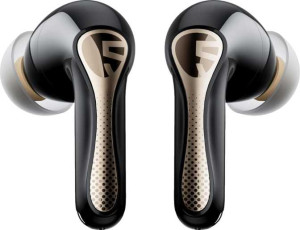
Soundpeats Air 5 Pro Plus
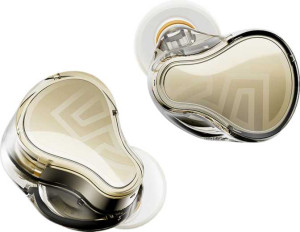
Soundpeats H3

Soundpeats Air 5 Pro Plus Soundpeats H3

Overview

Choosing between the Soundpeats Air 5 Pro Plus and the Soundpeats H3 is no simple task — both are fully wireless, in-ear earbuds sharing IPX5 water resistance, Bluetooth 5.4, and aptX Lossless support. Yet the two diverge in meaningful ways, from active noise cancellation and ambient sound mode to battery longevity, driver size, and codec compatibility. This detailed spec comparison will help you pinpoint which model truly fits your lifestyle and audio priorities.

Common Features

  • Both products use an in-ear fit design.
  • Both products carry an IPX5 ingress protection rating, making them water resistant.
  • Both products are fully wireless with no wires or cables.
  • Neither product is a neckband-style earbud.
  • Neither product includes wingtips.
  • Neither product features RGB lighting.
  • Both products have stereo speakers.
  • Both products offer passive noise reduction.
  • Both products have a lowest frequency of 20 Hz.
  • Spatial audio is not supported on either product.
  • Dolby Atmos is not available on either product.
  • Neither product uses a neodymium magnet.
  • Wireless charging is not available on either product.
  • Neither product has a solar power battery.
  • Both products have a battery level indicator.
  • Both products have a rechargeable battery.
  • Fast pairing is not available on either product.
  • Both products use USB Type-C for charging.
  • Both products support Bluetooth version 5.4.
  • Both products support LDAC audio codec.
  • LDHC support is not available on either product.
  • aptX Low Latency support is not available on either product.
  • aptX HD support is not available on either product.
  • Both products support aptX Lossless.
  • Neither product features in-ear or on-ear detection.
  • Neither product has a find device feature.
  • Both products support fast charging.
  • Both products support multipoint connection with up to 2 devices simultaneously.
  • Neither product can read notifications aloud.
  • Neither product has a built-in translator.
  • Both products include a mute function.
  • Both products can be used as a headset.
  • Both products feature a noise-canceling microphone.

Main Differences

  • Active noise cancellation (ANC) is available on Soundpeats Air 5 Pro Plus but not on Soundpeats H3.
  • The driver unit size is 10 mm on Soundpeats Air 5 Pro Plus and 12 mm on Soundpeats H3.
  • The highest frequency reaches 40000 Hz on Soundpeats Air 5 Pro Plus and 20000 Hz on Soundpeats H3.
  • Battery life is 6 hours on Soundpeats Air 5 Pro Plus and 7 hours on Soundpeats H3.
  • Battery life of the charging case is 24 hours on Soundpeats Air 5 Pro Plus and 30 hours on Soundpeats H3.
  • Charge time is 1.5 hours on Soundpeats Air 5 Pro Plus and 1 hour on Soundpeats H3.
  • Bluetooth LE Audio support is present on Soundpeats Air 5 Pro Plus but not available on Soundpeats H3.
  • aptX Adaptive support is present on Soundpeats H3 but not available on Soundpeats Air 5 Pro Plus.
  • aptX support is present on Soundpeats H3 but not available on Soundpeats Air 5 Pro Plus.
  • Ambient sound mode is available on Soundpeats Air 5 Pro Plus but not on Soundpeats H3.
Specs Comparison
Soundpeats Air 5 Pro Plus

Soundpeats Air 5 Pro Plus

Soundpeats H3

Soundpeats H3

Design:
Fit In-ear In-ear
Ingress Protection (IP) rating IPX5 IPX5
water resistance Water resistant Water resistant
has no wires or cables
are neckband earbuds
wingtips included
has RGB lighting
has stereo speakers
has UV light
Has a display

In terms of design, the Soundpeats Air 5 Pro Plus and the Soundpeats H3 are virtually identical across every measured spec. Both use an in-ear fit, are fully wireless with no cables, carry an IPX5 water resistance rating, and share the same set of omissions: no neckband, no wingtips, no RGB lighting, no UV light, and no display.

The IPX5 rating is worth noting for both — it means they can handle sweat and light rain without issue, making either a solid choice for workouts or commutes in variable weather. However, IPX5 does not cover submersion, so neither should be used near water in any meaningful depth.

Given that every design spec provided is a perfect match, this category is a clear tie. There is no basis in the supplied data to give either product an edge in design.

Sound quality:
has active noise cancellation (ANC)
has passive noise reduction
driver unit size 10 mm 12 mm
lowest frequency 20 Hz 20 Hz
highest frequency 40000 Hz 20000 Hz
supports spatial audio
has Dolby Atmos
has Dirac Virtuo
has a neodymium magnet

The most significant differentiator here is that the Air 5 Pro Plus includes Active Noise Cancellation (ANC), while the H3 relies solely on passive noise reduction. In practical terms, ANC uses microphones to actively counteract ambient sound — particularly effective against low-frequency, constant noise like engines or air conditioning — whereas passive isolation alone depends on the physical seal of the ear tip. For commuters or office users, this is a meaningful real-world gap.

On the driver side, the H3 uses a slightly larger 12 mm driver compared to the Air 5 Pro Plus's 10 mm driver. A larger driver can move more air and may contribute to stronger bass presence, though driver size alone does not guarantee superior sound. More notable is the frequency ceiling: the Air 5 Pro Plus reaches 40,000 Hz versus the H3's 20,000 Hz, extending well beyond the range of human hearing. While this has limited direct audibility impact, it can indicate a higher-resolution audio tuning approach.

Weighing both factors, the Air 5 Pro Plus holds a clear edge in this category. The addition of ANC is a practical, high-impact feature that the H3 simply does not offer, and the wider frequency range adds further differentiation — even if the H3's larger driver offers a minor potential counterpoint in bass response.

Power:
Battery life 6 hours 7 hours
Battery life of charging case 24 hours 30 hours
charge time 1.5 hours 1 hours
has wireless charging
Has a solar power battery
has a battery level indicator
has a rechargeable battery

Across every power metric provided, the Soundpeats H3 outperforms the Air 5 Pro Plus. The H3 delivers 7 hours of earbud battery life versus 6 hours for the Air 5 Pro Plus — a modest but real difference for long listening sessions or travel days where topping up isn't convenient. The case gap is more pronounced: 30 hours total for the H3 compared to 24 hours, meaning the H3 can go significantly longer between case charges.

Charge time further favors the H3, which refuels in 1 hour versus 1.5 hours for the Air 5 Pro Plus. That 30-minute difference matters most when you're in a hurry and need a quick top-up before heading out. Neither model supports wireless charging, so both require a wired connection — a shared limitation at this price tier.

The H3 takes a clear edge in power. Longer earbud runtime, a more capacious case, and a faster charge time make it the stronger performer in this category across the board. The only caveat worth keeping in mind is that the Air 5 Pro Plus's ANC feature — noted in the sound quality group — typically draws more power, which may partly explain the gap in battery figures.

Connectivity:
has fast pairing
Has USB Type-C
Bluetooth version 5.4 5.4
has LDAC
has LDHC
has Bluetooth LE Audio
has aptX Adaptive
has aptX Low Latency
has aptX HD
has aptX
has aptX Lossless
audio latency 60 ms 60 ms
has aptX Voice
has Auracast
maximum Bluetooth range 10 m 10 m
supports Bluetooth pairing using NFC
Can be used wirelessly
has AAC

Both earbuds share a strong connectivity foundation — Bluetooth 5.4, a 60 ms audio latency, a 10 m range, LDAC, aptX Lossless, and AAC. Where they diverge is in which additional high-res codec ecosystem each supports. The Air 5 Pro Plus adds Bluetooth LE Audio, a next-generation standard designed for lower power consumption and improved audio sharing capabilities. The H3, by contrast, brings aptX Adaptive and standard aptX to the table — aptX Adaptive being Qualcomm's flagship codec that dynamically adjusts bitrate for optimal quality and latency depending on connection conditions.

The practical implication depends entirely on your source device. If you use a Qualcomm-chipset Android phone that supports aptX Adaptive, the H3 could deliver a more responsive, high-quality wireless stream in real-world variable conditions. If your device ecosystem leans toward LE Audio-compatible hardware, the Air 5 Pro Plus's support for that standard becomes more relevant — particularly for future-proofing as LE Audio adoption grows.

This category is effectively a tie with ecosystem caveats. Neither product has a universal edge — the H3 wins for aptX Adaptive users, while the Air 5 Pro Plus wins for those invested in the LE Audio ecosystem. Users who rely primarily on LDAC or aptX Lossless will find both options equally capable.

Features:
release date November 2025 October 2025
has ambient sound mode
has in/on-ear detection
has find device feature
Supports fast charging
multipoint count 2 2
can read notifications
Has a built-in translator
has a mute function
can be used as a headset
control panel placed on a device
Has voice prompts
travel bag is included
Has an in-line control panel
Has a temperature sensor
Has a built-in camera remote control function

Feature sets for both earbuds are nearly identical — fast charging, 2-device multipoint connectivity, on-device controls, voice prompts, a mute function, headset capability, and an included travel bag are all shared. For most users, this common ground covers the practical day-to-day essentials without meaningful difference between the two.

The single spec that separates them is ambient sound mode, which the Air 5 Pro Plus supports and the H3 does not. Ambient mode uses the earbuds' microphones to pipe in environmental audio, letting you stay aware of your surroundings — useful for street crossings, airport announcements, or conversations — without removing the earbuds. Its absence on the H3 is a tangible usability gap, not just a checkbox difference.

The Air 5 Pro Plus holds the edge here, and it's a meaningful one. When combined with its ANC support noted in the sound quality group, ambient mode completes a full listening environment control suite — ANC to block the world out, ambient mode to let it back in on demand. The H3 offers neither, leaving users with only passive isolation and no dynamic control over their audio environment.

Microphone:
has a noise-canceling microphone

With only one data point available for this group, the comparison is straightforward: both the Soundpeats Air 5 Pro Plus and the Soundpeats H3 include a noise-canceling microphone. This means both are equipped to filter out background noise during calls — a relevant feature for anyone taking calls in busy or noisy environments.

This category is a clear tie. The provided specs give no basis to distinguish one from the other on microphone capability.

Comparison Summary & Verdict

After weighing all the evidence, both earbuds serve distinct listener profiles. The Soundpeats Air 5 Pro Plus stands out for commuters and focus-driven users thanks to its active noise cancellation, ambient sound mode, and Bluetooth LE Audio support — plus a wider frequency ceiling of 40,000 Hz for those chasing high-resolution detail. The Soundpeats H3, on the other hand, appeals to endurance-focused listeners: it delivers a longer 7-hour battery life (with 30 hours from the case), charges in just one hour, sports a larger 12 mm driver, and adds aptX Adaptive for flexible, high-quality wireless streaming. Neither product is a clear-cut winner — it all comes down to whether you value noise management and extended frequency range, or raw battery stamina and codec versatility.

Soundpeats Air 5 Pro Plus
Buy Soundpeats Air 5 Pro Plus if...

Buy the Soundpeats Air 5 Pro Plus if you need active noise cancellation and an ambient sound mode for commuting or focused listening, and want the wider 40,000 Hz frequency range with Bluetooth LE Audio support.

Soundpeats H3
Buy Soundpeats H3 if...

Buy the Soundpeats H3 if you prioritize longer battery life, faster one-hour charging, a larger 12 mm driver, and broader codec support including aptX Adaptive and aptX.