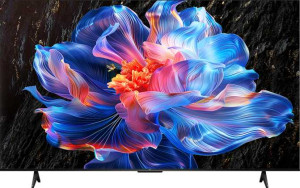
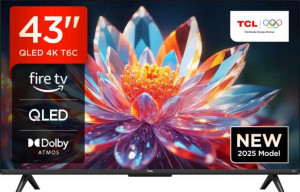
Both the TCL 43P6K and the TCL 43T6C-UK share a strong foundation: native 4K (3840 x 2160) resolution, a 10-bit panel capable of rendering over a billion colors, identical 178° horizontal and vertical viewing angles, and support for both HDR10 and HLG. Anti-reflection coating and an ambient light sensor are present on both, meaning neither has an edge on glare management or automatic brightness adaptation. At roughly 43 inches, their pixel densities (104 ppi vs. 102 ppi) are effectively indistinguishable in everyday use.
Where the two sets diverge meaningfully is in panel technology, brightness, refresh rate, and HDR ecosystem. The 43T6C-UK uses a QLED panel — a quantum-dot enhanced LCD — which translates directly into its 350-nit typical brightness, versus the P6K's standard LED-backlit LCD at just 260 nits. That roughly 35% brightness advantage matters in well-lit or sunlit rooms where a dimmer panel visibly washes out. The T6C-UK also runs at a native 120Hz refresh rate compared to the P6K's 60Hz, which produces noticeably smoother motion in fast-action content like sports and gaming. On the HDR side, the T6C-UK adds Dolby Vision support — a dynamically mastered, scene-by-scene HDR format found on most streaming platforms — while the P6K is limited to HDR10 and HLG, both of which use static metadata and deliver a less optimized HDR experience.
The 43T6C-UK has a clear advantage in this display category. Its QLED technology, higher brightness, doubled refresh rate, and Dolby Vision support collectively represent a meaningfully better viewing experience across brightness, motion clarity, and HDR fidelity — not just marginal spec sheet differences. The 43P6K is a competent 4K panel, but on display specs alone, it does not match its sibling in any of the key performance areas.