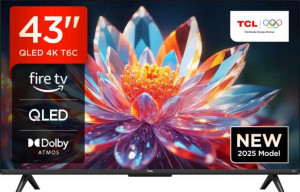
TCL 43T6C-UK 43"
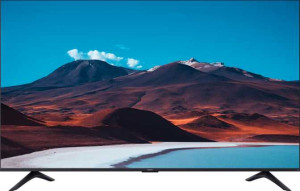
Xiaomi TV F 2026 43"

TCL 43T6C-UK 43" Xiaomi TV F 2026 43"

Overview

Welcome to our in-depth specification comparison between the TCL 43T6C-UK 43″ and the Xiaomi TV F 2026 43″ — two 43-inch 4K QLED televisions that share a surprisingly similar foundation yet diverge in meaningful ways. Both sets offer identical resolution, panel technology, and a strong connectivity suite, but key battlegrounds emerge around refresh rate and HDR capabilities, audio features, and practical design considerations that could tip the scales depending on your viewing priorities.

Common Features

  • Both TVs have a 43″ screen size.
  • Both TVs use a QLED, LED-backlit, LCD display type.
  • Both TVs offer 4K UHD resolution at 3840 x 2160 px.
  • Both TVs have a pixel density of 102 ppi.
  • Both TVs support 1070 million display colors with a 10-bit bit depth.
  • HDR10 support is available on both products.
  • Both TVs have 3 HDMI ports with HDMI 2.1 version.
  • Both TVs support Wi-Fi, including Wi-Fi 4 (802.11n) and Wi-Fi 5 (802.11ac).
  • Both TVs include Bluetooth version 5.
  • Both TVs have 1 RJ45 port.
  • Miracast support is available on both products.
  • Both TVs deliver an audio output power of 2 x 10W with stereo speakers.
  • Digital Out support is available on both products.
  • Dolby Audio support is available on both products.
  • DTS:X support is available on both products.
  • SRS TheaterSound HD is not available on either product.
  • Dolby Virtual support is not available on either product.
  • Neither TV includes a subwoofer.
  • Both TVs support VESA mounting.
  • AirPlay support is available on both products.
  • Both TVs have a built-in smart TV platform.
  • Both TVs work with Alexa.
  • Neither TV works with Siri or Apple HomeKit.
  • Both TVs support remote smartphone control.
  • Neither TV includes a rechargeable remote control.
  • Both TVs support USB recording.
  • Both TVs have a standby power consumption of 0.5W.

Main Differences

  • The refresh rate is 120Hz on the TCL 43T6C-UK 43″ and 60Hz on the Xiaomi TV F 2026 43″.
  • Dolby Vision support is present on the TCL 43T6C-UK 43″ but not available on the Xiaomi TV F 2026 43″.
  • The TCL 43T6C-UK 43″ has 2 USB ports, while the Xiaomi TV F 2026 43″ has 1 USB port.
  • A 3.5mm audio jack is present on the Xiaomi TV F 2026 43″ but not available on the TCL 43T6C-UK 43″.
  • Dolby Atmos support is present on the TCL 43T6C-UK 43″ but not available on the Xiaomi TV F 2026 43″.
  • The width is 956 mm on the TCL 43T6C-UK 43″ and 957 mm on the Xiaomi TV F 2026 43″.
  • The weight is 6400 g on the TCL 43T6C-UK 43″ and 6000 g on the Xiaomi TV F 2026 43″.
  • The thickness is 73 mm on the TCL 43T6C-UK 43″ and 72 mm on the Xiaomi TV F 2026 43″.
  • The height is 559 mm on the TCL 43T6C-UK 43″ and 563 mm on the Xiaomi TV F 2026 43″.
  • The volume is 39011.492 cm³ on the TCL 43T6C-UK 43″ and 38792.952 cm³ on the Xiaomi TV F 2026 43″.
  • The maximum operating temperature is 35 °C on the TCL 43T6C-UK 43″ and 40 °C on the Xiaomi TV F 2026 43″.
  • The lowest potential operating temperature is 5 °C on the TCL 43T6C-UK 43″ and 0 °C on the Xiaomi TV F 2026 43″.
  • The warranty period is 2 years on the TCL 43T6C-UK 43″ and 1 year on the Xiaomi TV F 2026 43″.
Specs Comparison
TCL 43T6C-UK 43"

TCL 43T6C-UK 43"

Xiaomi TV F 2026 43"

Xiaomi TV F 2026 43"

Display:
display resolution 4K (UHD) 4K (UHD)
Display type QLED, LED-backlit, LCD QLED, LED-backlit, LCD
screen size 43" 43"
resolution 3840 x 2160 px 3840 x 2160 px
pixel density 102 ppi 102 ppi
display colors 1070 million 1070 million
bit depth 10-bit 10-bit
refresh rate 120Hz 60Hz
supports HDR10
supports HDR10+
supports Dolby Vision
supports HLG
has anti-reflection coating
has an ambient light sensor
maximum horizontal viewing angle 178º 178º
maximum vertical viewing angle 178º 178º

Both the TCL 43T6C-UK and the Xiaomi TV F 2026 share an identical display foundation: the same 43″ QLED, LED-backlit LCD panel with a 4K (3840 x 2160) resolution, 102 ppi pixel density, 10-bit color depth, and a wide color gamut of 1.07 billion colors. Practical viewing comfort features — anti-reflection coating, an ambient light sensor, and 178° horizontal and vertical viewing angles — are also identical, meaning neither has an edge in panel build quality or everyday usability from these specs alone.

The meaningful differences emerge in two areas: refresh rate and HDR format support. The TCL offers a 120Hz refresh rate, while the Xiaomi is limited to 60Hz. In practice, 120Hz makes motion in fast-paced content — sports, action films, gaming — noticeably smoother and reduces blur, whereas 60Hz can exhibit judder in similar scenarios. On the HDR side, both support HDR10 and HLG, but the TCL additionally supports Dolby Vision, a dynamic HDR format that applies scene-by-scene metadata for more precise brightness and color rendering. The Xiaomi lacks Dolby Vision entirely, which matters if you subscribe to streaming services like Netflix or Apple TV+ that distribute content in that format.

The TCL 43T6C-UK holds a clear display advantage over the Xiaomi TV F 2026 43″. Its higher refresh rate improves motion handling and is also beneficial for gaming at higher frame rates, while its Dolby Vision support unlocks a richer HDR experience on compatible content. The Xiaomi is not a poor display by any means — the shared panel specs are strong — but it loses ground on both of these practically relevant differentiators.
Connectivity:
Has Bluetooth
HDMI version HDMI 2.1 HDMI 2.1
HDMI ports 3 3
supports Wi-Fi
Wi-Fi version Wi-Fi 4 (802.11n), Wi-Fi 5 (802.11ac) Wi-Fi 4 (802.11n), Wi-Fi 5 (802.11ac)
Bluetooth version 5 5
USB ports 2 1
RJ45 ports 1 1
supports Miracast
has a socket for a 3.5 mm audio jack
has an external memory slot
has a VGA connector
DVB standards DVB-T, DVB-T2, DVB-C, DVB-S, DVB-S2 DVB-T, DVB-T2, DVB-C, DVB-S, DVB-S2
has a DVI connector

Wireless and wired backbone connectivity is effectively identical between these two TVs. Both feature HDMI 2.1 across all three of their HDMI ports — important for passing high-bandwidth signals including 4K@120Hz from consoles or PC sources — alongside a shared Wi-Fi spec of Wi-Fi 4 and Wi-Fi 5, Bluetooth 5, one RJ45 Ethernet port, and Miracast screen mirroring support. Neither offers a VGA, DVI, or external memory slot, so on the foundational connectivity framework, they are evenly matched.

The split comes down to two physical ports. The TCL has 2 USB ports versus the Xiaomi's single 1 USB port, which is a tangible everyday difference — connecting a USB drive while a second device like a keyboard or dongle is already plugged in requires no adapter on the TCL, but forces a choice or hub on the Xiaomi. Conversely, the Xiaomi includes a 3.5mm audio jack that the TCL omits entirely; this matters if you want to plug in wired headphones or a basic audio system directly into the TV without routing through an HDMI ARC-capable receiver or a wireless solution.

Neither TV dominates this category outright — rather, each makes a different trade-off. The TCL is the better pick for users who regularly plug in multiple USB peripherals, while the Xiaomi suits those who rely on a direct headphone or analog audio output. Overall, the TCL holds a slight practical edge for most living-room setups, where USB flexibility tends to come up more frequently than analog audio output, but the gap is narrow and use-case dependent.

Audio:
audio output power 2 x 10W 2 x 10W
supports Digital Out
has SRS TheaterSound HD
has stereo speakers
has Dolby Atmos
has Dolby Audio
supports Dolby Virtual
has a subwoofer
has DTS:X
HDMI ARC / eARC HDMI ARC, HDMI eARC HDMI ARC, HDMI eARC

Raw audio hardware is a dead heat here: both TVs deliver 2 x 10W of stereo output with no subwoofer, and both support Digital Out, Dolby Audio, DTS:X, and a full HDMI ARC and eARC implementation. The eARC port in particular is worth noting — it carries enough bandwidth to pass lossless audio formats to a compatible soundbar or receiver, making either TV a capable hub for an external audio setup.

The one meaningful split is Dolby Atmos support, which the TCL carries and the Xiaomi does not. Dolby Atmos is an object-based surround format that adds height and spatial dimensionality to audio — increasingly common on streaming platforms and Blu-ray content. On the TV's own speakers the effect is more modest, but when passing the signal through eARC to an Atmos-capable soundbar, the TCL can relay the full Atmos bitstream while the Xiaomi cannot, resulting in a fundamentally different and more immersive audio experience downstream.

For users relying solely on the built-in speakers, the practical gap between these two TVs is small. But for anyone pairing the TV with an external audio system, the TCL's Dolby Atmos support gives it a clear and meaningful advantage — it future-proofs the setup for Atmos-enabled content and hardware in a way the Xiaomi TV F 2026 simply cannot match.

Design:
width 956 mm 957 mm
weight 6400 g 6000 g
thickness 73 mm 72 mm
height 559 mm 563 mm
volume 39011.492 cm³ 38792.952 cm³
Supports VESA mount
maximum operating temperature 35 °C 40 °C
lowest potential operating temperature 5 °C 0 °C

Physically, these two 43″ TVs are nearly indistinguishable on a shelf. Footprint dimensions differ by just 1mm in width and 4mm in height, and both support VESA mounting — so wall-mount compatibility and cabinet fit are effectively identical for planning purposes. The volume figures confirm this: a difference of roughly 218 cm³ across units this size is negligible.

The one design spec worth flagging is weight. The Xiaomi comes in at 6000g against the TCL's 6400g, a 400g difference. That gap is barely perceptible once either TV is wall-mounted or on a stand, but it can matter during installation — particularly for a single-person wall mount where handling a lighter unit is moderately easier and less stressful on mounting brackets over time.

More practically relevant is the operating temperature range. The Xiaomi tolerates conditions from 0°C to 40°C, while the TCL is rated for 5°C to 35°C. For a typical living room this distinction is moot, but in conservatories, garages, or warmer climates where ambient temperatures can push toward the higher end, the Xiaomi has a marginally broader envelope on both ends. On balance, the Xiaomi holds a slim design advantage — lighter to handle and rated for a wider temperature range — though neither difference is dramatic enough to be decisive for most buyers.

Features:
release date April 2025 September 2025
has AirPlay
has built-in smart TV
works with Alexa
works with Siri/Apple HomeKit
supports a remote smartphone
has a rechargeable remote control
supports USB recording
standby power consumption 0.5W 0.5W
has a search browser
has a sleep timer
has a child lock
warranty period 2 years 1 years
has voice commands

Across the full feature set, these two TVs are remarkably well matched. Both ship with a built-in smart TV platform, AirPlay, Alexa voice control, smartphone remote support, USB recording, a search browser, sleep timer, and child lock. Standby power consumption is identical at 0.5W, and neither Apple HomeKit nor a rechargeable remote appear on either model. For the vast majority of day-to-day smart TV interactions, a user switching between these two sets would notice no functional difference.

The single differentiator in this category is the warranty period: the TCL covers 2 years against the Xiaomi's 1 year. This is more consequential than it might first appear — TV panel and backlight failures, when they occur, often surface in the second year of use rather than the first. A two-year warranty provides a meaningful additional safety net without requiring the user to purchase extended coverage separately.

Given that every other feature in this group is identical, the TCL holds the edge here solely on the strength of its longer warranty. It represents a lower ownership risk over the medium term, which is a tangible real-world advantage even if it has no bearing on the day-to-day user experience.

Comparison Summary & Verdict

After examining every specification, it is clear that both TVs are competent 43-inch 4K QLED displays sharing the same resolution, Wi-Fi standards, Bluetooth 5, and core smart TV features — making the choice come down to specific priorities. The TCL 43T6C-UK 43″ stands out with its 120Hz refresh rate, Dolby Vision and Dolby Atmos support, two USB ports, and a longer 2-year warranty, making it the stronger pick for cinephiles and gamers who demand smoother motion and premium HDR formats. The Xiaomi TV F 2026 43″, meanwhile, counters with a lighter build at 6000 g, a 3.5mm audio jack for headphone use, a higher maximum operating temperature of 40°C, and a lower minimum operating temperature of 0°C, suiting those who value physical flexibility and broader environmental tolerance over top-tier picture processing.

TCL 43T6C-UK 43
Buy TCL 43T6C-UK 43" if...

Buy the TCL 43T6C-UK 43″ if you want a smoother 120Hz refresh rate, Dolby Vision and Dolby Atmos support, and the added peace of mind of a 2-year warranty.

Xiaomi TV F 2026 43
Buy Xiaomi TV F 2026 43" if...

Buy the Xiaomi TV F 2026 43″ if you prefer a lighter TV with a 3.5mm headphone jack, a wider operating temperature range, and a more budget-conscious entry point.