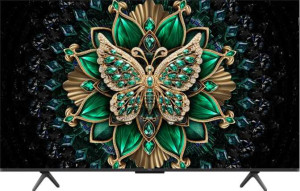
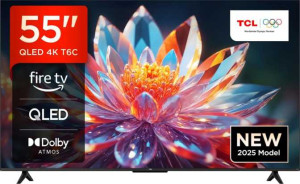
Both the TCL 55C6K and TCL 55T6C-UK share the same 4K (3840 x 2160) QLED panel with a 6000:1 contrast ratio, 10-bit color depth, 1.07 billion colors, and identical 178°/178° viewing angles — a strong shared foundation. However, the C6K adds a Mini-LED backlight, which is the single most impactful structural difference in this group: Mini-LED allows for far more precise local dimming zones, enabling the panel to achieve its 1000 nits of typical brightness versus just 350 nits on the T6C-UK. In real-world use, that nearly 3× brightness gap means the C6K renders HDR highlights far more convincingly, handles bright ambient rooms much better, and produces richer contrast in HDR content — areas where the T6C-UK will visibly struggle.
The HDR ecosystem also favors the C6K: it supports HDR10+ in addition to HDR10, Dolby Vision, and HLG, while the T6C-UK omits HDR10+. Though HDR10+ content is less common than Dolby Vision, it adds dynamic metadata support from a second major ecosystem, giving the C6K broader future-proofing. On the motion and gaming front, the C6K's 144Hz refresh rate edges out the T6C-UK's 120Hz, and its support for AMD FreeSync Premium Pro enables variable refresh rate with low framerate compensation and HDR gaming — capabilities entirely absent on the T6C-UK, which lists no adaptive sync standard at all.
The TCL 55C6K holds a clear and meaningful advantage across every key display differentiator in this group: superior brightness via Mini-LED, a higher refresh rate, broader HDR format support, and full adaptive sync for gaming. The T6C-UK is competitive only in the specs both models share — resolution, color depth, contrast ratio, and viewing angles. For users who prioritize HDR quality, gaming performance, or use the TV in a well-lit room, the C6K is the substantially stronger panel.