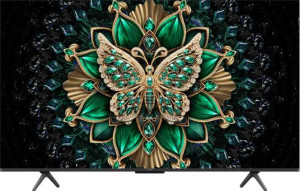
TCL 65C6K 65"
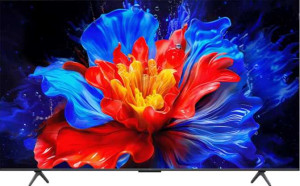
TCL 75P8K 75"

TCL 65C6K 65" TCL 75P8K 75"

Overview

Welcome to our detailed specification comparison between the TCL 65C6K 65″ and the TCL 75P8K 75″. Both TVs share a strong foundation of 4K UHD resolution, 144Hz refresh rate, and a full suite of HDR formats, yet they diverge in some meaningful ways. In this comparison, we examine their key differences across display technology, brightness output, adaptive sync capabilities, and physical design to help you decide which model best fits your needs.

Common Features

  • Both TVs have a 4K UHD display resolution of 3840 x 2160 px.
  • Both products display 1070 million colors with a 10-bit bit depth.
  • Both TVs feature a 144Hz refresh rate.
  • HDR10 support is available on both products.
  • HDR10+ support is available on both products.
  • Dolby Vision support is available on both products.
  • Bluetooth is available on both products at version 5.4.
  • Both TVs include 4 HDMI ports at HDMI 2.1 version.
  • Wi-Fi is supported on both products with Wi-Fi 4 (802.11n) and Wi-Fi 5 (802.11ac).
  • Both products include 1 RJ45 port.
  • Miracast support is available on both products.
  • Dolby Digital support is available on both products.
  • Digital Out support is available on both products.
  • Dolby Digital Plus support is available on both products.
  • Stereo speakers are present on both products.
  • Dolby Atmos support is available on both products.
  • Dolby Audio support is available on both products.
  • SRS TheaterSound HD is not available on either product.
  • Dolby Virtual is not supported on either product.
  • Both TVs support VESA mounting.
  • Both products share the same operating temperature range of 5 °C to 35 °C.
  • AirPlay is available on both products.
  • A built-in smart TV platform is present on both products.
  • Google Assistant compatibility is available on both products.
  • Siri and Apple HomeKit support is not available on either product.
  • Remote smartphone control is supported on both products.
  • Neither product includes a rechargeable remote control.
  • USB recording is supported on both products.
  • Both products have a standby power consumption of 0.5W.

Main Differences

  • The display technology is QLED, LED-backlit, LCD, and Mini-LED on TCL 65C6K 65″, while TCL 75P8K 75″ uses QLED, LED-backlit, and LCD without Mini-LED.
  • The screen size is 64.5″ on TCL 65C6K 65″ and 74.5″ on TCL 75P8K 75″.
  • Pixel density is 68 ppi on TCL 65C6K 65″ and 59 ppi on TCL 75P8K 75″.
  • Typical brightness is 1000 nits on TCL 65C6K 65″ and 350 nits on TCL 75P8K 75″.
  • Adaptive synchronization supports AMD FreeSync, AMD FreeSync Premium, and AMD FreeSync Premium Pro on TCL 65C6K 65″, while TCL 75P8K 75″ only supports AMD FreeSync.
  • USB ports number 2 on TCL 65C6K 65″ and 1 on TCL 75P8K 75″.
  • Width is 1447 mm on TCL 65C6K 65″ and 1666 mm on TCL 75P8K 75″.
  • Height is 832 mm on TCL 65C6K 65″ and 958 mm on TCL 75P8K 75″.
  • Thickness is 56 mm on TCL 65C6K 65″ and 69.5 mm on TCL 75P8K 75″.
  • Weight is 17200 g on TCL 65C6K 65″ and 24600 g on TCL 75P8K 75″.
  • Volume is 67418.624 cm³ on TCL 65C6K 65″ and 110923.946 cm³ on TCL 75P8K 75″.
Specs Comparison
TCL 65C6K 65"

TCL 65C6K 65"

TCL 75P8K 75"

TCL 75P8K 75"

Display:
display resolution 4K (UHD) 4K (UHD)
Display type QLED, LED-backlit, LCD, Mini-LED QLED, LED-backlit, LCD
screen size 64.5" 74.5"
resolution 3840 x 2160 px 3840 x 2160 px
pixel density 68 ppi 59 ppi
display colors 1070 million 1070 million
bit depth 10-bit 10-bit
brightness (typical) 1000 nits 350 nits
refresh rate 144Hz 144Hz
supports HDR10
supports HDR10+
supports Dolby Vision
supports HLG
Adaptive synchronization AMD FreeSync, AMD FreeSync Premium, AMD FreeSync Premium Pro AMD FreeSync
has anti-reflection coating
has an ambient light sensor
maximum horizontal viewing angle 178º 178º
maximum vertical viewing angle 178º 178º

Both the TCL 65C6K and the TCL 75P8K share a strong display foundation: 4K (3840 x 2160) resolution, a 10-bit panel capable of rendering 1.07 billion colors, a 144Hz refresh rate, and full support for every major HDR format — HDR10, HDR10+, Dolby Vision, and HLG. Wide viewing angles of 178° on both axes and a built-in ambient light sensor are also common to both. For everyday 4K HDR content, either TV delivers a complete feature set on paper.

The most consequential difference lies in the panel technology and brightness. The C6K uses a Mini-LED backlight — a significant hardware upgrade over the standard LED-backlit LCD panel in the P8K. This directly translates into the brightness gap: 1000 nits versus just 350 nits. In practice, that nearly 3× brightness advantage means the C6K produces far more impactful HDR highlights, handles bright ambient rooms much better, and delivers visibly deeper local contrast through tighter dimming zones. The P8K's 350-nit output is adequate for SDR viewing in a dim room, but it will struggle to render HDR content with genuine punch. Additionally, the C6K's higher pixel density (68 ppi vs 59 ppi) means slightly sharper detail despite its smaller screen — a noticeable difference up close. On the gaming side, the C6K supports AMD FreeSync Premium Pro, a higher tier that adds low-framerate compensation and HDR certification, while the P8K offers only baseline FreeSync.

The TCL 65C6K holds a clear display advantage. Its Mini-LED construction, dramatically higher brightness, superior pixel density, and more capable adaptive sync support make it the stronger performer across HDR content, bright environments, and gaming. The P8K's main draw is its larger 75″ screen, which may matter for viewers prioritizing sheer size over image quality — but on every measurable display metric provided, the C6K wins outright.
Connectivity:
Has Bluetooth
HDMI version HDMI 2.1 HDMI 2.1
HDMI ports 4 4
supports Wi-Fi
Wi-Fi version Wi-Fi 4 (802.11n), Wi-Fi 5 (802.11ac) Wi-Fi 4 (802.11n), Wi-Fi 5 (802.11ac)
Bluetooth version 5.4 5.4
USB ports 2 1
RJ45 ports 1 1
supports Miracast
has a socket for a 3.5 mm audio jack
has an external memory slot
has a VGA connector
DVB standards DVB-T, DVB-T2, DVB-C, DVB-S, DVB-S2 DVB-T, DVB-T2, DVB-C, DVB-S, DVB-S2
has a DVI connector

Across most connectivity dimensions, these two TVs are virtually identical. Both offer 4 HDMI 2.1 ports — enough to run a gaming console, streaming device, soundbar, and Blu-ray player simultaneously at full bandwidth — alongside a wired RJ45 Ethernet port, Wi-Fi 5, Bluetooth 5.4, Miracast screen mirroring, and a 3.5mm audio jack. The shared HDMI 2.1 standard is worth highlighting: it supports 4K at 144Hz and features like eARC, which matters for high-quality audio passthrough to a compatible soundbar without a separate optical cable.

The only functional difference between the two is USB port count. The C6K includes 2 USB ports while the P8K has just 1. In practice, this means the C6K can simultaneously accommodate, say, a USB storage drive for media playback and a USB-powered device or accessory, without requiring a hub. It is a small but real convenience advantage, particularly for users who connect multiple peripherals directly to the TV.

Overall, connectivity is nearly a tie, with a minor edge to the TCL 65C6K solely due to its extra USB port. Neither TV offers Wi-Fi 6, which would have been a more meaningful differentiator for households with congested networks, but both are otherwise well-equipped for a modern home theater setup.

Audio:
supports Dolby Digital
supports Digital Out
supports Dolby Digital Plus
has SRS TheaterSound HD
has stereo speakers
has Dolby Atmos
has Dolby Audio
supports Dolby Virtual
has a subwoofer
has DTS:X
HDMI ARC / eARC HDMI ARC, HDMI eARC HDMI ARC, HDMI eARC

Audio is a straight tie between these two TVs — every single specification in this group is identical. Both carry a built-in subwoofer alongside stereo speakers, which is a notable inclusion for a flat-panel TV and suggests a more substantial bass response than typical two-driver setups. On the decoding side, both support Dolby Atmos and DTS:X — the two dominant object-based surround formats — meaning either TV can process and virtualize height and spatial audio from compatible streaming content or Blu-ray discs without an external receiver.

For users planning to connect an external audio system, both TVs include HDMI eARC, the more capable successor to standard ARC. This allows lossless and object-based audio formats like Atmos TrueHD to pass through to a compatible soundbar or AV receiver over a single HDMI cable — a meaningful advantage over optical connections, which cannot carry those formats.

Given that every audio specification matches exactly, this group is a complete tie. Neither the C6K nor the P8K holds any audio advantage over the other based on the available data.

Design:
width 1447 mm 1666 mm
weight 17200 g 24600 g
thickness 56 mm 69.5 mm
height 832 mm 958 mm
volume 67418.624 cm³ 110923.946 cm³
Supports VESA mount
maximum operating temperature 35 °C 35 °C
lowest potential operating temperature 5 °C 5 °C

The physical differences here are substantial and expected given the screen size gap. The TCL 75P8K is considerably larger in every dimension — 1666 mm wide versus 1447 mm, and 958 mm tall versus 832 mm — which directly affects how much wall space or furniture surface it demands. More practically, its volume is nearly 65% greater than the C6K's, meaning room placement and furniture compatibility deserve careful consideration before purchase.

Weight is where the difference becomes most relevant during installation. The P8K weighs 24.6 kg compared to the C6K's 17.2 kg — a gap of over 7 kg. For wall mounting in particular, that extra mass means sturdier mounting hardware and very likely a second person for safe installation. The P8K is also noticeably thicker at 69.5 mm versus the C6K's 56 mm, which may matter for flush or near-flush wall mount setups. Both TVs support VESA mounting, though the specific VESA pattern is not provided here.

Operating temperature range is identical for both, so neither has an environmental advantage. Overall, this category has no winner in a traditional sense — the P8K is simply larger because it houses a bigger panel. The TCL 65C6K is the easier TV to handle, move, and install, while the P8K suits those who have the space and infrastructure to support it.

Features:
release date March 2025 March 2025
has AirPlay
has built-in smart TV
compatible with Google Assistant
works with Siri/Apple HomeKit
supports a remote smartphone
has a rechargeable remote control
supports USB recording
standby power consumption 0.5W 0.5W
has a search browser
has a sleep timer
has a child lock
has voice commands

Feature parity is absolute in this category — every specification listed is identical across the TCL 65C6K and the TCL 75P8K. Both run a built-in smart TV platform with Google Assistant and AirPlay support, covering the two most common voice and device ecosystems. Notably, neither supports Apple HomeKit, which may matter to users deeply embedded in the Apple smart home ecosystem. Smartphone remote control is available on both, allowing a phone to substitute for the physical remote.

A few features stand out as genuinely useful inclusions. USB recording lets users connect a USB drive to record live broadcast content directly — a practical cord-cutter feature tied to the DVB tuner support seen in both models. Standby power consumption is a lean 0.5W on both, which is efficient and unlikely to add meaningfully to an electricity bill even over extended periods. Neither TV ships with a rechargeable remote, which is a minor but recurring inconvenience given that replaceable batteries will be needed over time.

With zero differentiation across every data point provided, this group is an unambiguous complete tie. Whichever of the two TVs a buyer chooses, they are getting an identical smart feature set.

Comparison Summary & Verdict

After reviewing all specifications, both TVs deliver a capable 4K experience with shared strengths such as Dolby Vision, HDR10+, Dolby Atmos, and a 144Hz refresh rate. However, the differences are significant for the right buyer. The TCL 65C6K 65″ stands out with its Mini-LED backlighting, a much higher 1000 nits brightness, and advanced AMD FreeSync Premium Pro support, making it the stronger choice for home theater enthusiasts and gamers who demand superior picture quality and smooth gameplay. The TCL 75P8K 75″, on the other hand, offers a considerably larger 74.5″ screen at a more accessible display tier, appealing to viewers who prioritize sheer screen size for casual family viewing over peak brightness and gaming precision.

TCL 65C6K 65
Buy TCL 65C6K 65" if...

Buy the TCL 65C6K 65″ if you want superior picture quality thanks to Mini-LED backlighting and 1000 nits brightness, or if you are a gamer who needs advanced AMD FreeSync Premium Pro support.

TCL 75P8K 75
Buy TCL 75P8K 75" if...

Buy the TCL 75P8K 75″ if you prioritize a larger 74.5″ screen for immersive family viewing and do not require top-tier brightness or advanced adaptive sync features.