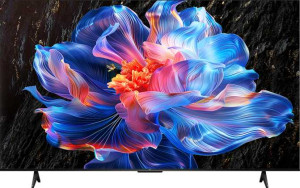
TCL 75P6K 75"
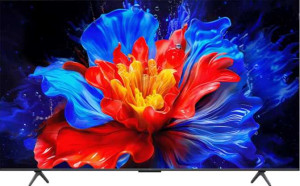
TCL 75P8K 75"

TCL 75P6K 75" TCL 75P8K 75"

Overview

When choosing between the TCL 75P6K 75″ and the TCL 75P8K 75″, buyers are looking at two large-screen 4K televisions that share a strong common foundation yet diverge in some meaningful ways. Both offer a 74.5-inch panel, 10-bit color, and a broad set of smart features, but key battlegrounds emerge around display technology and HDR support, refresh rate performance, and overall audio and connectivity capabilities. This detailed comparison will help you determine which model best fits your needs.

Common Features

  • Both TVs have a 4K (UHD) display resolution.
  • Both TVs have a screen size of 74.5″.
  • Both TVs have a resolution of 3840 x 2160 px.
  • Both TVs have a pixel density of 59 ppi.
  • Both TVs support 1070 million display colors.
  • Both TVs have a 10-bit color bit depth.
  • HDR10 support is available on both products.
  • HLG support is available on both products.
  • Bluetooth connectivity is available on both products.
  • Both TVs use HDMI 2.1 ports.
  • Wi-Fi is supported on both TVs, with Wi-Fi 4 (802.11n) and Wi-Fi 5 (802.11ac).
  • Both TVs have 1 USB port.
  • Both TVs have 1 RJ45 port.
  • Miracast support is available on both products.
  • Both TVs have a 3.5 mm audio jack socket.
  • Digital Out support is available on both products.
  • SRS TheaterSound HD is not available on either product.
  • Both TVs have stereo speakers.
  • Dolby Audio support is available on both products.
  • Both TVs support VESA mounting.
  • Both TVs have a maximum operating temperature of 35 °C and a lowest operating temperature of 5 °C.
  • AirPlay support is available on both products.
  • Both TVs have a built-in smart TV platform.
  • Google Assistant compatibility is available on both products.
  • Siri and Apple HomeKit support is not available on either product.
  • Remote smartphone control is supported on both products.
  • Neither TV comes with a rechargeable remote control.
  • Both TVs have a standby power consumption of 0.5W.
  • Both TVs include a search browser.

Main Differences

  • The display type is LED-backlit LCD on TCL 75P6K 75″ and QLED LED-backlit LCD on TCL 75P8K 75″.
  • Typical brightness is 330 nits on TCL 75P6K 75″ and 350 nits on TCL 75P8K 75″.
  • The refresh rate is 60Hz on TCL 75P6K 75″ and 144Hz on TCL 75P8K 75″.
  • HDR10+ support is present on TCL 75P8K 75″ but not available on TCL 75P6K 75″.
  • Dolby Vision support is present on TCL 75P8K 75″ but not available on TCL 75P6K 75″.
  • The number of HDMI ports is 3 on TCL 75P6K 75″ and 4 on TCL 75P8K 75″.
  • The Bluetooth version is 5.2 on TCL 75P6K 75″ and 5.4 on TCL 75P8K 75″.
  • A built-in subwoofer is present on TCL 75P8K 75″ but not available on TCL 75P6K 75″.
  • USB recording support is available on TCL 75P8K 75″ but not on TCL 75P6K 75″.
  • The width is 1667 mm on TCL 75P6K 75″ and 1666 mm on TCL 75P8K 75″.
  • The weight is 18200 g on TCL 75P6K 75″ and 24600 g on TCL 75P8K 75″.
  • The thickness is 74 mm on TCL 75P6K 75″ and 69.5 mm on TCL 75P8K 75″.
  • The height is 959 mm on TCL 75P6K 75″ and 958 mm on TCL 75P8K 75″.
  • The volume is 118300.322 cm³ on TCL 75P6K 75″ and 110923.946 cm³ on TCL 75P8K 75″.
Specs Comparison
TCL 75P6K 75"

TCL 75P6K 75"

TCL 75P8K 75"

TCL 75P8K 75"

Display:
display resolution 4K (UHD) 4K (UHD)
Display type LED-backlit, LCD QLED, LED-backlit, LCD
screen size 74.5" 74.5"
resolution 3840 x 2160 px 3840 x 2160 px
pixel density 59 ppi 59 ppi
display colors 1070 million 1070 million
bit depth 10-bit 10-bit
brightness (typical) 330 nits 350 nits
refresh rate 60Hz 144Hz
supports HDR10
supports HDR10+
supports Dolby Vision
supports HLG
has anti-reflection coating
has an ambient light sensor
maximum horizontal viewing angle 178º 178º
maximum vertical viewing angle 178º 178º

Both the TCL 75P6K and TCL 75P8K share the same 74.5″ 4K UHD panel with identical resolution, pixel density, color depth, and viewing angles — so on paper, the baseline image structure is the same. The critical panel-level difference, however, is the display technology: the P6K uses a standard LED-backlit LCD, while the P8K uses a QLED panel. QLED's quantum dot layer typically delivers more saturated, accurate colors and better peak brightness, which directly supports the P8K's slightly higher rated brightness of 350 nits vs. 330 nits on the P6K — a modest but real difference in well-lit rooms.

The single most impactful differentiator for many buyers will be the refresh rate. The P6K is capped at 60Hz, while the P8K supports 144Hz — more than double. In practice, a 144Hz panel delivers noticeably smoother motion in fast-action sports and gaming, and is essentially a requirement for high-frame-rate console or PC gaming. For a purely cinematic, TV-watching household, this matters less, but for anyone who games or watches high-motion content, the P8K's advantage here is substantial.

On HDR support, the P8K again pulls ahead: it covers HDR10, HDR10+, Dolby Vision, and HLG, while the P6K supports only HDR10 and HLG — lacking both HDR10+ and Dolby Vision. Since Dolby Vision is the dominant premium HDR format on Netflix, Disney+, and Apple TV+, the P6K will render that content without its intended tone-mapping, which is a meaningful real-world gap. Overall, the P8K holds a clear display advantage across panel technology, peak brightness, refresh rate, and HDR format coverage.
Connectivity:
Has Bluetooth
HDMI version HDMI 2.1 HDMI 2.1
HDMI ports 3 4
supports Wi-Fi
Wi-Fi version Wi-Fi 4 (802.11n), Wi-Fi 5 (802.11ac) Wi-Fi 4 (802.11n), Wi-Fi 5 (802.11ac)
Bluetooth version 5.2 5.4
USB ports 1 1
RJ45 ports 1 1
supports Miracast
has a socket for a 3.5 mm audio jack
has an external memory slot
has a VGA connector
DVB standards DVB-C, DVB-S, DVB-S2, DVB-T, DVB-T2 DVB-T, DVB-T2, DVB-C, DVB-S, DVB-S2
has a DVI connector

The wired connectivity story is straightforward but meaningful: both TVs ship with HDMI 2.1 ports and a single USB port, but the P8K adds a fourth HDMI port versus the P6K's three. For a living room with a soundbar, gaming console, streaming stick, and Blu-ray player all competing for inputs, that extra port eliminates the need for an HDMI switch — a small but genuinely practical advantage.

Wireless connectivity is a near-tie with one notable gap. Both share identical Wi-Fi 4/5 support and lack Wi-Fi 6, which means neither will take full advantage of a modern router on a congested network. On Bluetooth, the P8K carries Bluetooth 5.4 versus the P6K's 5.2 — a newer revision that brings improved connection stability and slightly better energy efficiency, relevant if you pair wireless headphones or a Bluetooth soundbar directly to the TV.

Everything else — RJ45 Ethernet, Miracast screen mirroring, 3.5mm audio jack, and the full DVB tuner suite — is identical between the two. The P8K holds a narrow but real connectivity edge, driven by the additional HDMI port and the newer Bluetooth version, both of which have tangible day-to-day implications in a well-equipped home entertainment setup.

Audio:
supports Digital Out
has SRS TheaterSound HD
has stereo speakers
has Dolby Audio
has a subwoofer
HDMI ARC / eARC HDMI eARC, HDMI ARC HDMI ARC, HDMI eARC

For the most part, the audio specs of these two TVs are aligned: both deliver stereo speakers, Dolby Audio decoding, Digital Out, and support for both HDMI ARC and eARC. The eARC port is worth noting as a shared strength — it supports high-bandwidth audio formats like Dolby TrueHD and DTS:X when paired with a compatible soundbar, making either TV a solid foundation for an external audio setup.

The one meaningful hardware difference is that the P8K includes a built-in subwoofer, while the P6K does not. In practical terms, a subwoofer adds dedicated low-frequency reproduction — deeper bass for action sequences, music, and cinematic sound effects — without relying on full-range drivers to handle the entire audio spectrum. For viewers who use the TV's internal speakers without an external soundbar, this is a genuine advantage in perceived audio richness.

If you plan to route audio through a soundbar or AV receiver, the subwoofer distinction largely disappears, since both TVs handle external audio output equally well. For standalone use, however, the P8K holds a clear audio edge by virtue of its subwoofer, which is the only hardware differentiator this group presents.

Design:
width 1667 mm 1666 mm
weight 18200 g 24600 g
thickness 74 mm 69.5 mm
height 959 mm 958 mm
volume 118300.322 cm³ 110923.946 cm³
Supports VESA mount
maximum operating temperature 35 °C 35 °C
lowest potential operating temperature 5 °C 5 °C

At 75 inches, both TVs occupy virtually the same footprint — width and height differ by just 1mm — so wall space and furniture compatibility are effectively identical. Where they diverge is in two opposing physical characteristics: the P8K is notably slimmer at 69.5mm compared to the P6K's 74mm depth, but it is also substantially heavier at 24.6 kg versus the P6K's 18.2 kg. That is a difference of roughly 6.4 kg, which is significant at this screen size.

The weight gap has real installation implications. For wall mounting, the heavier P8K demands closer attention to wall anchor ratings and may require a second person or professional installation where the lighter P6K might be more manageable. On a TV stand, the weight difference is largely irrelevant once the set is placed, but moving or repositioning the P8K is a meaningfully more physical task. Both TVs support VESA mounting, so bracket compatibility is not a factor in the decision.

On balance, neither product has a clean overall design advantage — it is a trade-off. The P6K is the easier TV to handle and install thanks to its lower weight, while the P8K offers a marginally sleeker profile. For most buyers the weight difference will be the more consequential factor, giving the P6K a practical edge in this category for anyone doing a DIY wall mount.

Features:
release date March 2025 March 2025
has AirPlay
has built-in smart TV
compatible with Google Assistant
works with Siri/Apple HomeKit
supports a remote smartphone
has a rechargeable remote control
supports USB recording
standby power consumption 0.5W 0.5W
has a search browser
has a sleep timer
has a child lock
has voice commands

Across the smart TV feature set, these two models are remarkably alike. Both offer a built-in smart platform, AirPlay, Google Assistant, smartphone remote control, voice commands, and standard convenience features like a sleep timer and child lock. Neither supports Apple HomeKit or Siri, and both share an identical 0.5W standby power consumption — so for the vast majority of day-to-day smart TV interactions, the experience will feel essentially the same.

The single differentiating feature in this group is USB recording, which the P8K supports and the P6K does not. This allows the P8K to record live broadcast content directly to a connected USB drive — a genuinely useful capability for households that rely on the TV's built-in tuner to watch or time-shift live television, eliminating the need for a separate PVR device.

For streaming-first households who rarely use live broadcast tuners, this distinction may be irrelevant in practice. For anyone who does watch live TV through the set's tuner, however, USB recording is a meaningful added convenience. The P8K holds a narrow features edge on the strength of that single capability, with everything else in this category landing as an identical tie.

Comparison Summary & Verdict

Both the TCL 75P6K 75″ and the TCL 75P8K 75″ deliver a solid 4K viewing experience with shared strengths like 10-bit color depth, Dolby Audio, AirPlay, and Google Assistant support. However, the differences between them are significant for discerning buyers. The TCL 75P8K 75″ steps ahead with its QLED panel, a much higher 144Hz refresh rate, support for both Dolby Vision and HDR10+, a built-in subwoofer, USB recording, and an extra HDMI port — making it the stronger choice for home cinema enthusiasts, gamers, and those who want premium audio-visual performance. The TCL 75P6K 75″, being notably lighter at 18.2 kg versus 24.6 kg, is better suited for buyers seeking a capable, no-frills 4K smart TV at a more accessible level without the added weight or premium features.

TCL 75P6K 75
Buy TCL 75P6K 75" if...

Buy the TCL 75P6K 75″ if you want a lightweight, straightforward 4K smart TV and do not need advanced features like a high refresh rate, Dolby Vision, or a built-in subwoofer.

TCL 75P8K 75
Buy TCL 75P8K 75" if...

Buy the TCL 75P8K 75″ if you want a premium viewing experience with a QLED panel, 144Hz refresh rate, Dolby Vision and HDR10+ support, built-in subwoofer, and USB recording capability.