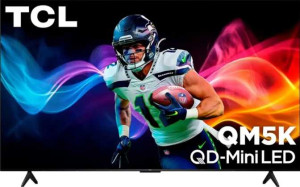
Both the TCL 75Q51K and the TCL 75QM5K share the same fundamental panel characteristics: a 74.5″ 4K (3840 x 2160) resolution at 59 ppi, a 10-bit color pipeline rendering 1.07 billion colors, identical 178°/178° viewing angles, anti-reflection coating, and an ambient light sensor. HDR support is also identical across the board, with both models covering HDR10, HDR10+, Dolby Vision, and HLG — a comprehensive suite that ensures compatibility with virtually every HDR source available today.
The meaningful differences emerge in two areas. First, the QM5K adds Mini-LED backlighting to the standard QLED/LED-backlit/LCD stack. Mini-LED uses a significantly larger number of smaller LEDs organized into more granular local dimming zones, which in practice translates to deeper perceived blacks, higher peak brightness, and reduced blooming around bright objects on dark backgrounds — all without the burn-in risk of OLED. The Q51K, using conventional LED backlighting, cannot match this level of contrast control. Second, and arguably just as impactful for certain users, the QM5K runs at a native 144Hz refresh rate versus the Q51K′s 60Hz. A higher refresh rate produces noticeably smoother motion in fast-paced content, and it is paired with AMD FreeSync adaptive sync on the QM5K — a feature entirely absent on the Q51K. This makes the QM5K a substantially better fit for gaming, where variable frame rates and motion clarity are critical.
The TCL 75QM5K holds a clear and meaningful advantage in this display group. Its Mini-LED backlight delivers superior contrast and local dimming precision, its 144Hz panel provides smoother motion handling, and AMD FreeSync adds practical value for gamers. The Q51K is a capable 4K QLED display, but on every differentiating spec here, the QM5K is the stronger performer.