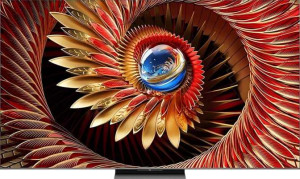
TCL 85C8K 85"
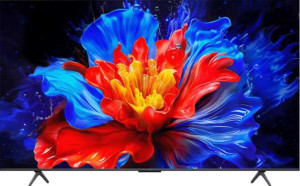
TCL 85P8K 85"

TCL 85C8K 85" TCL 85P8K 85"

Overview

Welcome to our in-depth spec comparison between the TCL 85C8K 85″ and the TCL 85P8K 85″. Both are 85-inch 4K QLED televisions sharing a strong common foundation, yet they differ significantly in areas that matter most to demanding viewers — particularly display technology, peak brightness, and gaming-oriented features. Read on to discover which of these large-screen TVs is the right fit for your living room.

Common Features

  • Both TVs have a 4K (UHD) display resolution of 3840 x 2160 px.
  • Both TVs have a pixel density of 52 ppi.
  • Both TVs support 1070 million display colors at 10-bit depth.
  • Both TVs have a 144Hz refresh rate.
  • HDR10 support is available on both products.
  • HDR10+ support is available on both products.
  • Bluetooth is available on both products at version 5.4.
  • Both TVs use HDMI 2.1 and include 4 HDMI ports.
  • Wi-Fi support is available on both products.
  • Both TVs include 1 USB port and 1 RJ45 port.
  • Miracast support is available on both products.
  • Dolby Atmos and Dolby Audio are available on both products.
  • Dolby Digital and Dolby Digital Plus support is available on both products.
  • Digital Out support is available on both products.
  • Stereo speakers are present on both products.
  • Both TVs support VESA mounting.
  • Both TVs share the same operating temperature range of 5 °C to 35 °C.
  • AirPlay is available on both products.
  • Both TVs have a built-in smart TV platform compatible with Google Assistant.
  • Both TVs support USB recording and have a standby power consumption of 0.5W.

Main Differences

  • The display type is Mini-LED, LED-backlit, LCD, QLED on TCL 85C8K 85″ and QLED, LED-backlit, LCD on TCL 85P8K 85″.
  • The screen size is 85″ on TCL 85C8K 85″ and 84.6″ on TCL 85P8K 85″.
  • Typical brightness is 5000 nits on TCL 85C8K 85″ and 450 nits on TCL 85P8K 85″.
  • Adaptive synchronization supports AMD FreeSync Premium Pro, AMD FreeSync Premium, and AMD FreeSync on TCL 85C8K 85″, while TCL 85P8K 85″ supports AMD FreeSync only.
  • Wi-Fi 6 (802.11ax) support is present on TCL 85C8K 85″ but not available on TCL 85P8K 85″.
  • A 3.5 mm audio jack socket is present on TCL 85P8K 85″ but not available on TCL 85C8K 85″.
  • Width is 1880 mm on TCL 85C8K 85″ and 1889.6 mm on TCL 85P8K 85″.
  • Height is 1073 mm on TCL 85C8K 85″ and 1086 mm on TCL 85P8K 85″.
  • Thickness is 53 mm on TCL 85C8K 85″ and 63 mm on TCL 85P8K 85″.
  • Weight is 41600 g on TCL 85C8K 85″ and 31000 g on TCL 85P8K 85″.
  • Volume is 106913.72 cm³ on TCL 85C8K 85″ and 129282.65 cm³ on TCL 85P8K 85″.
Specs Comparison
TCL 85C8K 85"

TCL 85C8K 85"

TCL 85P8K 85"

TCL 85P8K 85"

Display:
display resolution 4K (UHD) 4K (UHD)
Display type Mini-LED, LED-backlit, LCD, QLED QLED, LED-backlit, LCD
screen size 85" 84.6"
resolution 3840 x 2160 px 3840 x 2160 px
pixel density 52 ppi 52 ppi
display colors 1070 million 1070 million
bit depth 10-bit 10-bit
brightness (typical) 5000 nits 450 nits
refresh rate 144Hz 144Hz
supports HDR10
supports HDR10+
supports Dolby Vision
supports HLG
Adaptive synchronization AMD FreeSync, AMD FreeSync Premium, AMD FreeSync Premium Pro AMD FreeSync
has anti-reflection coating
has an ambient light sensor
maximum horizontal viewing angle 178º 178º
maximum vertical viewing angle 178º 178º

Both the TCL 85C8K and TCL 85P8K share a strong display foundation: 4K (3840 x 2160) resolution at 52 ppi, a 10-bit panel capable of 1.07 billion colors, a 144Hz refresh rate, and full HDR support across HDR10, HDR10+, Dolby Vision, and HLG. Anti-reflection coating, an ambient light sensor, and wide 178º viewing angles in both directions are also common to both. For everyday picture quality and content compatibility, they start from the same baseline.

The single most significant differentiator is brightness and backlight technology. The C8K uses a Mini-LED backlight, which enables far more precise local dimming zones and pushes typical brightness to a staggering 5000 nits — more than ten times the P8K's 450 nits. In practice, this gap is transformative: the C8K can render blinding HDR highlights, maintain vivid color in brightly lit rooms, and deliver the kind of contrast and punch that the P8K simply cannot match. The P8K is a standard QLED LCD panel, which is competent, but it operates in an entirely different league for HDR performance and ambient viewing conditions.

The C8K also extends its edge for gaming enthusiasts by supporting AMD FreeSync Premium Pro (alongside the standard tiers), which adds low framerate compensation and HDR requirements on top of basic variable refresh rate support — whereas the P8K offers only baseline AMD FreeSync. Overall, the TCL 85C8K has a clear and decisive display advantage, primarily driven by its Mini-LED backlighting and vastly superior brightness; the P8K is a reasonable choice for budget-conscious buyers in controlled lighting, but cannot compete on HDR fidelity or peak luminance.
Connectivity:
Has Bluetooth
HDMI version HDMI 2.1 HDMI 2.1
HDMI ports 4 4
supports Wi-Fi
Wi-Fi version Wi-Fi 4 (802.11n), Wi-Fi 5 (802.11ac), Wi-Fi 6 (802.11ax) Wi-Fi 4 (802.11n), Wi-Fi 5 (802.11ac)
Bluetooth version 5.4 5.4
USB ports 1 1
RJ45 ports 1 1
supports Miracast
has a socket for a 3.5 mm audio jack
has an external memory slot
has a VGA connector
DVB standards DVB-T, DVB-T2, DVB-C, DVB-S, DVB-S2 DVB-T, DVB-T2, DVB-C, DVB-S, DVB-S2
has a DVI connector

On the wired side, both TVs are effectively identical: four HDMI 2.1 ports (supporting the full bandwidth needed for 4K/144Hz sources), one USB port, and one RJ45 ethernet jack. The shared Bluetooth 5.4 and Miracast support round out a solid and evenly matched physical connectivity package for the vast majority of users.

Where the two diverge is wireless networking and analog audio. The C8K adds Wi-Fi 6 (802.11ax) to its wireless repertoire, whereas the P8K tops out at Wi-Fi 5 (802.11ac). In real-world terms, Wi-Fi 6 offers meaningfully better performance in congested home networks — multiple devices streaming simultaneously will contend less for bandwidth, and throughput in busy environments is more stable. For a TV in a modern household with many connected devices, this is a genuine practical upgrade. Conversely, the P8K includes a 3.5mm audio jack that the C8K omits entirely — a small but tangible advantage for users who want to connect wired headphones directly to the TV without relying on Bluetooth.

The connectivity edge belongs to the TCL 85C8K, primarily due to Wi-Fi 6 support, which is increasingly relevant as home networks grow more congested. The P8K's 3.5mm jack is a useful practical addition for some users, but it does not offset the networking advantage. For most buyers, the C8K's wireless capability will prove the more impactful differentiator.

Audio:
supports Dolby Digital
supports Digital Out
supports Dolby Digital Plus
has SRS TheaterSound HD
has stereo speakers
has Dolby Atmos
has Dolby Audio
supports Dolby Virtual
has a subwoofer
has DTS:X
HDMI ARC / eARC HDMI ARC, HDMI eARC HDMI ARC, HDMI eARC

Across every audio specification provided, the TCL 85C8K and TCL 85P8K are a complete match. Both carry Dolby Atmos and DTS:X — the two dominant object-based surround formats — meaning either TV can decode and present height-channel audio metadata from streaming services, Blu-ray, and broadcast sources without requiring an external processor. Both also include a built-in subwoofer and stereo speakers, which is a meaningful inclusion at the TV level, adding low-frequency reinforcement that most flat panels lack entirely.

On the output side, both support HDMI eARC alongside standard ARC, which matters for anyone planning to connect a soundbar or AV receiver. eARC carries full-bandwidth, lossless audio formats — including Dolby TrueHD and DTS-HD Master Audio — back to an external audio system, something the older ARC standard cannot do. The presence of this feature on both models ensures neither TV bottlenecks a high-end audio setup.

This group is a complete tie. There is no audio specification in the provided data that distinguishes one model from the other, and the shared feature set is genuinely capable rather than merely adequate. Audio performance should not factor into the decision between these two TVs.

Design:
width 1880 mm 1889.6 mm
weight 41600 g 31000 g
thickness 53 mm 63 mm
height 1073 mm 1086 mm
volume 106913.72 cm³ 129282.6528 cm³
Supports VESA mount
maximum operating temperature 35 °C 35 °C
lowest potential operating temperature 5 °C 5 °C

The physical footprints of these two TVs are broadly similar — both are roughly 1880–1890mm wide and just over a meter tall — but two measurements tell a more interesting story. The C8K is notably heavier at 41.6 kg compared to the P8K's 31 kg, a difference of over 10 kg. That extra mass is almost certainly a consequence of the C8K's Mini-LED backlight assembly, which requires substantially more hardware than a conventional LED panel. In practical terms, this gap matters most during installation: wall-mounting or repositioning the C8K is a meaningfully more demanding task, and buyers should verify that their wall mount and wall structure are rated for the additional load.

The thickness figures point in the opposite direction. The C8K is the slimmer of the two at 53 mm, versus the P8K's 63 mm — a 10mm difference that is noticeable in profile, particularly for wall-mount installations where depth off the wall is a concern. The C8K therefore presents a more refined silhouette despite its greater weight. Both models support VESA mounting and share identical operating temperature ranges, so neither has an edge in placement flexibility or environmental tolerance.

Design-wise, the outcome is nuanced and context-dependent. The P8K has a clear handling and installation advantage thanks to its significantly lower weight, making it the easier TV to move and mount solo or with minimal help. The C8K counters with a slimmer profile. Neither product wins outright — the better choice depends on whether weight or wall depth is the greater concern for a given installation.

Features:
release date June 2025 March 2025
has AirPlay
has built-in smart TV
compatible with Google Assistant
works with Siri/Apple HomeKit
supports a remote smartphone
has a rechargeable remote control
supports USB recording
standby power consumption 0.5W 0.5W
has a search browser
has a sleep timer
has a child lock
has voice commands

Feature-for-feature, the TCL 85C8K and TCL 85P8K are identical across every specification in this group. Both run a built-in smart TV platform with a search browser, support Google Assistant and AirPlay for voice control and Apple device casting respectively, and allow smartphone remote control. Notably, neither is compatible with Siri/Apple HomeKit, which is worth flagging for users deeply embedded in the Apple ecosystem who rely on HomeKit automations.

A few shared features deserve particular attention for their practical value. USB recording support means both TVs can record live broadcast content directly to an attached USB drive — a useful cord-cutter feature that is not universal at this price tier. The 0.5W standby power consumption is also identical, reflecting efficient idle behavior. Neither model ships with a rechargeable remote, which is a minor but recurring inconvenience compared to premium rivals that do.

This group is a complete tie with no differentiating data points between the two models. Features should carry no weight in the decision between these two TVs — any choice made here will be driven entirely by the other specification groups.

Comparison Summary & Verdict

After examining every specification, these two TCL televisions serve distinctly different audiences. The TCL 85C8K 85″ is the clear choice for those who want the best possible picture quality and gaming performance, thanks to its Mini-LED backlighting, exceptional 5000-nit peak brightness, and advanced AMD FreeSync Premium Pro adaptive sync support, alongside Wi-Fi 6 connectivity. It is heavier and thicker, but its visual performance credentials are in a different league. The TCL 85P8K 85″, on the other hand, is a more accessible large-screen option — it is notably lighter at 31 kg, includes a practical 3.5 mm audio jack, and still delivers solid 4K HDR performance for everyday viewing. Both share identical audio features, smart platform capabilities, and connectivity essentials, making either a well-rounded choice depending on your priorities and budget.

TCL 85C8K 85
Buy TCL 85C8K 85" if...

Buy the TCL 85C8K 85″ if you want a premium viewing and gaming experience with Mini-LED technology, 5000-nit brightness, and AMD FreeSync Premium Pro support.

TCL 85P8K 85
Buy TCL 85P8K 85" if...

Buy the TCL 85P8K 85″ if you want a lighter, more compact large-screen TV for everyday viewing and value the convenience of a built-in 3.5 mm audio jack.