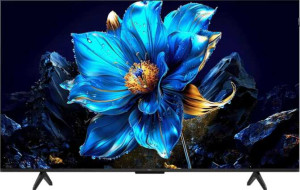
TCL 85P7K 85"
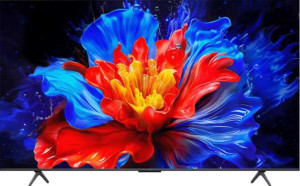
TCL 85P8K 85"

TCL 85P7K 85" TCL 85P8K 85"

Overview

Welcome to our in-depth specification comparison between the TCL 85P7K 85″ and the TCL 85P8K 85″. Both are large-screen QLED televisions sharing the same 4K resolution, identical physical dimensions, and a rich audio feature set. Yet beneath their shared DNA lie meaningful differences that could sway your buying decision, particularly around refresh rate and connectivity options. Read on to see how these two 85-inch giants stack up against each other.

Common Features

  • Both TVs have a 4K UHD resolution of 3840 x 2160 px.
  • Both TVs feature a QLED, LED-backlit LCD display type.
  • Both TVs have a screen size of 84.6″.
  • Both TVs have a pixel density of 52 ppi.
  • Both TVs support 1070 million display colors with 10-bit bit depth.
  • Both TVs have a typical brightness of 450 nits.
  • Both TVs support Bluetooth 5.4.
  • Both TVs include an HDMI 2.1 port.
  • Both TVs support Wi-Fi 4 (802.11n) and Wi-Fi 5 (802.11ac).
  • Both TVs include one RJ45 port.
  • Both TVs support Miracast.
  • Both TVs include a 3.5 mm audio jack.
  • Both TVs have stereo speakers and a subwoofer.
  • Both TVs support Dolby Atmos and DTS:X.
  • Dolby Virtual support is not available on either TV.
  • SRS TheaterSound HD is not available on either TV.
  • Digital audio output is supported on both TVs.
  • Both TVs share identical physical dimensions: 1889.6 mm wide, 1086 mm tall, and 63 mm thick.
  • Both TVs weigh 31000 g and support VESA mounting.
  • Both TVs have AirPlay, a built-in smart TV platform, and Google Assistant compatibility.
  • Apple HomeKit and Siri support is not available on either TV.
  • Both TVs support remote smartphone control and include a search browser.
  • Neither TV has a rechargeable remote control.
  • Both TVs have a standby power consumption of 0.5W.
  • Both TVs operate within a temperature range of 5 °C to 35 °C.

Main Differences

  • Refresh rate is 60Hz on TCL 85P7K 85″ and 144Hz on TCL 85P8K 85″.
  • HDMI port count is 3 on TCL 85P7K 85″ and 4 on TCL 85P8K 85″.
  • USB port count is 2 on TCL 85P7K 85″ and 1 on TCL 85P8K 85″.
  • USB recording is not supported on TCL 85P7K 85″ but is available on TCL 85P8K 85″.
Specs Comparison
TCL 85P7K 85"

TCL 85P7K 85"

TCL 85P8K 85"

TCL 85P8K 85"

Display:
display resolution 4K (UHD) 4K (UHD)
Display type QLED, LED-backlit, LCD QLED, LED-backlit, LCD
screen size 84.6" 84.6"
resolution 3840 x 2160 px 3840 x 2160 px
pixel density 52 ppi 52 ppi
display colors 1070 million 1070 million
bit depth 10-bit 10-bit
brightness (typical) 450 nits 450 nits
refresh rate 60Hz 144Hz
supports HDR10
supports HDR10+
supports Dolby Vision
supports HLG
Adaptive synchronization AMD FreeSync AMD FreeSync
has anti-reflection coating
has an ambient light sensor
maximum horizontal viewing angle 178º 178º
maximum vertical viewing angle 178º 178º

Both the TCL 85P7K and TCL 85P8K share the same fundamental display DNA: identical 84.6″ QLED LED-backlit LCD panels with a 3840×2160 (4K UHD) resolution at 52 ppi, 10-bit color depth supporting 1.07 billion colors, and 450 nits of typical brightness. HDR coverage is equally matched, with both supporting HDR10, HDR10+, Dolby Vision, and HLG, alongside AMD FreeSync adaptive sync, anti-reflection coating, an ambient light sensor, and full 178° viewing angles in both axes. In other words, the core picture quality foundation — color volume, contrast handling, and HDR versatility — is effectively identical between the two.

The one meaningful differentiator in this group is the refresh rate. The P7K is capped at 60Hz, while the P8K steps up to 144Hz. In practical terms, 60Hz is perfectly adequate for standard broadcast, streaming, and cinematic content. However, a 144Hz panel delivers noticeably smoother motion in fast-action sports, high-frame-rate content, and — critically — gaming. Combined with AMD FreeSync, the P8K's higher refresh ceiling allows the variable refresh rate to operate across a much wider and more useful range, reducing screen tearing and stutter far more effectively than on the P7K.

For the intended use of most TV buyers — streaming and general viewing — both displays will look virtually identical in practice. But for users who game on console or PC, or who prioritize ultra-smooth motion, the P8K holds a clear edge in this group purely on the strength of its 144Hz panel. The P7K has no compensating display advantage to offset this difference.
Connectivity:
Has Bluetooth
HDMI version HDMI 2.1 HDMI 2.1
HDMI ports 3 4
supports Wi-Fi
Wi-Fi version Wi-Fi 4 (802.11n), Wi-Fi 5 (802.11ac) Wi-Fi 4 (802.11n), Wi-Fi 5 (802.11ac)
Bluetooth version 5.4 5.4
USB ports 2 1
RJ45 ports 1 1
supports Miracast
has a socket for a 3.5 mm audio jack
has an external memory slot
has a VGA connector
DVB standards DVB-C, DVB-S, DVB-S2, DVB-T, DVB-T2 DVB-T, DVB-T2, DVB-C, DVB-S, DVB-S2
has a DVI connector

Across most connectivity dimensions, the TCL 85P7K and TCL 85P8K are essentially mirror images: both carry HDMI 2.1 ports, a single RJ45 Ethernet port, Wi-Fi 5 (backward-compatible with Wi-Fi 4), Bluetooth 5.4, Miracast wireless display support, and a 3.5mm audio jack. HDMI 2.1 is worth noting as a genuine asset on both TVs — it supports bandwidth sufficient for 4K at high refresh rates, which pairs well with the P8K's 144Hz panel in particular.

The only divergence between the two comes down to a straight trade-off: the P8K gains an extra HDMI port (4 vs. 3), while the P7K counters with an extra USB port (2 vs. 1). In a typical living room setup with a soundbar, a games console, a streaming stick, and a Blu-ray player, that fourth HDMI on the P8K removes the need for an HDMI switch entirely. The P7K's second USB port, by contrast, is more useful for simultaneously connecting a storage drive and a peripheral like a keyboard or mouse — a convenience, but generally a lower-priority need for most TV users.

Which trade-off matters more depends entirely on the user's setup. For heavily HDMI-dependent configurations — especially given the P8K's gaming-oriented 144Hz panel — the P8K holds a practical edge in this group. Users with fewer HDMI devices but a need to keep multiple USB accessories plugged in simultaneously will find the P7K's dual USB ports the more useful arrangement.

Audio:
supports Digital Out
has SRS TheaterSound HD
has stereo speakers
has Dolby Atmos
supports Dolby Virtual
has a subwoofer
has DTS:X
HDMI ARC / eARC HDMI eARC, HDMI ARC HDMI ARC, HDMI eARC

Audio is the rare category where no trade-offs exist between these two TVs — the TCL 85P7K and TCL 85P8K are spec-for-spec identical. Both feature stereo speakers with a built-in subwoofer, support for Dolby Atmos and DTS:X object-based surround formats, digital audio output, and both HDMI ARC and eARC. The presence of eARC in particular is worth highlighting: unlike standard ARC, eARC carries enough bandwidth to pass through lossless audio formats such as Dolby TrueHD and DTS-HD Master Audio to a compatible soundbar or AV receiver, future-proofing the external audio chain for users who invest in higher-end sound equipment.

Given the complete parity across every audio specification in this group, this category results in a dead tie. Neither TV offers any audio capability or hardware advantage over the other, and the choice between them has no bearing on the listening experience.

Design:
width 1889.6 mm 1889.6 mm
weight 31000 g 31000 g
thickness 63 mm 63 mm
height 1086 mm 1086 mm
volume 129282.6528 cm³ 129282.6528 cm³
Supports VESA mount
maximum operating temperature 35 °C 35 °C
lowest potential operating temperature 5 °C 5 °C

From a physical standpoint, the TCL 85P7K and TCL 85P8K are completely interchangeable. Every dimension — 1889.6 mm wide, 1086 mm tall, 63 mm thick — and the 31 kg weight are identical, meaning installation requirements, furniture clearance, and wall-mounting logistics are exactly the same for both. VESA mount support is confirmed on both, so wall-mount bracket compatibility will not be a differentiating factor when planning an install.

Operating temperature range is likewise shared: both function between 5 °C and 35 °C, which covers all standard indoor environments without issue. This is a complete tie in every measurable design and physical specification — the decision between these two TVs rests entirely on the feature and performance differences found in other specification groups.

Features:
release date March 2025 March 2025
has AirPlay
has built-in smart TV
compatible with Google Assistant
works with Siri/Apple HomeKit
supports a remote smartphone
has a rechargeable remote control
supports USB recording
standby power consumption 0.5W 0.5W
has a search browser
has a sleep timer
has a child lock
has voice commands

The smart feature sets of the TCL 85P7K and TCL 85P8K are nearly identical: both run a built-in smart TV platform with Google Assistant voice control, AirPlay support, smartphone remote compatibility, a search browser, sleep timer, and child lock. Notably, neither supports Apple HomeKit/Siri integration, which is worth flagging for users deeply embedded in the Apple ecosystem. Standby power consumption is a matching 0.5W on both — negligible in practical terms.

The sole functional differentiator in this group is USB recording, available on the P8K but absent on the P7K. This feature allows users to connect a USB storage drive and record live broadcast content directly to it — a meaningful convenience for anyone who relies on over-the-air or cable tuner content and prefers not to depend on a separate PVR device. For cord-cutters or households that regularly time-shift broadcast TV, this is a genuinely useful capability.

For pure streaming-focused users, the omission on the P7K is inconsequential. But for broadcast TV viewers, the P8K holds a clear edge in this group by virtue of its USB recording support — a feature that adds tangible utility without any corresponding drawback on the P7K's side to balance it out.

Comparison Summary & Verdict

The TCL 85P7K 85″ and TCL 85P8K 85″ are remarkably similar televisions that share the same 4K QLED panel, identical dimensions, and an impressive audio package including Dolby Atmos and DTS:X. The decisive factor between them comes down to intended use. The TCL 85P8K 85″ pulls ahead for gamers and home-cinema enthusiasts with its 144Hz refresh rate, an extra HDMI 2.1 port for a total of four, and USB recording support — making it the stronger all-round performer. The TCL 85P7K 85″, on the other hand, offers two USB ports versus the P8K's single port, which may appeal to users who regularly connect multiple USB devices and do not need the higher refresh rate. Choose the P7K for straightforward everyday viewing with more USB flexibility, and opt for the P8K if gaming performance or broadcast recording are priorities.

TCL 85P7K 85
Buy TCL 85P7K 85" if...

Buy the TCL 85P7K 85″ if you need more USB ports for connecting multiple devices simultaneously and a standard 60Hz refresh rate is sufficient for your viewing habits.

TCL 85P8K 85
Buy TCL 85P8K 85" if...

Buy the TCL 85P8K 85″ if you want a smoother 144Hz refresh rate for gaming or fast-motion content, an extra HDMI port, and the ability to record broadcasts via USB.