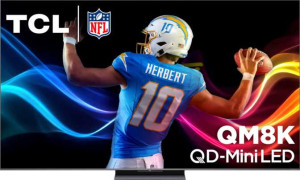
TCL 98QM8K 98"
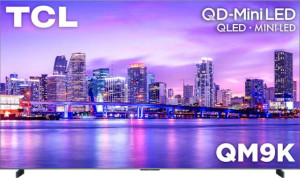
TCL 98QM9K 98"

TCL 98QM8K 98" TCL 98QM9K 98"

Overview

Choosing between two premium 98-inch televisions from the same manufacturer is never straightforward, and the TCL 98QM8K 98″ versus TCL 98QM9K 98″ comparison is no exception. Both models are built around an identical QLED Mini-LED panel with a blazing 144Hz refresh rate and a full-featured smart TV platform, yet they part ways on some surprisingly impactful specifications. From pixel density and wireless connectivity to audio hardware, the differences between these two giants deserve a close look before you commit.

Common Features

  • Both TVs have a 4K (UHD) display resolution.
  • Both TVs feature a QLED, LED-backlit, LCD, Mini-LED display type.
  • Both TVs have a screen size of 97.5″.
  • Both TVs have a resolution of 3840 x 2160 px.
  • Both TVs support 1070 million display colors.
  • Both TVs have a 10-bit bit depth.
  • Both TVs have a 144Hz refresh rate.
  • HDR10 support is available on both TVs.
  • Bluetooth is available on both TVs.
  • Both TVs use HDMI 2.1 and include 4 HDMI ports.
  • Wi-Fi support is available on both TVs.
  • Both TVs use Bluetooth version 5.4.
  • Both TVs include 2 USB ports and 1 RJ45 port.
  • Miracast support is available on both TVs.
  • Dolby Digital, Dolby Digital Plus, Dolby Atmos, and Dolby Audio support are available on both TVs.
  • Digital Out support is available on both TVs.
  • SRS TheaterSound HD is not available on either TV.
  • Stereo speakers are present on both TVs.
  • Dolby Virtual support is not available on either TV.
  • Both TVs weigh 56001 g and share the same thickness of 54.1 mm and height of 1235.9 mm.
  • VESA mount support is available on both TVs.
  • Both TVs operate within a temperature range of 5 °C to 35 °C.
  • Chromecast built-in is available on both TVs.
  • AirPlay support is available on both TVs.
  • Both TVs have a built-in smart TV platform.
  • Google Assistant compatibility is available on both TVs.
  • Alexa support is available on both TVs.
  • Siri and Apple HomeKit support is not available on either TV.
  • Remote smartphone control is supported on both TVs.
  • Neither TV includes a rechargeable remote control.

Main Differences

  • Pixel density is 45 ppi on TCL 98QM8K 98″ and 54 ppi on TCL 98QM9K 98″.
  • Wi-Fi support includes Wi-Fi 4 and Wi-Fi 5 on TCL 98QM8K 98″, while TCL 98QM9K 98″ additionally supports Wi-Fi 6 (802.11ax).
  • A built-in subwoofer is present on TCL 98QM8K 98″ but not available on TCL 98QM9K 98″.
  • Width is 2179.3 mm on TCL 98QM8K 98″ and 2166.1 mm on TCL 98QM9K 98″.
  • Volume is 145712.77 cm³ on TCL 98QM8K 98″ and 144830.19 cm³ on TCL 98QM9K 98″.
Specs Comparison
TCL 98QM8K 98"

TCL 98QM8K 98"

TCL 98QM9K 98"

TCL 98QM9K 98"

Display:
display resolution 4K (UHD) 4K (UHD)
Display type QLED, LED-backlit, LCD, Mini-LED QLED, LED-backlit, LCD, Mini-LED
screen size 97.5" 97.5"
resolution 3840 x 2160 px 3840 x 2160 px
pixel density 45 ppi 54 ppi
display colors 1070 million 1070 million
bit depth 10-bit 10-bit
refresh rate 144Hz 144Hz
supports HDR10
supports HDR10+
supports Dolby Vision
supports HLG
Adaptive synchronization AMD FreeSync, AMD FreeSync Premium, AMD FreeSync Premium Pro AMD FreeSync, AMD FreeSync Premium, AMD FreeSync Premium Pro
has anti-reflection coating
has an ambient light sensor
maximum horizontal viewing angle 178º 178º
maximum vertical viewing angle 178º 178º

The TCL 98QM8K and TCL 98QM9K share an identical display foundation: both are 97.5″ QLED Mini-LED LCD panels running at a native 3840 x 2160 (4K UHD) resolution with a 144Hz refresh rate, 10-bit color depth, and support for 1.07 billion colors. They also match on every HDR front — HDR10, HDR10+, Dolby Vision, and HLG are all present on both — and share the same AMD FreeSync Premium Pro adaptive sync suite, anti-reflection coating, ambient light sensor, and a wide 178° viewing angle in both axes. For most practical purposes, these two panels start from a virtually indistinguishable baseline.

The sole measurable difference in the provided specs is pixel density: the QM8K registers at 45 ppi, while the QM9K comes in at 54 ppi — a roughly 20% increase. On a screen this large, both figures fall well below the threshold where individual pixels become visible at normal viewing distances (typically 8–12 feet for a 98″ TV). In practice, that gap is unlikely to produce a perceptible sharpness difference during everyday viewing, though the QM9K′s higher ppi could offer marginally crisper fine detail when content is viewed up close or when the screen is used as a monitor.

Based strictly on the data provided, the QM9K holds a narrow edge in pixel density, but given that both TVs share the same resolution, panel technology, HDR capabilities, and refresh rate, the real-world display experience will be nearly identical for the vast majority of users. The decision between them should hinge on specs outside this group rather than any meaningful display-level distinction.
Connectivity:
Has Bluetooth
HDMI version HDMI 2.1 HDMI 2.1
HDMI ports 4 4
supports Wi-Fi
Wi-Fi version Wi-Fi 4 (802.11n), Wi-Fi 5 (802.11ac) Wi-Fi 4 (802.11n), Wi-Fi 5 (802.11ac), Wi-Fi 6 (802.11ax)
Bluetooth version 5.4 5.4
USB ports 2 2
RJ45 ports 1 1
supports Miracast
has a socket for a 3.5 mm audio jack
has an external memory slot
has a VGA connector
has a DVI connector

Across most of the connectivity checklist, the QM8K and QM9K are identical: both offer 4 HDMI 2.1 ports — critical for running multiple 4K/120fps sources simultaneously — along with 2 USB ports, a dedicated RJ45 ethernet jack, Bluetooth 5.4, and Miracast wireless mirroring. That shared HDMI 2.1 lineup is particularly valuable for gaming households pairing the TV with current-gen consoles or high-end GPUs.

The one meaningful split comes down to Wi-Fi. The QM8K tops out at Wi-Fi 5 (802.11ac), while the QM9K adds Wi-Fi 6 (802.11ax) support. In practical terms, Wi-Fi 6 delivers higher throughput on congested networks, lower latency, and more efficient communication when multiple devices compete for bandwidth — a real advantage in a busy smart home. For users who rely on a wired ethernet connection, this difference evaporates entirely, but for those streaming over Wi-Fi in dense environments, it is a tangible upgrade.

The QM9K holds a clear connectivity edge solely due to its Wi-Fi 6 capability. Everything else — ports, Bluetooth version, mirroring support — is a dead heat. If your setup depends on wireless streaming or future-proofing against increasingly crowded home networks, the QM9K is the stronger choice here.

Audio:
supports Dolby Digital
supports Digital Out
supports Dolby Digital Plus
has SRS TheaterSound HD
has stereo speakers
has Dolby Atmos
has Dolby Audio
supports Dolby Virtual
has a subwoofer
has DTS:X
HDMI ARC / eARC HDMI ARC, HDMI eARC HDMI ARC, HDMI eARC

Both the QM8K and QM9K arrive with a well-rounded audio codec suite — Dolby Atmos, Dolby Audio, Dolby Digital Plus, DTS:X, and full HDMI ARC/eARC support are present on each. The inclusion of eARC is worth highlighting: it supports high-bandwidth audio formats like uncompressed Dolby Atmos and DTS:X over a single HDMI cable to a soundbar or receiver, making either TV a clean foundation for an external audio setup.

Where these two diverge is the built-in subwoofer. The QM8K includes one; the QM9K does not. A dedicated subwoofer in the TV chassis handles low-frequency reproduction — bass from action sequences, music, and cinematic sound design — without requiring an external speaker system. Its absence on the QM9K means that out of the box, the QM9K will deliver comparatively leaner bass response relying solely on its stereo speakers.

For users who plan to pair either TV with a soundbar or home theater system, the subwoofer difference is largely irrelevant since the external system takes over bass duties entirely. But for those who intend to rely on the TV's integrated audio, the QM8K holds a clear advantage in this group, offering a more complete standalone listening experience.

Design:
width 2179.3 mm 2166.1 mm
weight 56001 g 56001 g
thickness 54.1 mm 54.1 mm
height 1235.9 mm 1235.9 mm
volume 145712.770667 cm³ 144830.189759 cm³
Supports VESA mount
maximum operating temperature 35 °C 35 °C
lowest potential operating temperature 5 °C 5 °C

At 98 inches, neither the QM8K nor the QM9K is a light or compact installation — both weigh an identical 56,001 g (~123 lbs) and share the same 54.1 mm thickness and 1235.9 mm height. Wall-mounting will be an equally demanding two-person job for either model, and both support VESA mounting as a standard option. Their operating temperature ranges are also identical, so environmental placement considerations are a non-factor in choosing between them.

The only dimensional difference is a marginal one: the QM8K measures 2179.3 mm wide versus the QM9K's 2166.1 mm — a gap of just 13.2 mm, or roughly half an inch. This translates to a negligibly smaller overall volume for the QM9K. In practice, this difference is unlikely to affect furniture fit, wall bracket selection, or room placement decisions in any meaningful way.

From a design and physical footprint standpoint, these two TVs are effectively identical. The width delta is too small to influence any real-world installation decision, and weight, depth, height, and mounting compatibility are an exact match. This group offers no meaningful basis for choosing one over the other.

Features:
release date May 2025 September 2025
has Chromecast built-in
has AirPlay
has built-in smart TV
compatible with Google Assistant
works with Alexa
works with Siri/Apple HomeKit
supports a remote smartphone
has a rechargeable remote control
supports USB recording
standby power consumption 0.5W 0.5W
has a search browser
has a sleep timer
has a child lock
warranty period 1 years 1 years
has voice commands

When it comes to smart features, the QM8K and QM9K are carbon copies of each other. Both run a full smart TV platform with Chromecast built-in and AirPlay support, meaning iPhone, iPad, Mac, and Android users can all cast or mirror content natively without additional hardware. Voice control is covered from multiple angles — Google Assistant and Amazon Alexa are both supported, though neither model is compatible with Siri or Apple HomeKit, which may matter to deeply invested Apple ecosystem users.

A few features stand out as genuinely useful for day-to-day ownership. USB recording allows users to record live broadcast content directly to an external drive — a practical addition for antenna users. Standby power consumption is a minimal 0.5W on both, which is negligible over time. Smartphone remote support means the physical remote is not the only control option, and both models carry the same 1-year warranty.

There is no differentiator to call out here — every single feature in this group is identical across both TVs. The QM8K and QM9K are perfectly tied on features, and this category provides no basis for choosing one over the other.

Comparison Summary & Verdict

Both the TCL 98QM8K 98″ and the TCL 98QM9K 98″ are formidable 98-inch televisions that share a strong common foundation: a QLED Mini-LED panel with 144Hz refresh rate, four HDMI 2.1 ports, Dolby Atmos audio, and a fully loaded smart platform with Chromecast, AirPlay, Google Assistant, and Alexa. Where they diverge is telling. The TCL 98QM9K 98″ delivers a higher pixel density of 54 ppi compared to 45 ppi, and steps up to Wi-Fi 6 support, offering a more future-ready wireless experience. The TCL 98QM8K 98″ counters with a built-in subwoofer, providing a more immersive out-of-the-box audio performance that the QM9K cannot match on its own. Your decision ultimately hinges on whether you prioritize visual sharpness and connectivity headroom, or a richer integrated sound setup.

TCL 98QM8K 98
Buy TCL 98QM8K 98" if...

Buy the TCL 98QM8K 98″ if a built-in subwoofer and richer out-of-the-box audio performance matter more to you than squeezing out the highest possible pixel density.

TCL 98QM9K 98
Buy TCL 98QM9K 98" if...

Choose the TCL 98QM9K 98″ if you want the sharper image detail of a higher pixel density and the future-proof advantage of Wi-Fi 6 connectivity.